
What Is a Sonotube Concrete Calculator?
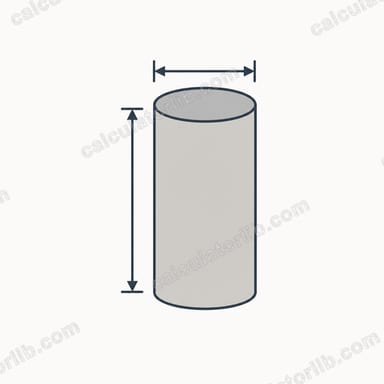
A Sonotube is a cylindrical cardboard form used to pour concrete columns, deck footings, posts, and piers. This calculator works out exactly how much concrete you need to fill one or more of these round forms. Enter the tube's diameter and height (depth) in inches, plus the number of tubes, and it returns the total volume in cubic yards, cubic feet, and cubic meters — along with an estimate of how many 60 lb and 80 lb pre-mix bags you'll need.
How to Use It
Measure the inside diameter of the tube (common sizes are 6", 8", 10", and 12") and the height you intend to fill. Enter both values in inches and set the number of tubes for the project. The result updates instantly. Ordering ready-mix concrete is usually priced by the cubic yard, so the headline figure is what you'll quote to the supplier — always round up and add 5–10% for waste and spillage.
The Formula Explained
A Sonotube is a cylinder, so its volume is \(V = \pi \times (D/2)^{2} \times H\). The calculator first converts your inch measurements to feet (divide by 12), computes the volume in cubic feet, then divides by 27 to get cubic yards (since \(1\ \text{yd}^3 = 27\ \text{ft}^3\)). Multiplying by the tube count gives the total. Bag estimates assume a 60 lb bag yields about \(0.45\ \text{ft}^3\) and an 80 lb bag about \(0.6\ \text{ft}^3\).
$$V = \pi \left( \frac{\text{Diameter (in)}}{24} \right)^{2} \cdot \frac{\text{Height (in)}}{12} \cdot \text{Tubes}$$ $$\text{Cubic Yards} = \frac{V}{27}$$ $$\text{Bags}_{60} = \left\lceil \frac{V}{0.45} \right\rceil \qquad \text{Bags}_{80} = \left\lceil \frac{V}{0.6} \right\rceil$$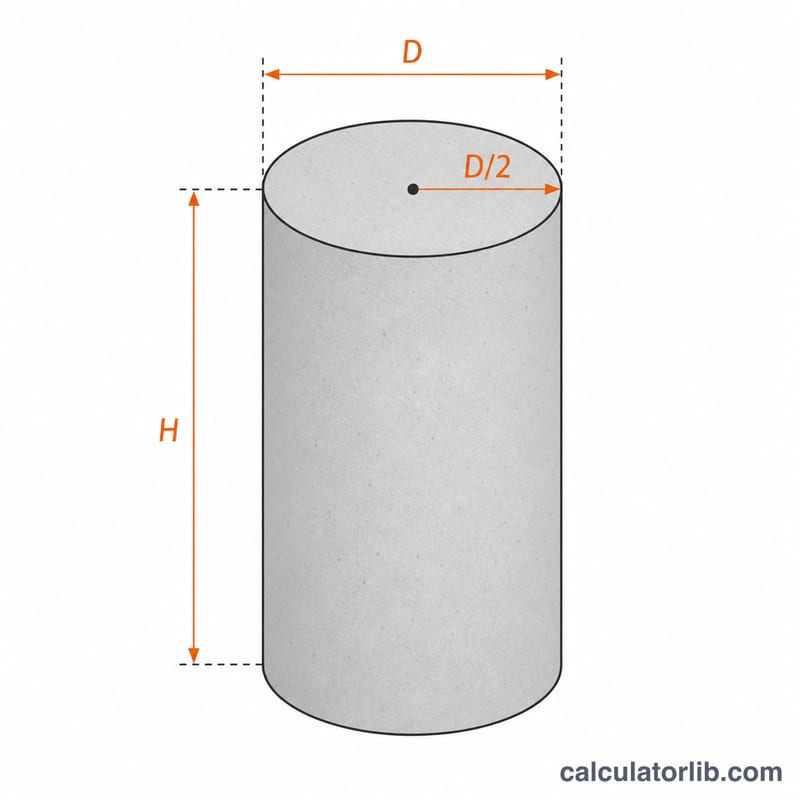
Worked Example
For a 12-inch (1 ft) diameter tube filled to 48 inches (4 ft):
$$V = \pi \times (0.5)^{2} \times 4 = \pi \times 0.25 \times 4 = 3.1416\ \text{ft}^3$$In cubic yards that is \(3.1416 \div 27 \approx 0.116\ \text{yd}^3\). You'd need about 7 of the 80 lb bags per tube.
FAQ
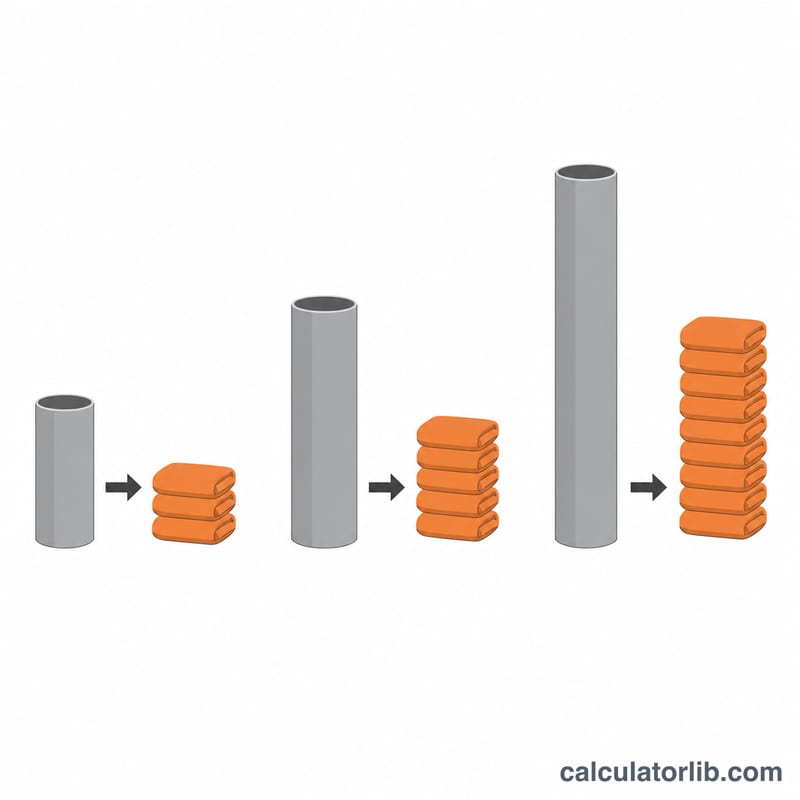
Should I order extra concrete? Yes. Add roughly 10% for waste, uneven bottoms, and over-digging.
Does diameter mean inside or outside? Use the inside diameter, since that's the space the concrete fills. Sonotubes are usually labeled by inside diameter.
Why do bag counts differ from yardage? Bagged mix is best for one or two small footings. For larger pours, ready-mix delivered by the yard is far cheaper and faster.