
What Is the Shiplap Calculator?
Shiplap is a popular wall and ceiling cladding made of overlapping wooden boards that create a clean, lined look. Planning a project means knowing exactly how many boards to buy — too few stalls the job, too many wastes money. This calculator estimates the number of shiplap boards required to cover a wall based on its dimensions, your board size, and a waste allowance for cuts and mistakes.
How to Use It
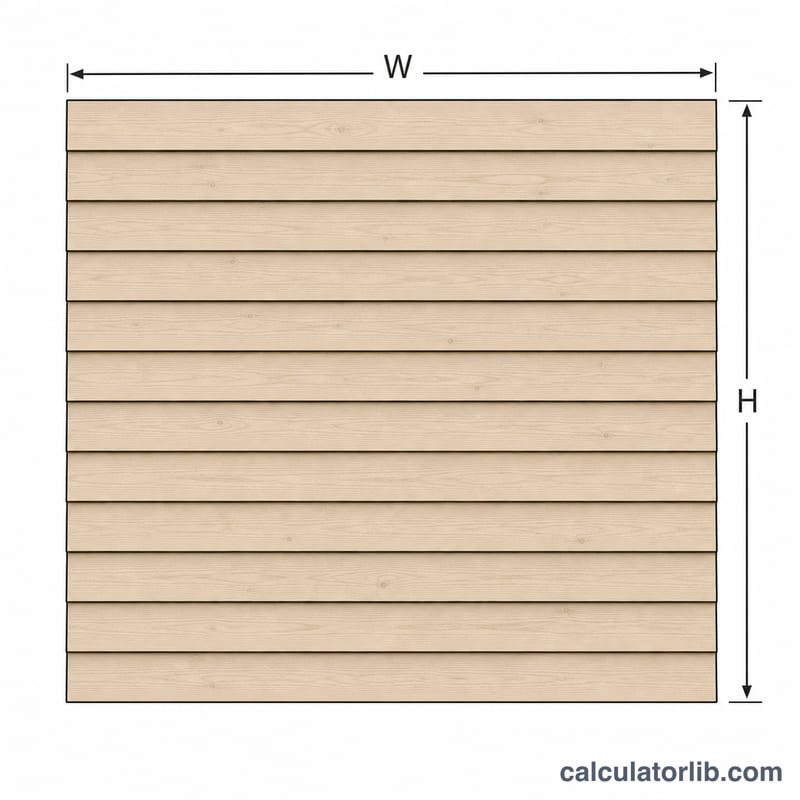
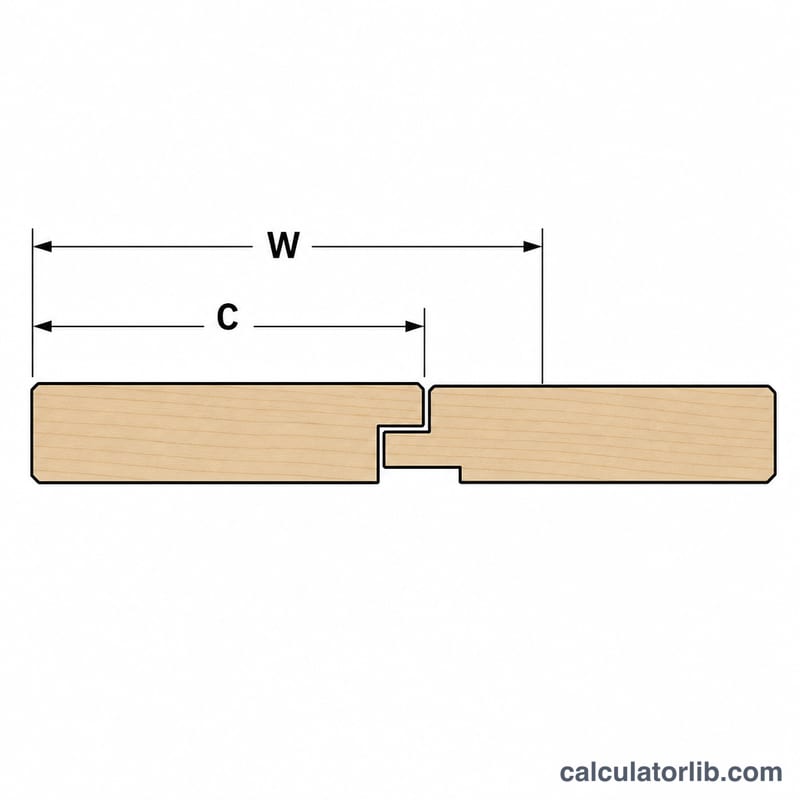
Enter the wall width and height in feet, the length of one board in feet, and the board's coverage width in inches (the exposed face after overlap, often a little less than the nominal board width). Add a waste allowance — 10% is a common starting point, more if your wall has many openings or you are new to installing shiplap. The calculator returns the total board count rounded up to a whole board.
The Formula Explained
First the total wall area is found: \(\text{Area} = \text{Wall Width} \times \text{Wall Height}\). The coverage of one board is its length multiplied by its coverage width converted from inches to feet (divide by 12). The area is multiplied by (1 + waste%) and divided by the coverage of one board, then rounded up with the ceiling function so you never come up short.
$$\text{Boards} = \left\lceil \frac{\text{Width} \times \text{Height} \times \left(1 + \frac{\text{Waste \%}}{100}\right)}{\dfrac{\text{Coverage (in)}}{12} \times \text{Board Length}} \right\rceil$$
Worked Example
Suppose a wall is 12 ft wide and 8 ft tall, using 8 ft boards with a 7 in coverage width and a 10% waste allowance. Wall area = \(12 \times 8 = 96\) sq ft. One board covers \((7 \div 12) \times 8 = 4.667\) sq ft. With waste: \(96 \times 1.10 = 105.6\) sq ft. Boards = \(\lceil 105.6 \div 4.667 \rceil = \lceil 22.63 \rceil =\) 23 boards.
FAQ
Should I subtract windows and doors? For small openings it is safest not to, since the extra acts as waste buffer. For very large openings, reduce the wall height or width input accordingly.
What waste percentage should I use? 10% is typical for simple walls; use 15–20% for diagonal patterns, many corners, or beginners.
Coverage width vs. nominal width? Always use the coverage (exposed face) width because boards overlap. A nominal 8-inch board often covers about 7 inches.