
What is a Birdsmouth Cut?
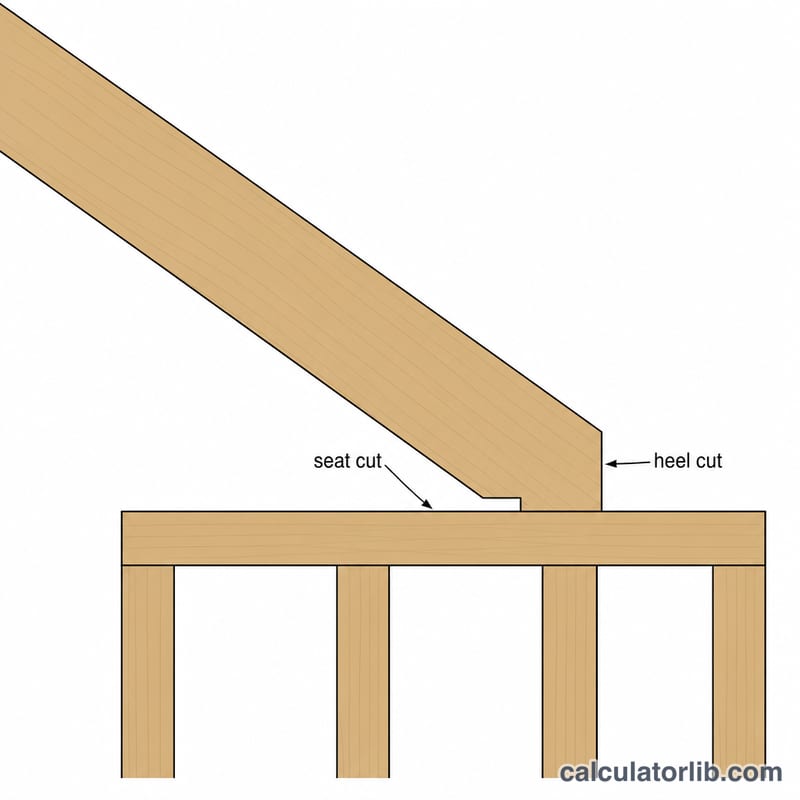
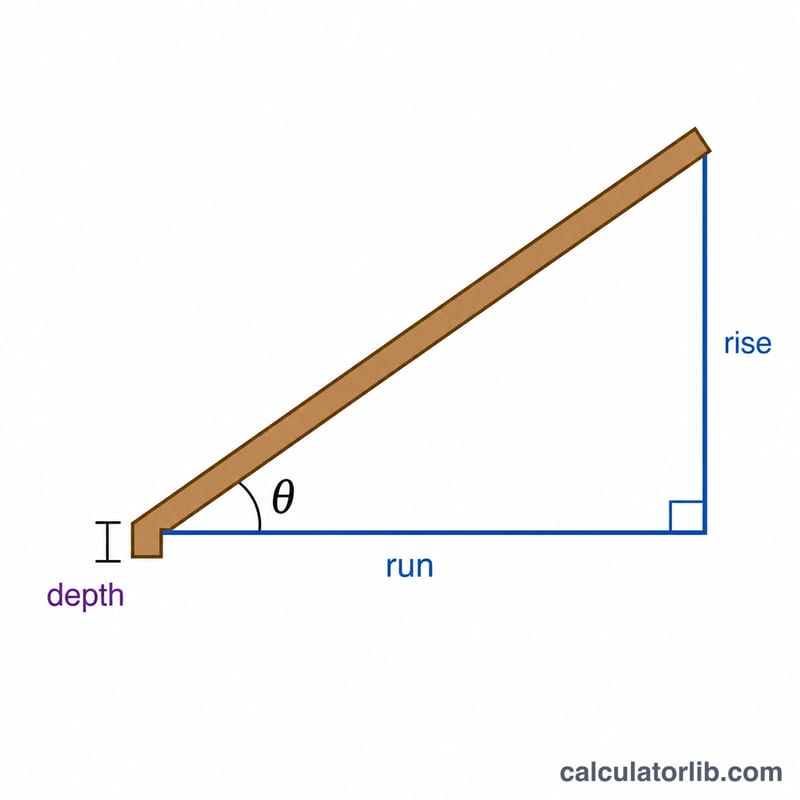
A birdsmouth (or bird's mouth) is the notch cut into a roof rafter where it rests on the top plate of a wall. It consists of two cuts: the seat cut (a horizontal, level cut that sits flat on the wall plate) and the heel cut (a vertical, plumb cut against the outer edge of the plate). Cutting these correctly ensures the rafter bears fully on the wall and sits at the right roof pitch.
How to Use This Calculator
Enter the roof rise and run that define your pitch (for example a 6/12 roof has a rise of 6 over a run of 12). Then enter the seat cut depth — the horizontal distance the rafter notch extends across the plate. A common rule of thumb is to make the seat cut between one-third and one-half of the rafter's board depth so you don't over-notch and weaken the rafter. The calculator returns the heel (plumb) cut depth, the seat cut depth, and the pitch angle.
The Formula Explained
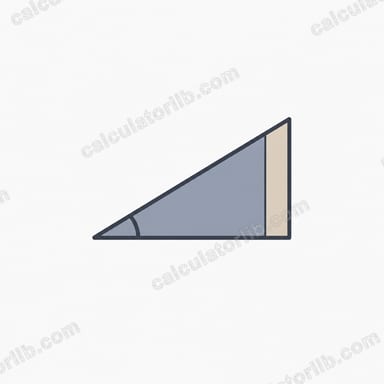
First the pitch angle is found from the slope: \( \theta = \arctan(\text{rise} \div \text{run}) \). The seat cut is simply the depth you entered, measured level across the plate. The heel cut is the vertical drop of that notch, found by multiplying the depth by the tangent of the pitch angle: \( \text{heelCut} = \text{depth} \times \tan(\theta) \). Because \( \tan(\theta) \) equals rise/run, the heel cut also equals depth × (rise/run).
Worked Example
For a 6/12 roof (rise 6, run 12) with a seat depth of 3 inches: the pitch angle is $$ \arctan(6/12) = 26.565^\circ. $$ The seat cut is 3 inches. The heel cut is $$ 3 \times \tan(26.565^\circ) = 3 \times 0.5 = 1.5 \text{ inches}. $$
Common Roof Pitches and Heel Cut Depths
The birdsmouth notch is defined by two cuts: the horizontal seat cut (its depth set by the framer) and the vertical heel cut. For a seat cut of depth \(d\), the heel cut height is \(d \cdot \tan\theta\), where \(\theta\) is the pitch angle. The table below lists the pitch angle and the heel cut depth per inch of seat depth (i.e. \(\tan\theta\)) for standard pitches. Multiply the value in the last column by your actual seat depth to get the heel cut height.
| Pitch (rise/12) | Slope | Pitch Angle \(\theta\) | Heel cut per inch of seat depth (\(\tan\theta\)) | Heel cut for 1.5″ seat |
|---|---|---|---|---|
| 3/12 | 0.250 | 14.04° | 0.250 | 0.375″ |
| 4/12 | 0.333 | 18.43° | 0.333 | 0.500″ |
| 5/12 | 0.417 | 22.62° | 0.417 | 0.625″ |
| 6/12 | 0.500 | 26.57° | 0.500 | 0.750″ |
| 7/12 | 0.583 | 30.26° | 0.583 | 0.875″ |
| 8/12 | 0.667 | 33.69° | 0.667 | 1.000″ |
| 9/12 | 0.750 | 36.87° | 0.750 | 1.125″ |
| 10/12 | 0.833 | 39.81° | 0.833 | 1.250″ |
| 11/12 | 0.917 | 42.51° | 0.917 | 1.375″ |
| 12/12 | 1.000 | 45.00° | 1.000 | 1.500″ |
Worked example for an 8/12 pitch with a 1.5″ seat cut: \(\theta=\arctan(8/12)=33.69^\circ\), so the heel cut \(=1.5 \times \tan(33.69^\circ)=1.5 \times 0.667=\)1.0″.
Practical Cutting Recommendations
- Limit the seat depth. A widely used rule of thumb is to keep the seat cut no deeper than \(1/3\) of the rafter board’s depth so the remaining cross-section above the notch carries the load. Some local codes allow up to \(1/2\); always defer to your jurisdiction and any engineered design.
- Check the remaining heel. After the heel cut, confirm the uncut material above the notch is adequate. For a 2×10 (9.25″ actual) rafter, a 1/3 limit means a seat depth of about 3″ — but the seat depth should also not exceed the bearing width of the top plate.
- Account for plate width. A nominal 2×4 top plate is 3.5″ wide and a 2×6 is 5.5″ wide. The seat cut should bear fully across (or as designed for) the plate; a seat deeper than the plate provides no extra bearing and only weakens the rafter.
- Mark with a framing or speed square. Set the square to the pitch (e.g. 8 on the common scale for 8/12) to scribe the plumb heel cut, then mark the level seat cut perpendicular to it. A consistent reference line keeps every rafter identical.
- Cut and fit a test rafter first. Make one rafter, set it on the plates and against the ridge, and verify the seat sits flat and the plumb cut meets the ridge before mass-cutting the rest. Use it as the master template.
- Avoid over-notching. Never let the birdsmouth extend past the inner edge of the top plate, and keep the notch out of the rafter’s outermost tension fibers where avoidable.
This is general construction information, not engineering advice. Roof framing is governed by building codes and, for many designs, by an engineer’s specifications — verify load, span, and notch limits for your specific project before cutting.
Definitions & Glossary
- Seat cut
- The horizontal (level) cut of the birdsmouth notch that rests flat on top of the wall plate. Its depth into the rafter is the “seat depth.”
- Heel cut
- The vertical (plumb) cut of the birdsmouth that bears against the outer face or edge of the top plate. Its height equals the seat depth times the tangent of the pitch angle.
- Plumb cut
- Any vertical cut on the rafter when it is installed at pitch — including the ridge cut and the heel cut. “Plumb” means truly vertical relative to the finished roof.
- Top plate
- The horizontal framing member capping the top of a wall, on which the rafter’s seat cut bears. Common widths are 3.5″ (2×4) and 5.5″ (2×6).
- Rise
- The vertical height the roof gains over a given horizontal run — the numerator of the pitch ratio.
- Run
- The horizontal distance over which the rise occurs — conventionally 12 inches when expressing pitch as “rise/12.”
- Pitch
- The steepness of the roof expressed as rise over run, e.g. 6/12 means 6 inches of rise per 12 inches of run.
- Pitch angle
- The pitch expressed as an angle from horizontal, \(\theta=\arctan(\text{rise}/\text{run})\). A 6/12 pitch equals about 26.57°.
- Rafter board depth
- The actual face dimension (height) of the rafter lumber, e.g. 9.25″ for a nominal 2×10. It limits how deep the seat cut can safely be.
FAQ
How deep should the seat cut be? Keep it to no more than one-third of the rafter depth where codes apply, so the remaining rafter section is strong enough to carry the load.
What units does this use? Rise and run are unitless ratio values (use the same unit for both). The seat depth and resulting heel cut are in inches, but any consistent length unit works.
Is the seat cut always horizontal? Yes — the seat cut is level so it bears flat on the top plate, while the heel cut is plumb (vertical).