
What Is a Roof Shingle Calculator?
A roof shingle calculator estimates the amount of roofing material you need for a re-roofing or new construction project. It converts your roof's surface area into roofing squares (1 square = 100 sq ft) and then into bundles of shingles, the unit most shingles are sold in. Most standard asphalt shingles are packaged 3 bundles per square.
How to Use It
Enter the length and width of one roof plane, the total number of planes (a simple gable roof has 2; a hip or complex roof has more), and a waste allowance percentage. Waste covers cuts, ridges, valleys, and starter courses — 10% is typical for simple roofs and up to 15–20% for cut-up roofs with many hips and valleys.
The Formula Explained
First the tool computes total roof area as length × width × planes. It adds your waste percentage, divides by 100 to get squares, multiplies by 3 to get bundles, and rounds up because you cannot buy a fraction of a bundle.
$$\text{Bundles} = \left\lceil \frac{A \times \left(1 + \frac{\text{Waste \%}}{100}\right)}{100} \times 3 \right\rceil$$ $$\text{where}\quad A = \text{Length (ft)} \times \text{Width (ft)} \times \text{Planes}$$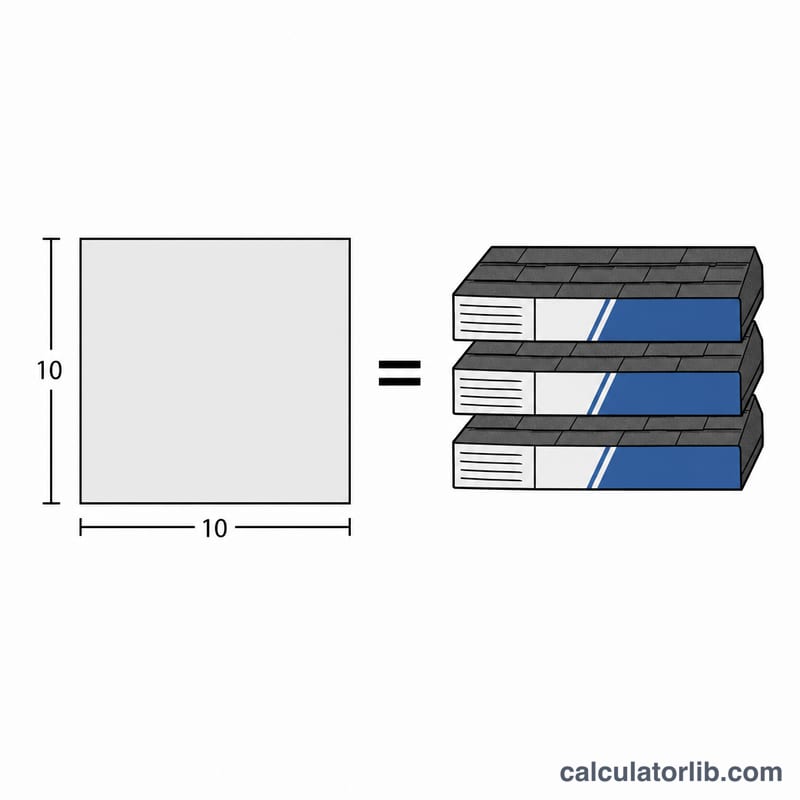
Worked Example
A gable roof with two planes each 30 ft × 20 ft has 1,200 sq ft of area. With a 10% waste allowance that becomes 1,320 sq ft, or 13.2 squares. Multiplied by 3 gives 39.6 bundles, which rounds up to 40 bundles.
$$A = 30 \times 20 \times 2 = 1{,}200 \text{ sq ft}$$ $$\text{Bundles} = \left\lceil \frac{1{,}200 \times \left(1 + \frac{10}{100}\right)}{100} \times 3 \right\rceil = \left\lceil \frac{1{,}320}{100} \times 3 \right\rceil = \lceil 13.2 \times 3 \rceil = \lceil 39.6 \rceil = 40$$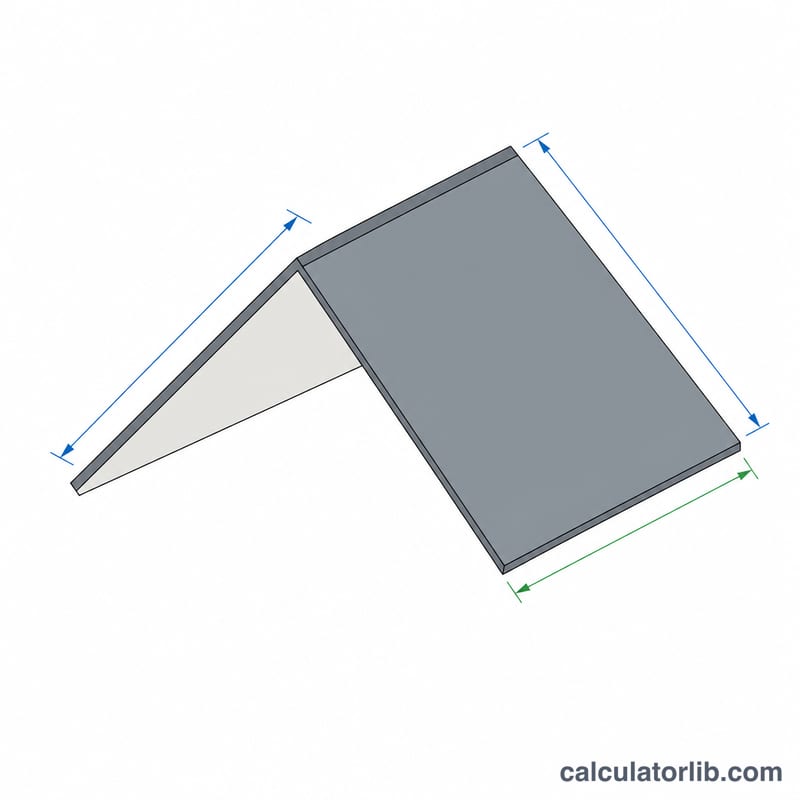
FAQ
How many bundles are in a square? Standard 3-tab asphalt shingles come 3 bundles per square. Some thicker architectural shingles use 4 or 5 bundles per square, so check your product.
What waste percentage should I use? Use 10% for straightforward gable roofs and 15–20% for roofs with many hips, valleys, dormers, or steep angles.
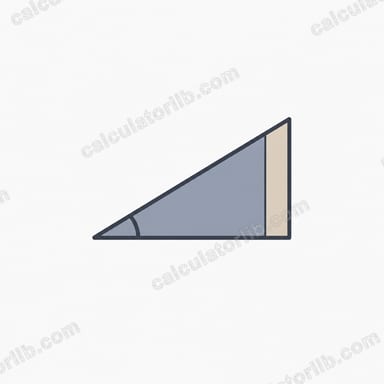
Does this include the actual roof slope? Enter the actual sloped surface dimensions (not the building footprint) for the most accurate result, or multiply footprint by a pitch factor first.