
What Is a Snow Load Calculator?
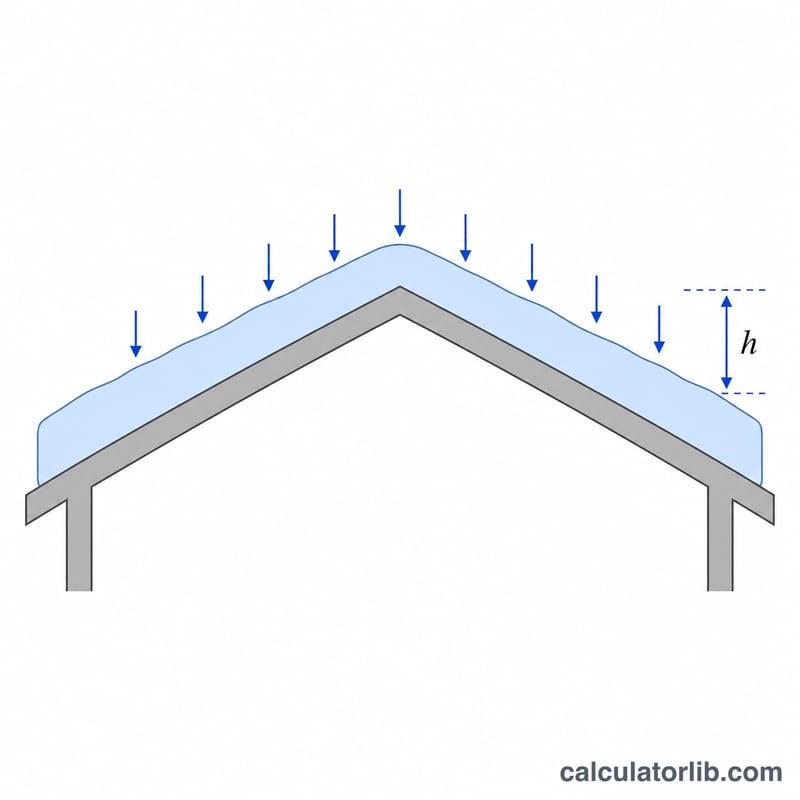
A snow load calculator estimates the weight that accumulated snow places on a roof or surface, expressed as a pressure in kilonewtons per square metre (kN/m²), pascals (Pa = N/m²), or pounds per square foot (psf). Knowing the snow load helps engineers, builders and homeowners judge whether a structure can safely carry winter snow. The ASCE 7 method shown here reflects the US design standard; the depth × density method is a universal physics estimate.
How to Use It
Choose a method. For a quick field estimate, select Snow Depth × Density and enter the measured snow depth in metres and an estimated density (fresh snow ≈ 50–100 kg/m³, settled ≈ 200–300 kg/m³, wet/packed ≈ 400+ kg/m³). For a code-based design value, select ASCE 7 Flat Roof Load and enter the ground snow load pg plus the exposure (Ce), thermal (Ct) and importance (I) factors from the standard.
The Formulas Explained
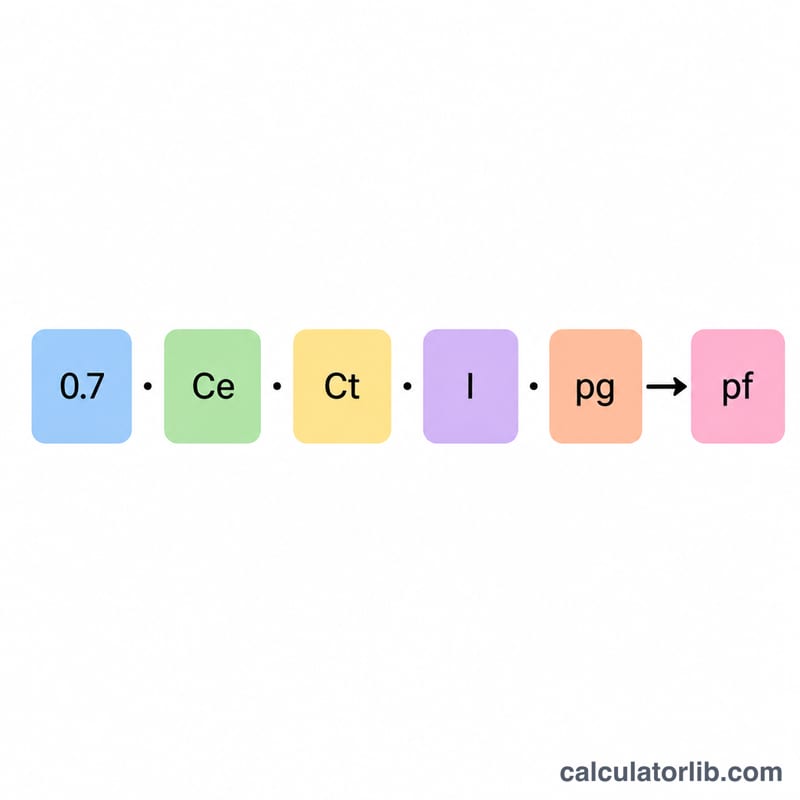
The physics method computes pressure as \(p = \rho \cdot h \cdot g\), where \(\rho\) is density, \(h\) is depth and \(g = 9.81 \text{ m/s}^2\). This gives the load in pascals, which we also convert to kN/m² and psf. The ASCE 7 flat-roof load is \(p_f = 0.7 \cdot C_e \cdot C_t \cdot I \cdot p_g\). The 0.7 factor accounts for the fact that flat-roof loads are typically lower than ground snow loads.
Worked Example
Suppose snow is 0.5 m deep with a density of 200 kg/m³. Load:
$$S = 0.5 \times 200 \times 9.81 = 981 \text{ Pa} = 0.981 \text{ kN/m}^2 \approx 20.49 \text{ psf}$$Using ASCE 7 with pg = 1.5 kN/m², Ce = 1.0, Ct = 1.0, I = 1.0:
$$p_f = 0.7 \times 1.0 \times 1.0 \times 1.0 \times 1.5 = 1.05 \text{ kN/m}^2$$FAQ
What density should I use? Use 50–100 kg/m³ for light fresh snow, 200–300 for settled snow and 400+ for wet or compacted snow and ice.
What are typical Ce, Ct and I values? Ce ≈ 0.9–1.2 depending on exposure, Ct ≈ 1.0 for heated buildings, and I ≈ 0.8–1.2 by risk category. Confirm exact values from ASCE 7.
Does this account for drifts or slope? No. It gives a basic balanced/flat-roof load; sliding, drifting and unbalanced loads require additional ASCE 7 provisions.