
What Is Wind Load?
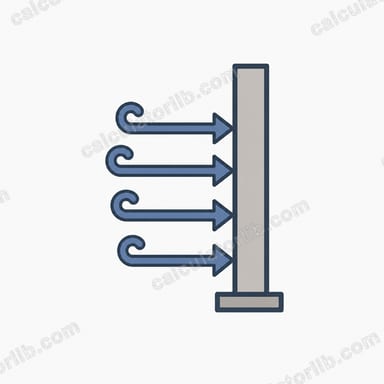
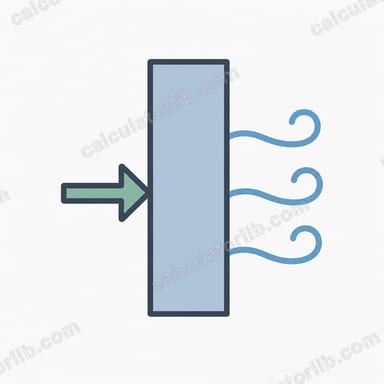
Wind load is the force that moving air exerts on a structure or surface. Engineers use it to size beams, fasteners, signs, solar panels, fences and façades so they withstand storms. This calculator computes the total horizontal force using the drag-equation form of dynamic wind pressure, which is unit-agnostic and works worldwide as long as SI inputs are used.
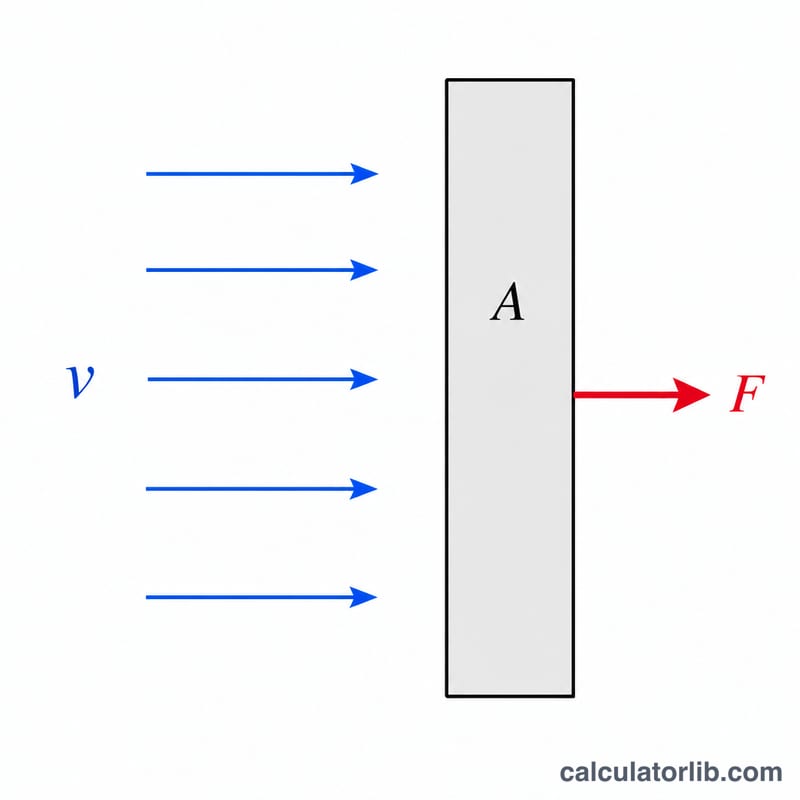
How to Use This Calculator
Enter the design wind speed in metres per second, the projected area facing the wind in square metres, a drag coefficient for the shape, and the air density (about 1.225 kg/m³ at sea level, 15 °C). The tool returns the force in newtons and kilonewtons plus the dynamic pressure in pascals.
The Formula Explained
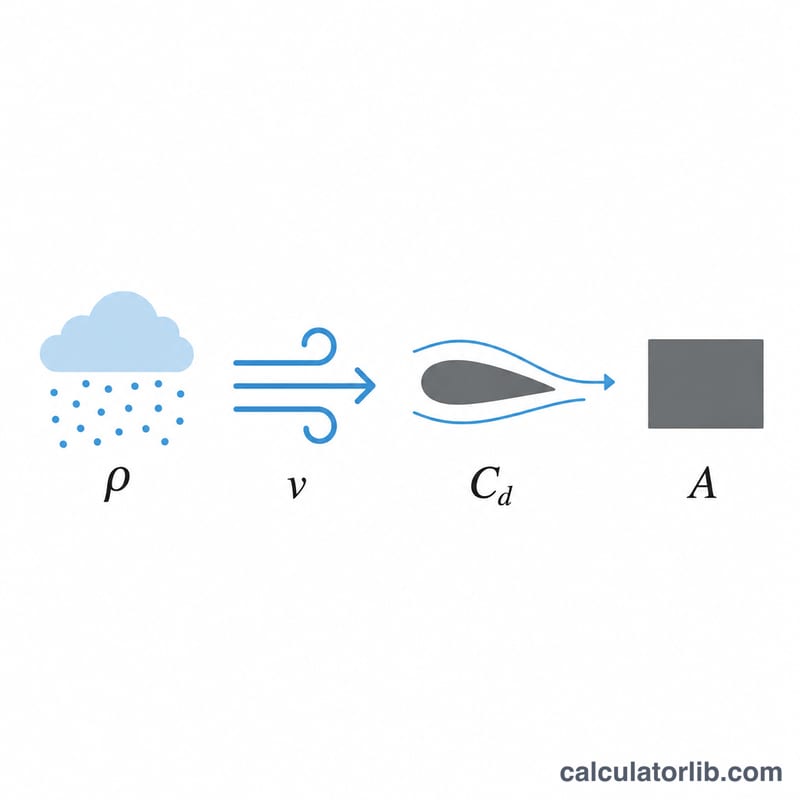
The wind force is $$F = \tfrac{1}{2} \cdot \rho \cdot v^{2} \cdot C_d \cdot A$$ where \(\rho\) is air density, \(v\) is wind velocity, \(C_d\) is the drag coefficient and \(A\) is the projected area. The term \(\tfrac{1}{2}\cdot\rho\cdot v^{2}\) is the stagnation (dynamic) pressure; multiplying by \(C_d\) accounts for shape, and by \(A\) scales it to the exposed surface. Typical \(C_d\) values: ~1.2 for a flat plate or wall, ~2.0 for a long structural member, ~0.5–1.0 for rounded shapes. In US units this is often approximated as \(q = 0.00256\cdot V^{2}\) psf with \(V\) in mph.
Worked Example
A wall 10 m² faces a 30 m/s gust, \(C_d = 1.2\), \(\rho = 1.225\) kg/m³. Pressure $$q = 0.5 \times 1.225 \times 30^{2} \times 1.2 = 661.5 \text{ Pa}$$ Force $$F = 661.5 \times 10 = 6{,}615 \text{ N} \approx 6.62 \text{ kN}$$
FAQ
What air density should I use? Use 1.225 kg/m³ at sea level; reduce it at altitude or high temperature.
What is a projected area? The area of the surface as seen looking along the wind direction — the "shadow" the object casts into the wind.
Is this a building-code design value? No. It is a physics estimate. Local codes (ASCE 7, Eurocode 1) add gust, exposure and importance factors for permitting.