
What is y+?
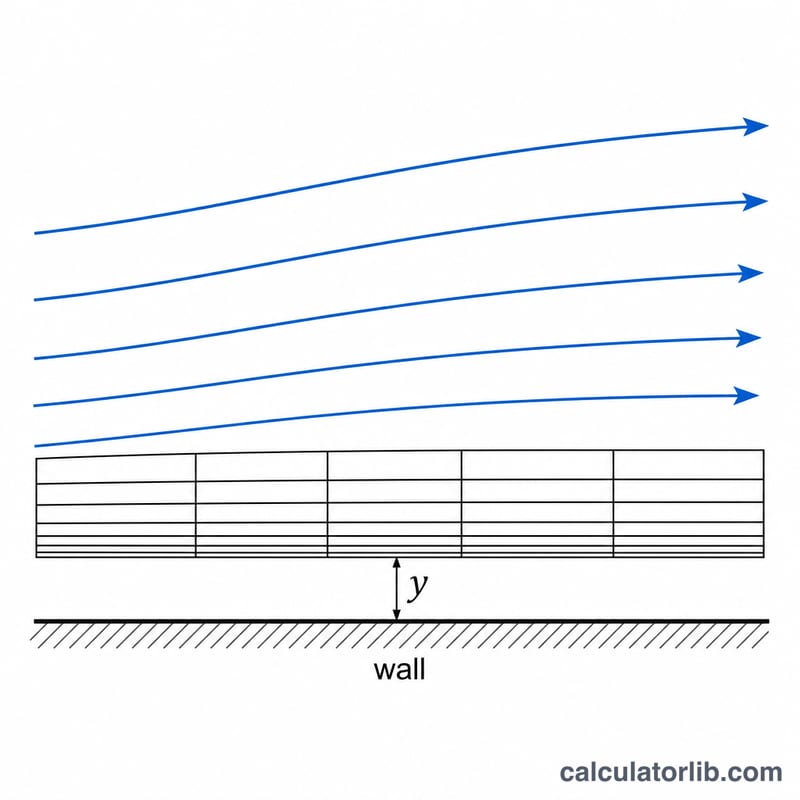
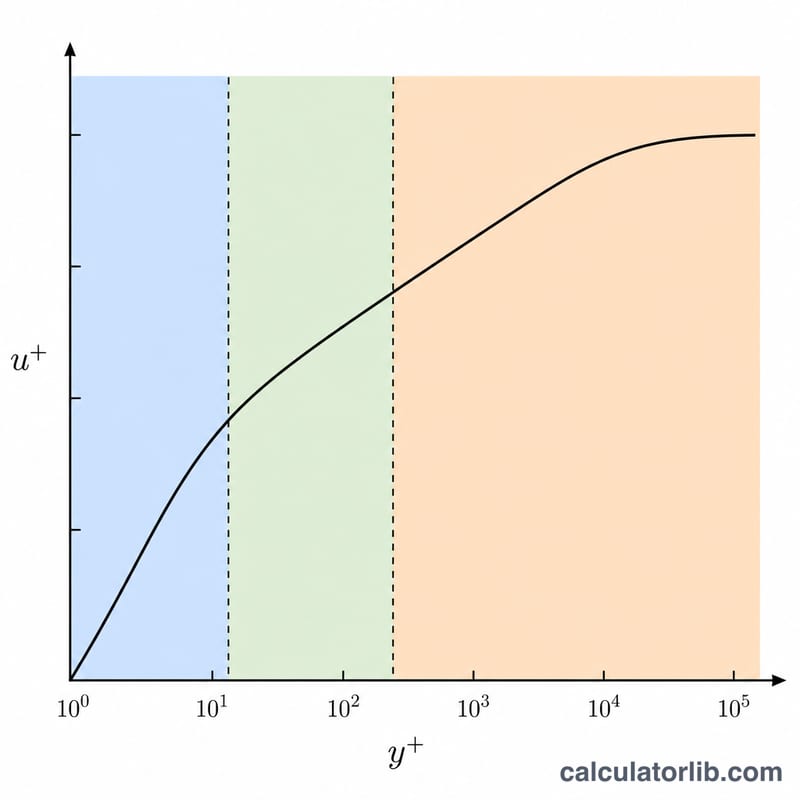
The dimensionless wall distance, written y+ (y-plus), is a key parameter in computational fluid dynamics (CFD) that describes the height of the first mesh cell in a turbulent boundary layer relative to the viscous length scale. It tells you whether your near-wall mesh resolves the viscous sublayer, the buffer layer, or relies on wall functions in the log-law region.
How to use this calculator
Enter the fluid density \(\rho\), the dynamic viscosity \(\mu\), the wall shear stress \(\tau_w\), and the distance \(y\) from the wall to the first cell centroid. The tool computes the friction velocity \(u_\tau\) and then \(y^+\). Aim for \(y^+ \approx 1\) for wall-resolved (low-Reynolds) models and roughly 30–300 when using wall functions.
The formula explained
First the friction velocity is found from the wall shear stress:
$$u_\tau = \sqrt{\frac{\tau_w}{\rho}}$$This velocity scale characterises turbulence near the wall. Then
$$y^+ = \frac{\rho \, u_\tau \, y}{\mu}$$scales the physical distance \(y\) by the viscous length \(\nu/u_\tau\), where \(\nu = \mu/\rho\) is the kinematic viscosity. Equivalently \(y^+ = u_\tau \, y / \nu\).
Worked example
For air, \(\rho = 1.225 \ \text{kg/m}^3\), \(\mu = 1.81 \times 10^{-5} \ \text{Pa}\cdot\text{s}\), \(\tau_w = 0.1 \ \text{Pa}\) and \(y = 5 \times 10^{-5} \ \text{m}\). Then
$$u_\tau = \sqrt{\frac{0.1}{1.225}} = 0.28571 \ \text{m/s}$$$$y^+ = \frac{1.225 \times 0.28571 \times 5 \times 10^{-5}}{1.81 \times 10^{-5}} \approx 0.967$$To reach \(y^+ \approx 1\) your first cell here is already well placed.
FAQ
What y+ should I target? About 1 for wall-resolved models (e.g. k-ω SST low-Re), and 30–300 if using standard wall functions.
Why is y+ dimensionless? It is the wall distance divided by the viscous length scale \(\nu/u_\tau\), so units cancel.
What if I do not know \(\tau_w\)? Estimate it from the skin friction coefficient: \(\tau_w = \tfrac{1}{2} \rho U^2 C_f\), where \(C_f\) comes from correlations such as \(0.058 \cdot Re^{-0.2}\).