
What is the SI Prefix Conversion Calculator?
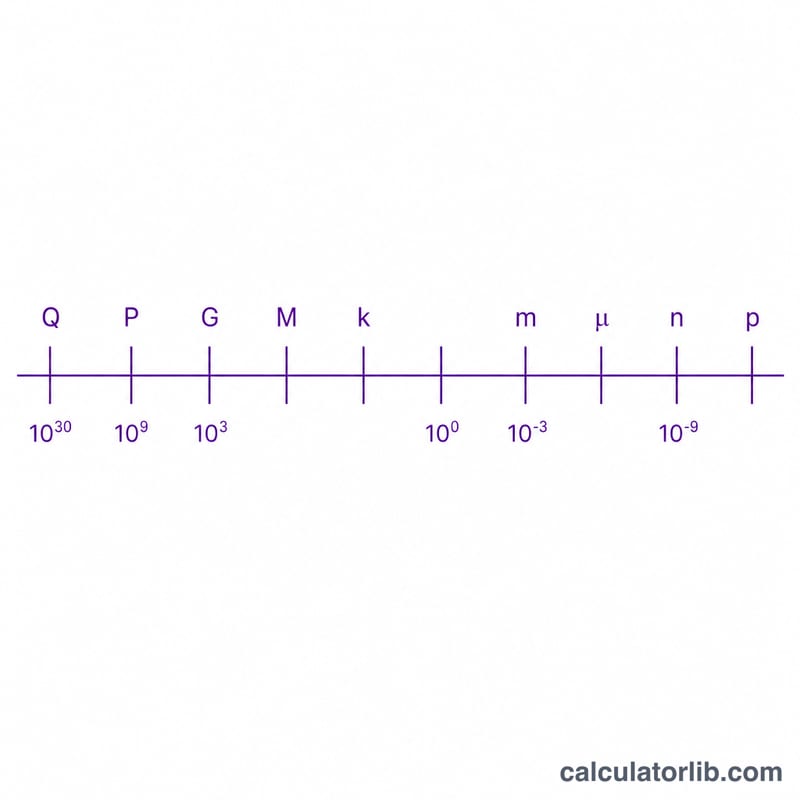
This tool converts a number expressed with one SI (International System of Units) metric prefix into the equivalent value expressed with every other standard prefix. The SI prefixes are simply names for powers of ten - from quetta (\(10^{30}\)) at the largest end down to quecto (\(10^{-30}\)) at the smallest. Because metric prefixes are pure powers of ten, this conversion is universal: it works identically in every country and for any base unit (meters, grams, watts, bytes treated as decimal, and so on).
How to use it
Enter your number in the Value field, then pick the Source prefix that the value currently uses. The calculator instantly shows the same physical quantity rewritten with all 25 prefixes. The row that matches your source prefix is highlighted and shows exactly your input value.
The formula explained
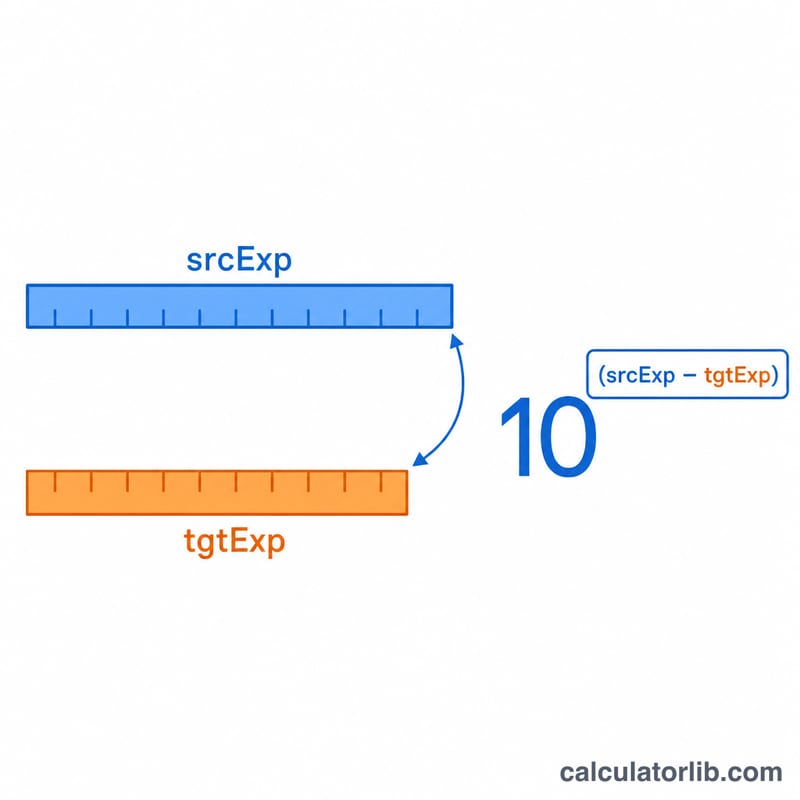
Each prefix carries an integer exponent. To move a value from a source prefix (exponent srcExp) to a target prefix (exponent tgtExp), shift the decimal point by the difference of the exponents:
$$\text{converted} = \text{value} \times 10^{(\text{srcExp} - \text{tgtExp})}$$
This is the same as first normalizing to prefix-less base units (\(\text{base} = \text{value} \times 10^{\text{srcExp}}\)) and then dividing by the target factor (\(\text{base} / 10^{\text{tgtExp}}\)). Working with the single exponent difference avoids overflow when the gap is large (up to \(\pm 60\)).
Worked example
Suppose you have 5 Mega (\(\text{srcExp} = 6\)). The base value is \(5 \times 10^6 = 5{,}000{,}000\).
- In Giga (tgtExp 9): \(5 \times 10^{(6-9)} = 0.005 \text{ G}\)
- In Kilo (tgtExp 3): \(5 \times 10^3 = 5{,}000 \text{ k}\)
- In base units (tgtExp 0): \(5{,}000{,}000\)
- In Milli (tgtExp -3): \(5 \times 10^9 = 5{,}000{,}000{,}000 \text{ m}\)
- In Micro (tgtExp -6): \(5 \times 10^{12} \text{ m}\)
FAQ
Why are symbols case-sensitive? Capital M means mega (\(10^6\)) while lowercase m means milli (\(10^{-3}\)). Kilo uses a lowercase k. Getting the case wrong changes the value by a factor of a billion.
What are quetta, ronna, ronto and quecto? These four prefixes were added by the 27th CGPM in 2022 to cover \(10^{30}\), \(10^{27}\), \(10^{-27}\) and \(10^{-30}\), mainly for data-storage and scientific scales.
Can I enter negative numbers or zero? Yes. Zero converts to zero everywhere, and negative values keep their sign.