What this calculator does
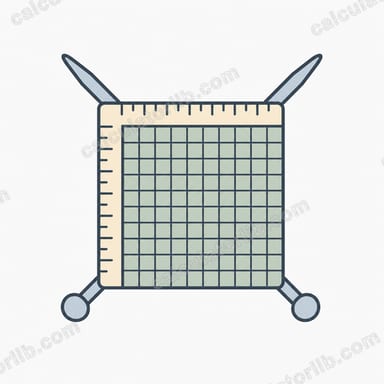
This tool converts a knitting gauge into the exact stitch and row counts you need for a finished piece. A gauge is measured by knitting a small test swatch and counting how many stitches fit across 10 cm and how many rows fit down 10 cm. Because gauge is referenced to the international standard 10 cm by 10 cm square, this calculator is universal and works with any yarn, needle size or pattern.

How to use it
Knit and lightly block a swatch, then count your gauge over a 10 cm window. Enter the stitches per 10 cm and rows per 10 cm. Next, type the finished width (the stitch direction) and finished height (the row direction) in centimetres. The calculator instantly shows how many stitches to cast on and how many rows to work, both rounded to the nearest whole number.
The formula explained
The math is a simple proportion. Since gauge is per 10 cm, the number of stitches you need equals your stitch gauge multiplied by the width divided by 10:
$$\text{Stitches} = \text{round}\left(\text{gaugeStitches} \times \frac{\text{width}}{10}\right)$$Rows follow the same logic with your row gauge and the height. Results are rounded half-up to a whole stitch or row, since you cannot knit a partial stitch.
$$\begin{gathered} \text{Stitches} = \left\lfloor \text{Stitches / 10 cm} \cdot \frac{\text{Width (cm)}}{10} + 0.5 \right\rfloor \\[1.2em] \text{Rows} = \left\lfloor \text{Rows / 10 cm} \cdot \frac{\text{Height (cm)}}{10} + 0.5 \right\rfloor \end{gathered}$$
Worked example
Suppose your swatch gives 32 stitches and 46 rows per 10 cm, and you want a piece 20 cm wide and 50 cm tall.
$$\text{Stitches} = \text{round}\left(32 \times \frac{20}{10}\right) = \text{round}(64) = \textbf{64 stitches}$$$$\text{Rows} = \text{round}\left(46 \times \frac{50}{10}\right) = \text{round}(230) = \textbf{230 rows}$$Typical Gauge Ranges by Yarn Weight
The table below is based on the Craft Yarn Council (CYC) standard yarn weight system, whose published stockinette gauges are given per 4 inches. They are converted here to approximate stitches per 10 cm. Row counts are rough estimates, since stockinette usually has about 1.3 to 1.5 times as many rows as stitches per 10 cm. Treat every value as approximate: your own tension, needle material, yarn and fabric will shift the result, so always knit a swatch.
| Yarn weight | Stitches per 10 cm | Rows per 10 cm (approx.) | Needle size (mm) |
|---|---|---|---|
| Lace (CYC 0) | 32–40 | 44–56 | 1.5–2.25 |
| Fingering / 4-ply (CYC 1) | 27–32 | 36–46 | 2.25–3.25 |
| Sport (CYC 2) | 23–26 | 30–36 | 3.25–3.75 |
| DK (CYC 3) | 21–24 | 28–32 | 3.75–4.5 |
| Worsted (CYC 4) | 16–20 | 22–28 | 4.5–5.5 |
| Aran (CYC 4, heavier end) | 16–18 | 20–24 | 4.5–5.5 (sometimes up to 6) |
| Bulky (CYC 5) | 12–15 | 14–20 | 5.5–8 |
| Super bulky (CYC 6) | 7–11 | 9–14 | 8–12.75 |
Note: the CYC system places worsted and aran together in category 4, so the aran row is only a narrower sub-range. Always trust the gauge printed on your yarn label and, above all, your own swatch.
Practical Tips for Using Your Stitch Count
- Fit the stitch pattern multiple. Many stitch patterns need a set multiple, such as a multiple of 4 plus 2. Round the calculated cast-on to the nearest number that fits. Example: at 22 stitches per 10 cm and a 48 cm width, \(22 \times \frac{48}{10} + 0.5 = 106.1\), which rounds down to 106 stitches. That is already \(4 \times 26 + 2\), so it fits a multiple of 4 plus 2 exactly.
- Add selvedge stitches for seams. If the piece will be sewn, add 2 stitches (1 at each edge) to the cast-on. In the example, 106 + 2 = 108 stitches. Re-check your pattern multiple afterwards.
- Swatch properly. Knit a swatch at least 15 cm square in the actual stitch pattern, then wash and block it the way you will care for the finished item. Let it dry fully before measuring. Measure over the central stitches, away from the edges.
- Remeasure if gauge is off. If your swatch does not match the target, enter the new measured stitches and rows per 10 cm into the calculator rather than forcing the old numbers.
- Adjust needle size to correct gauge. Too many stitches per 10 cm means your fabric is tighter than intended, so try a needle one size larger. Too few stitches means it is looser, so try one size smaller. Re-swatch after each change.
- Rows matter too. For length-critical pieces, such as sleeves and yokes, row gauge affects the fit as much as stitch gauge. Where possible, knit to a measured length instead of a row count.
Inches to Centimetres Quick Conversion
Use the exact definition 1 inch = 2.54 cm. Enter the centimetre value into the calculator's width and height fields.
| Inches | Centimetres |
|---|---|
| 4 | 10.16 |
| 6 | 15.24 |
| 8 | 20.32 |
| 10 | 25.4 |
| 12 | 30.48 |
| 16 | 40.64 |
| 20 | 50.8 |
| 24 | 60.96 |
| 30 | 76.2 |
| 36 | 91.44 |
Converting gauge from 4 inches to 10 cm: 4 inches is 10.16 cm, so multiply a per-4-inch count by \(\frac{10}{10.16} \approx 0.984\). Example: 20 stitches per 4 inches becomes \(20 \times 0.984 \approx 19.7\) stitches per 10 cm. The same factor applies to rows.
FAQ
Why must the gauge be per 10 cm? The 10 cm square is the international knitting standard, so the formula divides by 10. If you measured over a different size, your result will be inaccurate.
Why are the answers rounded? You can only cast on whole stitches and knit whole rows, so the calculator rounds to the nearest integer using round-half-up.
Does it work in inches? This version uses centimetres for dimensions; convert inches to cm \(1\text{ inch} = 2.54\text{ cm}\) before entering them.