What Is the Coin Roll Calculator?
This tool tells you how many standard coin rolls (wrappers) you can make from a pile of coins, how many coins are left over, and the total dollar value of your stash. It uses official US Mint roll standards, so it applies to United States coins: pennies, nickels, dimes, quarters, half dollars and dollar coins.
How to Use It
Pick the coin type from the dropdown and enter the number of coins you have. The calculator instantly shows the number of complete rolls, leftover loose coins, the value of one roll, the value tied up in full rolls, and the total value of every coin you entered.
The Formula Explained
Standard US rolls hold a fixed number of coins: 50 pennies, 40 nickels, 50 dimes, 40 quarters, 20 half dollars and 25 dollar coins. The number of full rolls is the coin count divided by the coins-per-roll, rounded down: $$\text{rolls} = \left\lfloor \frac{\text{coins}}{\text{coins\_per\_roll}} \right\rfloor$$. The total value is simply $$\text{value} = \text{coins} \times \text{coin\_value}$$, where coin_value is the face value of one coin in dollars.
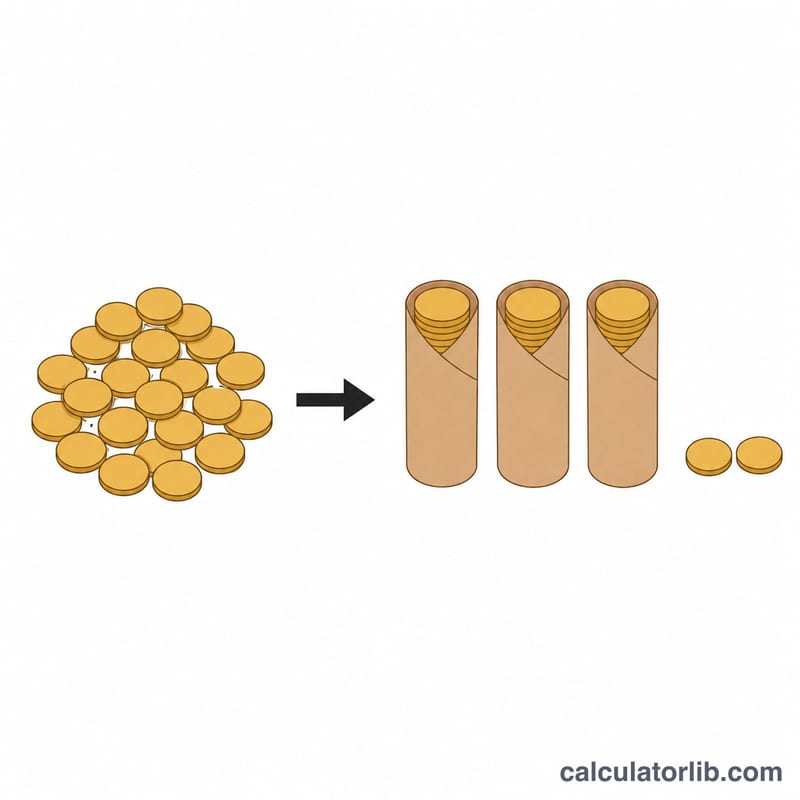
Worked Example
Suppose you have 100 quarters. Quarters roll 40 to a wrapper, so \(\lfloor 100 \div 40 \rfloor = 2\) full rolls, with \(100 - (2 \times 40) = 20\) leftover quarters. Each roll is worth \(40 \times \$0.25 = \$10.00\), so two rolls hold $20.00. The total value of all 100 quarters is \(100 \times \$0.25 = \$25.00\).
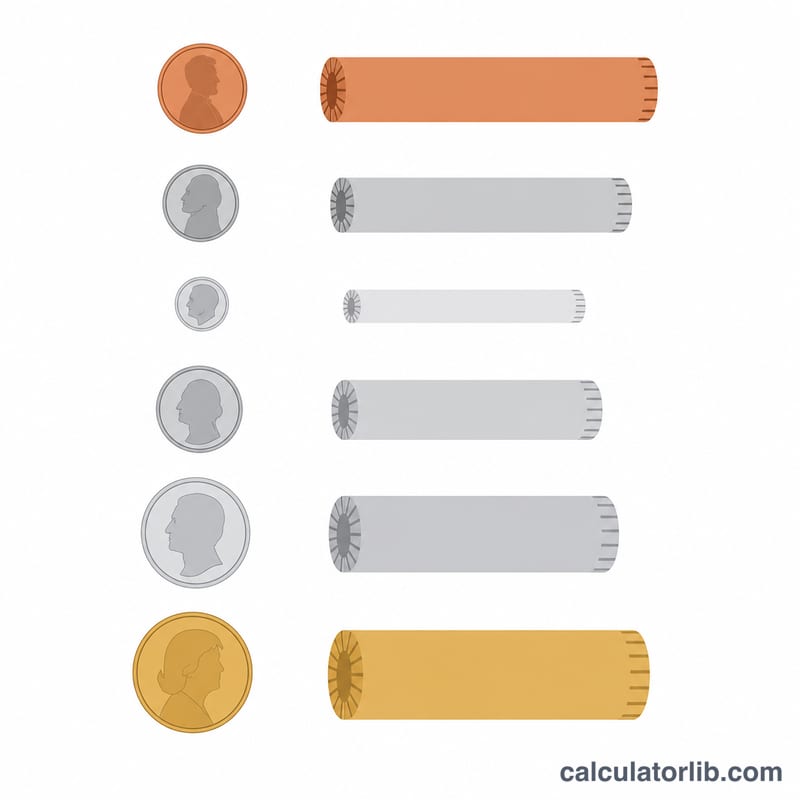
US Coin Roll Standards Reference Table
In the United States, coin rolls (also called shotgun rolls or wrappers) hold a fixed number of coins per denomination. The counts and wrapper colors below follow the standard US Mint / American Bankers Association (ABA) conventions used by US banks and wrapper manufacturers. Other countries use entirely different roll sizes and colors, so these values apply to US coinage only.
| Denomination | Coins per roll | Face value per coin | Value per full roll | Standard wrapper color |
|---|---|---|---|---|
| Penny (1¢) | 50 | $0.01 | $0.50 | Red |
| Nickel (5¢) | 40 | $0.05 | $2.00 | Blue |
| Dime (10¢) | 50 | $0.10 | $5.00 | Green |
| Quarter (25¢) | 40 | $0.25 | $10.00 | Orange |
| Half dollar (50¢) | 20 | $0.50 | $10.00 | Beige |
| Dollar coin ($1) | 25 | $1.00 | $25.00 | Grey |
The calculator uses exactly these constants. With \(N\) coins on hand, \(P\) coins per roll and face value \(v\) per coin:
$$\text{Full Rolls} = \left\lfloor \frac{N}{P} \right\rfloor, \qquad \text{Leftover} = N - P\left\lfloor \frac{N}{P} \right\rfloor, \qquad \text{Total Value} = N \times v$$For example, 90 quarters give \(\lfloor 90 / 40 \rfloor = 2\) full rolls worth \(2 \times \$10.00 = \$20.00\), with 10 quarters (\(\$2.50\)) left over, for a total face value of $22.50.
Coin Roll Scenarios at a Glance
These examples show typical jar-and-drawer piles run through the same rules: divide by the coins-per-roll figure for the denomination, keep the whole number as full rolls, and the remainder as loose coins that stay out of the wrappers.
| Coin type | Coins entered | Full rolls | Leftover coins | Value in full rolls | Total face value |
|---|---|---|---|---|---|
| Penny (50/roll) | 237 | 4 | 37 | $2.00 | $2.37 |
| Nickel (40/roll) | 150 | 3 | 30 | $6.00 | $7.50 |
| Dime (50/roll) | 500 | 10 | 0 | $50.00 | $50.00 |
| Quarter (40/roll) | 1,000 | 25 | 0 | $250.00 | $250.00 |
| Half dollar (20/roll) | 63 | 3 | 3 | $30.00 | $31.50 |
| Dollar coin (25/roll) | 80 | 3 | 5 | $75.00 | $80.00 |
Worked check on the half-dollar row: \(\lfloor 63 / 20 \rfloor = 3\) full rolls, leftover \(63 - 3 \times 20 = 3\) coins, rolled value \(3 \times \$10.00 = \$30.00\), and total face value \(63 \times \$0.50 = \$31.50\). The difference, \(\$31.50 - \$30.00 = \$1.50\), is exactly the three loose halves.
Note that the two zero-remainder rows are not a coincidence: 500 is a multiple of 50 and 1,000 is a multiple of 40, so every coin fits a wrapper. Whenever your count is not a multiple of the roll size, expect a remainder you will have to hold back or top up.
Practical Tips for Rolling and Depositing Coins
- Buy wrappers by denomination and match the color code. Red is pennies, blue nickels, green dimes, orange quarters, beige half dollars and grey dollar coins in the standard US scheme. A quarter wrapper will not hold 50 dimes, and a mismatched color slows down whoever processes your deposit.
- Count directly into the wrapper, never estimate by eye or by height. Crimp one end first, drop coins in while counting aloud or in groups of ten, then crimp the other end. A roll that is one coin short is the most common reason a deposit gets rejected.
- Expect banks to accept only full, correctly-filled rolls. Many US banks also ask you to write your name and account number on each roll so a short roll can be traced back to you. Policies differ between institutions and countries — call ahead if you are bringing a large batch, and ask whether the branch has a coin machine or charges a counting fee.
- Set leftovers aside instead of padding rolls. Never mix denominations to fill a wrapper. Keep the remainder in a labeled bag or jar until it reaches a full wrapper's worth — the calculator's leftover figure tells you exactly how many more coins you need.
- Weigh-check large batches as a sanity test. Current US circulating coins have specified weights, so a full roll has a predictable mass. A full quarter roll is \(40 \times 5.670\ \text{g} = 226.8\ \text{g}\) of coin (plus a few grams of paper), and a full nickel roll is \(40 \times 5.000\ \text{g} = 200\ \text{g}\). A kitchen scale accurate to a gram will catch a missing coin fast. Worn coins and the wrapper itself add a little variance, so treat it as a check, not proof.
- Pull silver and collectible coins out before rolling. US dimes, quarters and half dollars dated 1964 and earlier are 90% silver, and 1965–1970 Kennedy half dollars are 40% silver; their metal value far exceeds face value. The same goes for error coins, key dates and proof coins. Once they are rolled and deposited, you have sold them for face value.
- Sort before you count. Run the pile through a simple sorter or separate by hand first, then enter each denomination into the calculator separately. Mixing steps is where miscounts creep in.
This section is general information about handling and depositing coins, not professional financial or numismatic advice. Bank policies, coin specifications and wrapper conventions vary by country and by institution; confirm the rules that apply where you live, and have potentially valuable coins appraised by a qualified dealer before parting with them.
FAQ
How many coins fit in a roll? 50 pennies, 40 nickels, 50 dimes, 40 quarters, 20 half dollars, and 25 dollar coins.
What about the leftover coins? Leftover coins can't fill a complete roll. Banks usually only accept full rolls, so save loose coins until you have enough for another wrapper.
Does this work outside the US? The roll counts here follow US Mint standards. Other countries use different roll sizes, so the totals would differ.