
What Is the Roll Length Calculator?
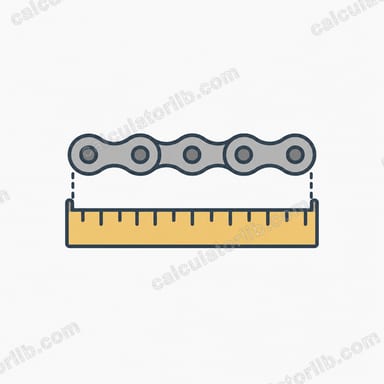
This calculator estimates how much material is wound onto a cylindrical roll — such as paper, plastic film, foil, fabric, tape, or label stock — without unwinding it. By comparing the cross-sectional area of the wound material to the thickness of a single layer, it returns the total linear length still on the roll.
How to Use It
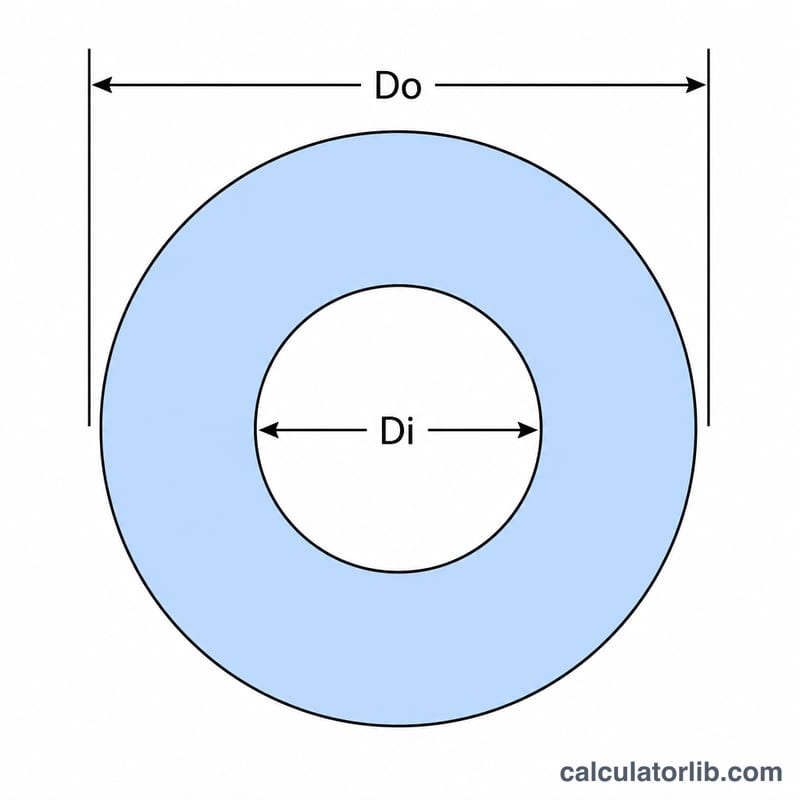
Enter three measurements in the same unit (millimeters work well): the outer diameter of the full roll, the inner diameter of the empty core, and the thickness of a single layer of material. The calculator returns the length in millimeters, meters, and feet.
The Formula Explained
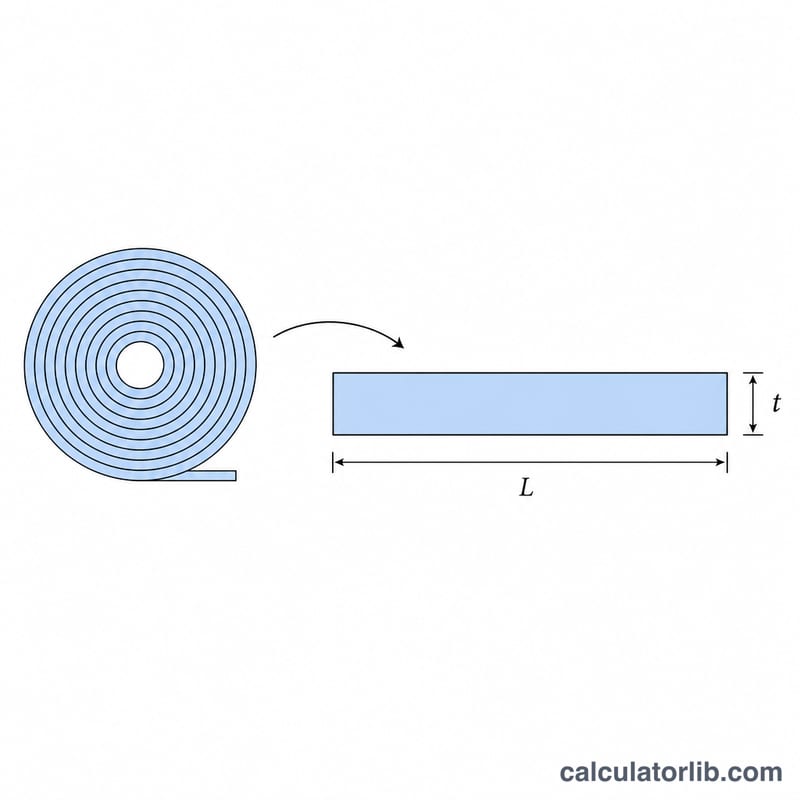
The wound material forms an annulus (ring) when viewed from the end. Its cross-sectional area is \( \pi(D_0^2 - D_i^2)/4 \). If you imagine unwinding that material into a long thin rectangle, its area equals length × thickness. Setting the two equal and solving for length gives:
$$ L = \frac{\pi \left( D_0^2 - D_i^2 \right)}{4t} $$
Because every layer adds the same thickness, this geometric approach is accurate as long as the material is wound at consistent tension and thickness.
Worked Example
A roll has an outer diameter of 300 mm, a core (inner) diameter of 76 mm, and a material thickness of 0.1 mm. Then $$ L = \frac{\pi \times \left( 300^2 - 76^2 \right)}{4 \times 0.1} = \frac{\pi \times \left( 90000 - 5776 \right)}{0.4} = \frac{\pi \times 84224}{0.4} = \pi \times 210560 \approx 661{,}478 \text{ mm} \approx 661.5 \text{ m}. $$
FAQ
Do units matter? Use the same length unit for all three inputs. If diameters and thickness are in mm, length comes out in mm (then converted to m and ft).
Why is my real length slightly different? Air gaps, varying tension, or coatings change effective thickness. Measure thickness carefully — it has the biggest impact on accuracy.
Can I use it for tape or wire? Yes — any material wound flat in even layers. For round wire, use the wire diameter as the "thickness" for an approximation.