
What is the Bike Chain Length Calculator?
This tool estimates the correct length for a bicycle chain using the well-known "rigid" chain length equation. It works from three measurements: your frame's chainstay length, the number of teeth on your largest front chainring, and the number of teeth on your largest rear cog. The result is given both in inches and in the number of half-inch chain links you should run.
How to Use It
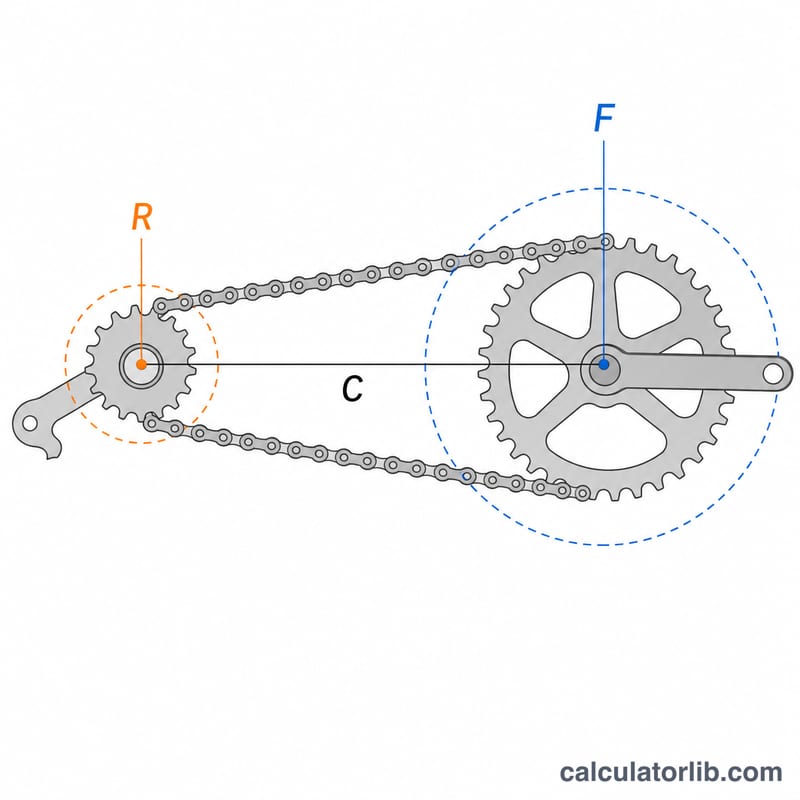
Measure the chainstay length in millimetres (the distance from the centre of the bottom bracket to the centre of the rear axle). Enter the tooth count of your biggest chainring and biggest sprocket. The calculator returns a raw length, then rounds to the nearest whole link because chains can only be broken at full links.
The Formula Explained
The equation is $$L = 2\cdot\left(\frac{C}{25.4}\right) + \frac{F}{4} + \frac{R}{4} + 1$$ where \(C\) is in millimetres. Dividing the chainstay by 25.4 converts millimetres to inches, and doubling accounts for both the top and bottom runs of chain. Adding \(\frac{F}{4}\) and \(\frac{R}{4}\) wraps the chain around the largest gears, and the constant 1 inch provides clearance for the derailleur to take up slack.
Worked Example
For an MTB with a 445 mm chainstay, a 32T chainring and a 51T cassette cog: $$L = \frac{445}{12.7} + \frac{32}{4} + \frac{51}{4} + 1 = 35.039 + 8 + 12.75 + 1 \approx 56.79 \text{ inches}$$ Rounded to the nearest half-inch link this is 112 links, or 56 inches.
FAQ
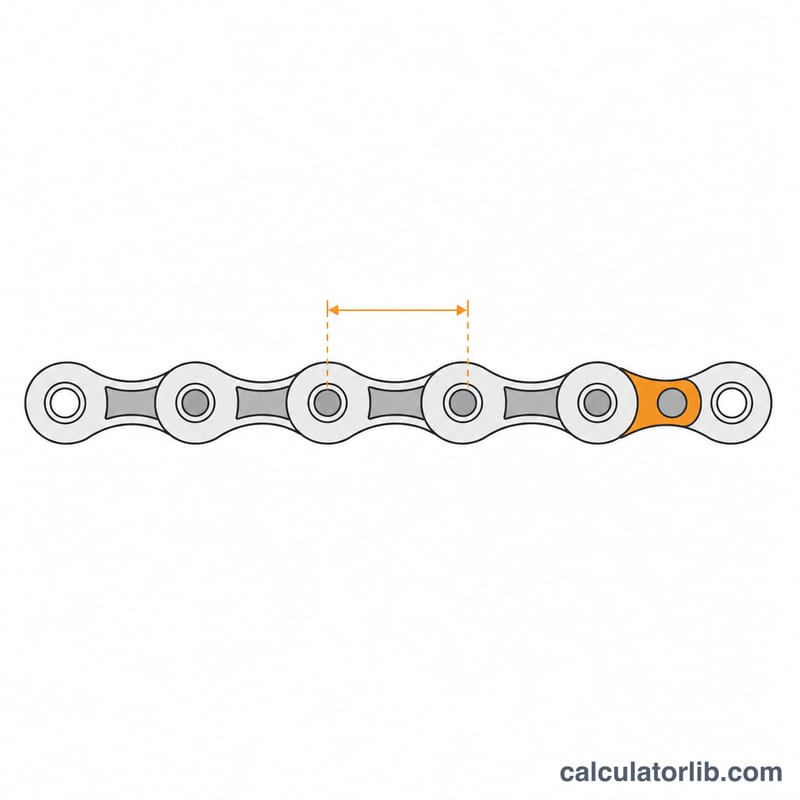
Why round to links? A chain can only be cut between rollers, so its length is always a whole number of half-inch links.
Which gears do I use? Always use the largest chainring and largest cog — the combination that demands the most chain — then let the derailleur absorb the slack in smaller gears.
Is this exact? It is an estimate. Always finalise length on the bike by shifting to the big-big combination and following your derailleur manufacturer's wrap method.