
What this calculator does
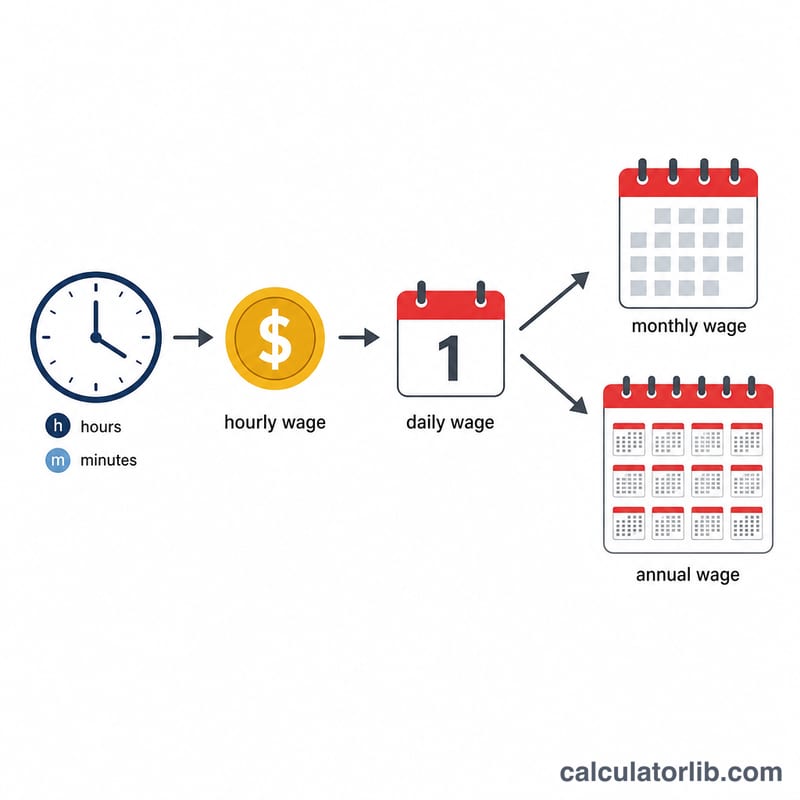
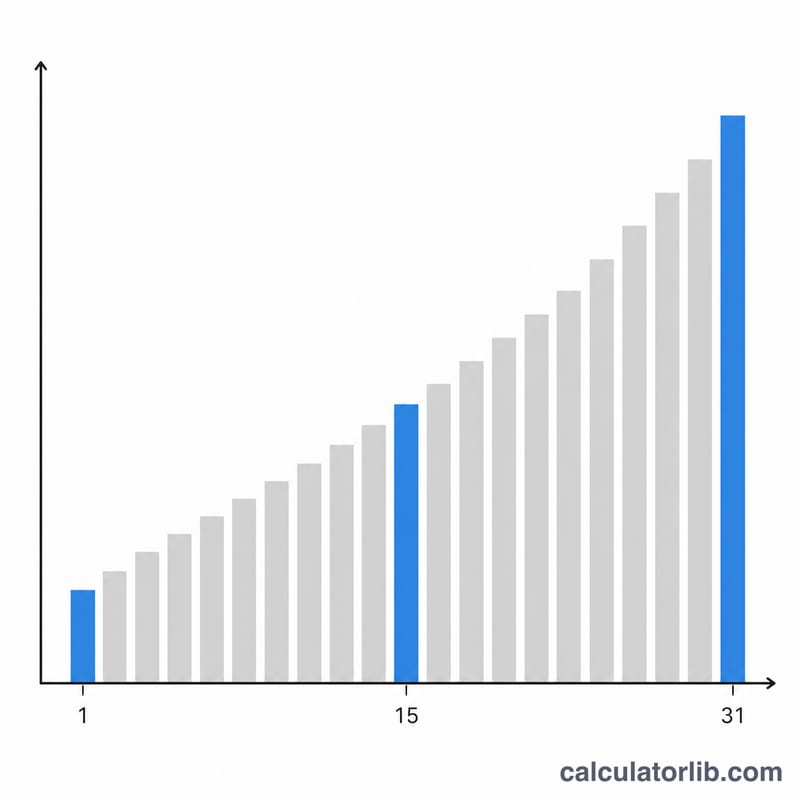
This tool converts an hourly wage into a daily wage, and then projects monthly and annual income across every realistic schedule from 1 to 31 working days per month. It is currency-neutral: enter the wage in any unit (the original tool was built for Japanese yen, but the arithmetic is universal), and the results stay in that same unit.
How to use it
Enter your hourly wage, then your working time per day split into hours and minutes (for example 7 hours and 30 minutes). The calculator computes the daily wage and builds a full table so you can read off the monthly and annual income for whatever number of days you actually work each month.
The formula explained
First the daily working time is converted to decimal hours: \( \text{dailyHours} = \text{hours} + \dfrac{\text{minutes}}{60} \). The daily wage is then \( \text{hourlyWage} \times \text{dailyHours} \), rounded half up to the nearest whole currency unit. For each number of working days d, monthly income is \( \text{dailyWage} \times d \) and annual income is that monthly figure times 12.
$$\text{Daily Wage} = \left\lfloor \text{Hourly Wage} \times H + 0.5 \right\rfloor \quad\text{where}\quad H = \text{Hours/Day} + \dfrac{\text{Minutes/Day}}{60}$$$$\text{Monthly} = \text{Daily Wage} \times D, \qquad \text{Annual} = \text{Monthly} \times 12$$
Worked example
Suppose the hourly wage is 850 and the working day is 7 hours 30 minutes. Then \( \text{dailyHours} = 7 + 30/60 = 7.5 \), so the daily wage \( = \text{round}(850 \times 7.5) = \text{round}(6375) = 6375 \). Working 20 days a month gives \( 6375 \times 20 = 127{,}500 \) monthly and \( 127{,}500 \times 12 = 1{,}530{,}000 \) annually. Working 22 days gives 140,250 monthly and 1,683,000 annually.
FAQ
Why is only the daily wage rounded? The daily wage is rounded once to the nearest whole unit; monthly and annual figures are exact multiples of that rounded daily wage, so they remain whole numbers.
What currency does it use? Any. The math does not depend on the currency, so the numbers you enter and the numbers you read out are in the same unit.
Does this include taxes or overtime? No. It is a gross-pay projection based purely on hourly wage and hours worked, before any deductions, bonuses, or premium pay.