
What This Calculator Does
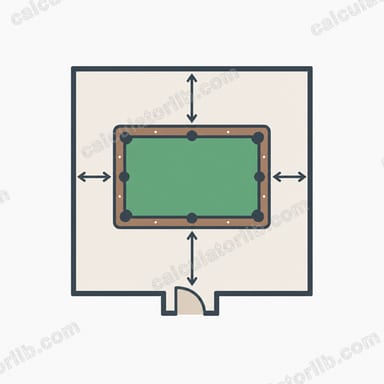
The Pool Table Room Size Calculator tells you the minimum floor space you need to comfortably set up and play on a pool, snooker, or billiards table. The challenge is not just fitting the table — you also need enough clearance on every side to draw back and stroke a cue without hitting a wall. This tool adds the recommended clearance to the table's playing dimensions and returns the total room size in inches, feet, and square footage.
How to Use It
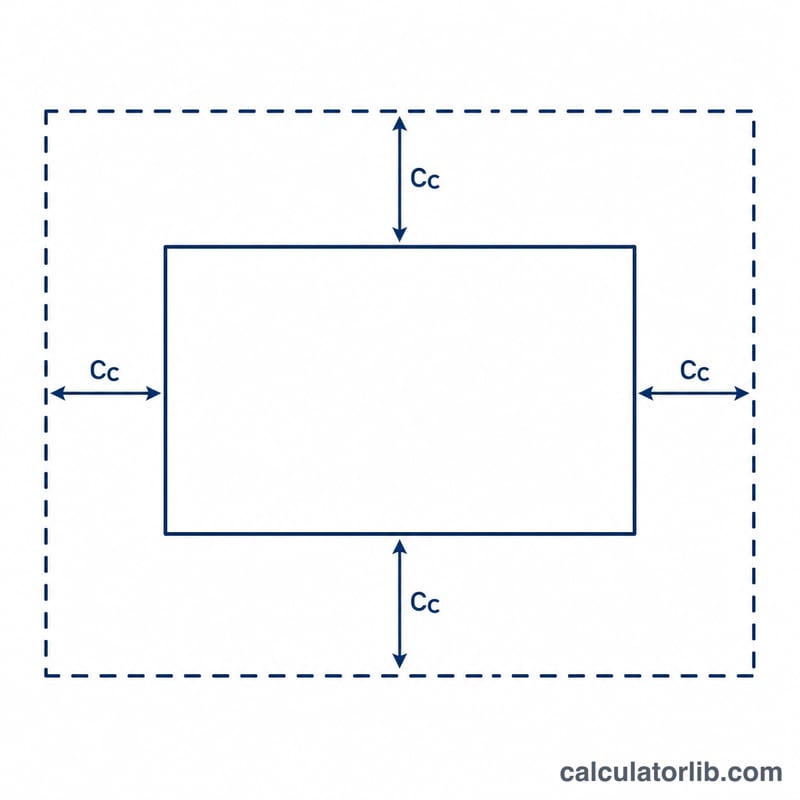
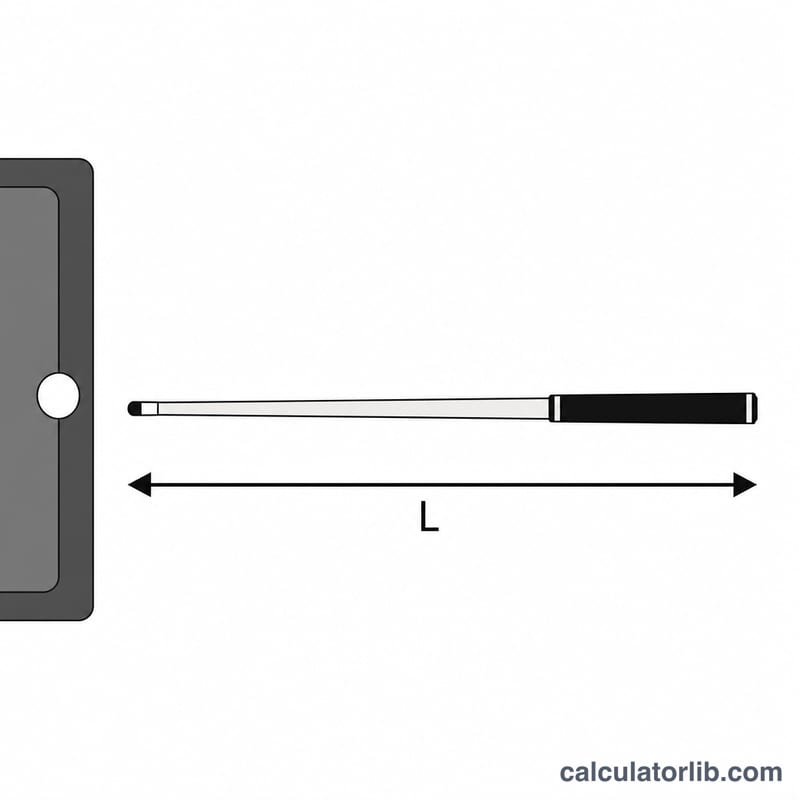
Enter the playing area length and width of your table (the felt surface inside the cushions, not the outer cabinet). Then choose the cue length you intend to use — a standard cue is about 57–58 inches. The calculator adds two cue lengths to each dimension, since you need clearance on both opposite sides.
The Formula Explained
The clearance rule is simple: leave at least one cue length of free space beyond every edge of the playing surface. That gives:
$$\text{Room Length} = \text{Table Length} + 2 \times \text{Cue Length}$$
$$\text{Room Width} = \text{Table Width} + 2 \times \text{Cue Length}$$
If you use a shorter cue (48" or 52"), the required room shrinks accordingly, which is handy for tight rec rooms — just expect awkward shots near the rails.
Worked Example
A 7-foot table has a playing area of roughly 78 × 39 inches. With a standard 57" cue: $$\text{Room Length} = 78 + 2 \times 57 = 192 \text{ in } (16 \text{ ft})$$ $$\text{Room Width} = 39 + 2 \times 57 = 153 \text{ in } (12.75 \text{ ft})$$ So you'd want about a \(16 \times 12.75\) ft room.
FAQ
Do I measure the playing area or the whole table? Use the playing area (inside the cushions). The cabinet overhang is already covered by the cue clearance.
What if I can only fit a shorter cue on one side? Pick a shorter cue length in the dropdown; many players keep a 48" or 52" cue for tight spots.
Is this for snooker too? Yes — the same clearance logic applies. Just enter your snooker table's playing dimensions.