
What is the Shoe Size Converter?
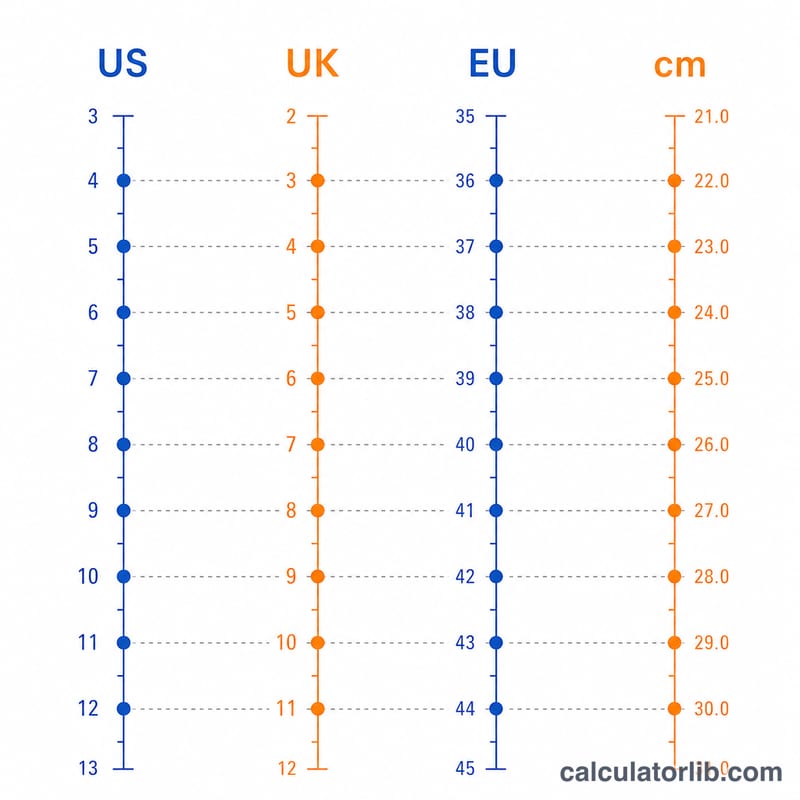
Shoe sizing is a notorious mess: the US, UK, and Europe all use different scales, and even within those, men's and women's numbers differ. This converter starts from the one measurement that is universal — your actual foot length in centimeters — and translates it into matching US, UK, and EU sizes so you can shop with confidence anywhere in the world.
How to use it
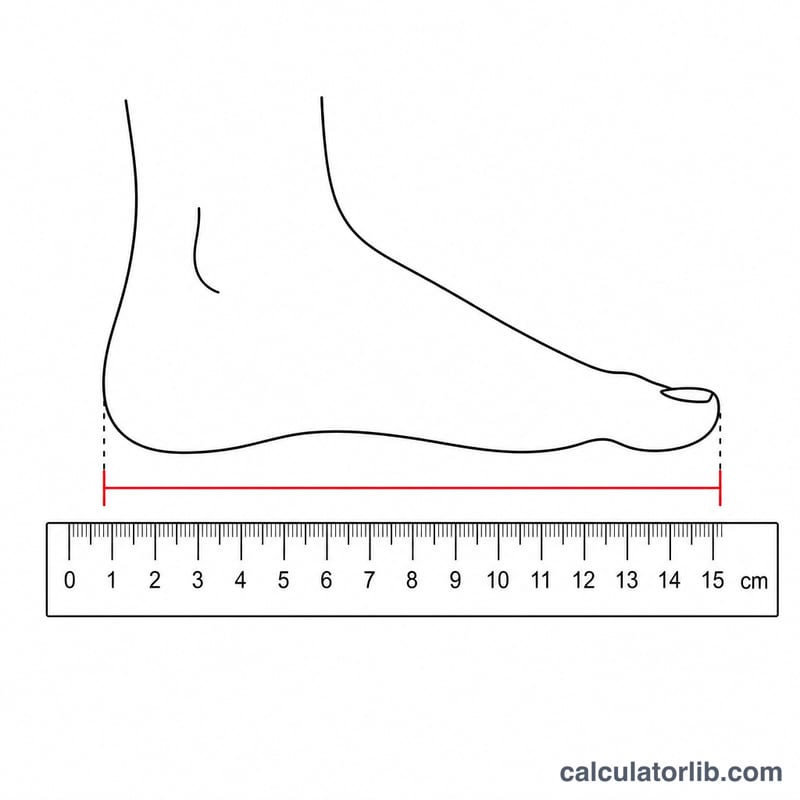
Measure your foot from the back of the heel to the tip of your longest toe (do this while standing, late in the day, and add a few millimeters of wiggle room). Enter that length in centimeters, choose Men or Women, and the calculator returns your EU, US, and UK sizes. If you fall between sizes, round up.
The formula explained
The European scale uses the "Paris point" where each size equals 2/3 cm, so EU size is approximately $$\text{EU} = \left(\text{foot length} + 1.5\right) \times 1.5$$, with the 1.5 cm allowance for toe room. UK sizing uses the old English "barleycorn" (1 size = 1/3 inch), giving $$\text{UK} = 3 \times \frac{\text{foot\_cm}}{2.54} - 23$$. US men's sizes run one full size above UK; US women's run about two sizes above UK.
Worked example
Suppose your foot is 26 cm long. $$\text{EU} = (26 + 1.5) \times 1.5 = \mathbf{41.25}$$ Inches = \(26 \div 2.54 = 10.236\); $$\text{UK} = 3 \times 10.236 - 23 = \mathbf{7.71}$$ $$\text{US men} = 7.71 + 1 = \mathbf{8.71}$$ So you'd look at EU 41–42, UK 8, US men 9.
FAQ
Why do my sizes differ slightly from a brand's chart? Every manufacturer uses its own "last" and tolerances, so treat these as a starting point and try before you buy.
Should I round up or down? Round up — a slightly roomy shoe is far more comfortable than a tight one.
Is half a size noticeable? Yes, roughly 4 mm in length, enough to matter for fit, especially in stiff or athletic shoes.