

What Is Return on Equity (ROE)?
Return on Equity (ROE) is a key profitability ratio that shows how effectively a company uses shareholders' invested capital to generate profit. It answers a simple question: for every dollar of equity, how much net income does the business produce? A higher ROE generally signals more efficient use of equity, though it should always be compared with industry peers and examined alongside debt levels.
How to Use This Calculator
Enter the company's net income (profit after taxes and expenses, taken from the income statement) and its shareholders' equity (total assets minus total liabilities, from the balance sheet). The calculator divides net income by equity and multiplies by 100 to return the ROE as a percentage. Use the same reporting period for both figures, and consider using average equity for greater accuracy.
The Formula Explained
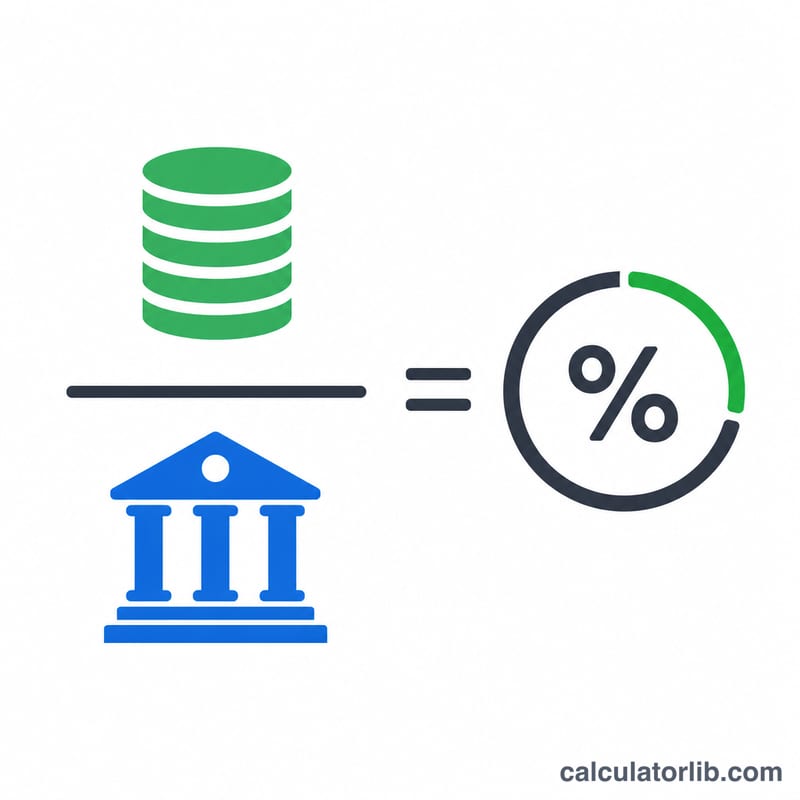
The formula is:
$$\text{ROE} = \frac{\text{Net Income}}{\text{Shareholders Equity}} \times 100\%$$
Net income is the "bottom line" profit. Shareholders' equity is the book value belonging to owners. Multiplying by 100 converts the decimal ratio into a percentage that is easy to interpret and benchmark.
Worked Example
Suppose a company reports net income of $100,000 and shareholders' equity of $500,000. $$\text{ROE} = \frac{100{,}000}{500{,}000} \times 100 = 0.2 \times 100 = \textbf{20\%}$$ This means the company earned 20 cents of profit for every dollar of equity invested.
FAQ
What is a good ROE? Many investors view an ROE of 15–20% as strong, but ideal levels vary widely by industry. Compare against direct competitors.
Can ROE be negative? Yes. If a company has a net loss (negative net income) with positive equity, ROE will be negative, indicating value destruction.
Does high ROE always mean a great company? Not necessarily. A high ROE can result from excessive debt that shrinks equity. Always review the balance sheet and leverage before drawing conclusions.