
What Is Return on Sales?
Return on Sales (ROS), also called operating margin, measures how much operating profit a company generates from each dollar of net sales. It is a key efficiency and profitability metric: a higher ROS means more of every sales dollar is kept as operating profit after covering operating costs. ROS is widely used to compare companies within the same industry and to track a single company's performance over time.
How to Use This Calculator
Enter your operating profit (earnings before interest and taxes) and your net sales (revenue after returns, allowances, and discounts). The calculator divides operating profit by net sales and multiplies by 100 to express the result as a percentage. Use figures from the same accounting period for an accurate result.
The Formula Explained
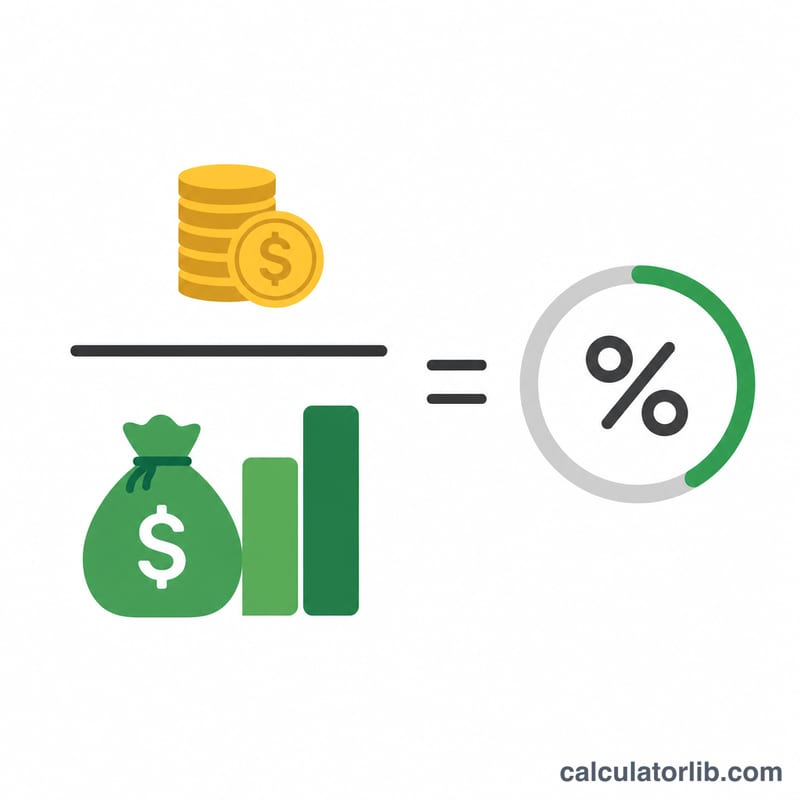
The formula is $$\text{ROS} = \frac{\text{Operating Profit (\$)}}{\text{Net Sales (\$)}} \times 100\%$$ Operating profit excludes non-operating items such as interest and taxes, which makes ROS a clean view of core operating efficiency. Net sales should already be reduced by returns and discounts so the ratio reflects actual realized revenue.
Worked Example
Suppose a business has operating profit of $150,000 and net sales of $1,000,000. $$\text{ROS} = \frac{150{,}000}{1{,}000{,}000} \times 100 = \mathbf{15\%}$$ This means the company keeps 15 cents of operating profit from every dollar of sales.
FAQ
What is a good ROS? It varies by industry. Retail often runs low single digits, while software companies can exceed 20–30%. Compare against peers in your sector.
Is ROS the same as net profit margin? No. ROS uses operating profit (before interest and taxes), while net profit margin uses net income after all expenses.
Can ROS be negative? Yes. If operating profit is negative, the company is losing money on operations and ROS will be negative.