
What Is Return on Assets?
Return on Assets (ROA) is a profitability ratio that measures how efficiently a company uses its assets to generate net income. It tells you how many cents of profit a business earns for every dollar of assets it owns. A higher ROA means management is using the company's resources more effectively.
How to Use This Calculator
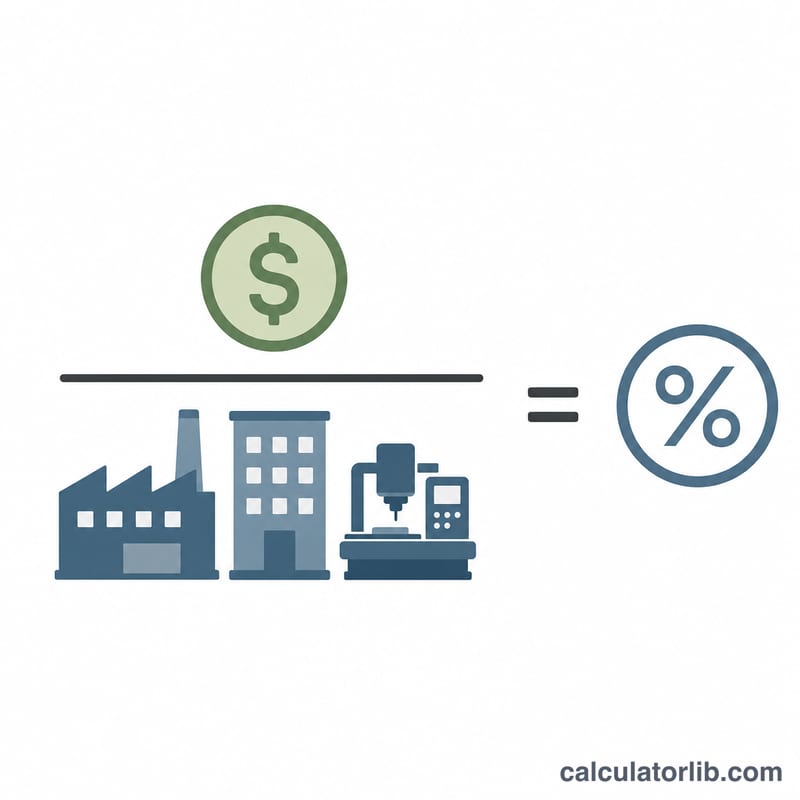
Enter the company's net income (from the bottom of the income statement) and its total assets (from the balance sheet). The calculator divides net income by total assets and multiplies by 100 to express the result as a percentage. Use figures from the same reporting period for an accurate comparison.
The Formula Explained
The equation is $$\text{ROA} = \frac{\text{Net Income}}{\text{Total Assets}} \times 100\%$$ Net income is profit after all expenses, interest, and taxes. Total assets include everything the company owns — cash, receivables, inventory, property, and equipment. Multiplying by 100 converts the decimal ratio into an easy-to-read percentage.
Worked Example
Suppose a company reports net income of $50,000 and total assets of $500,000. $$\text{ROA} = \frac{50{,}000}{500{,}000} \times 100 = 0.10 \times 100 = \textbf{10\%}$$ This means the company generates 10 cents of profit for every dollar of assets.
FAQ
What is a good ROA? It varies by industry, but generally an ROA above 5% is considered solid, while above 20% is excellent. Asset-heavy industries like manufacturing tend to have lower ROAs than asset-light service firms.
How is ROA different from ROE? ROA measures profit relative to total assets, while Return on Equity (ROE) measures profit relative to shareholders' equity. ROA reflects how well a company uses all its resources, including debt-financed ones.
Can ROA be negative? Yes. If a company has a net loss, net income is negative, producing a negative ROA — a sign the business is losing money on its asset base.