

What Is the Expected Return Calculator?
The Expected Return Calculator estimates the average return you can anticipate from an investment when its future outcome is uncertain. Instead of a single guaranteed return, most investments have a range of possible results — a strong economy, a normal year, or a recession. By assigning a probability to each scenario and the return you'd earn in it, this tool computes the probability-weighted average, known as the expected return, \(E(R)\).
How to Use It
Enter up to four scenarios. For each one, type the probability of that scenario occurring (as a percentage) and the return you would earn if it happens (also a percentage). Leave unused rows at zero. The probabilities should ideally sum to 100%. Click calculate to see the expected return and the total probability you entered as a check.
The Formula Explained
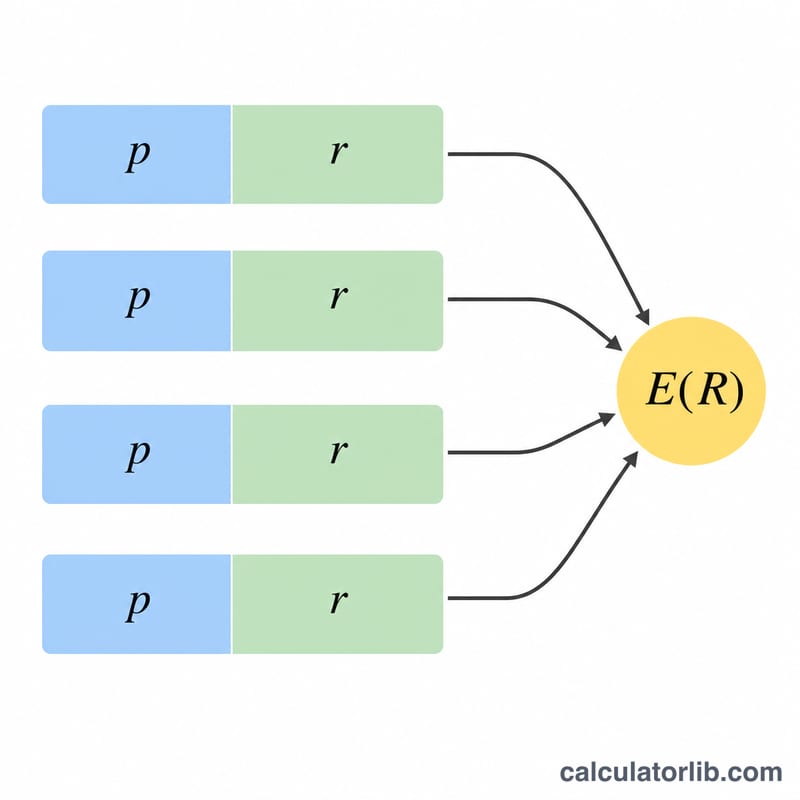
The expected return is the sum of each scenario's probability multiplied by its return:
$$E(R) = \sum (p_i \times r_i)$$
Here \(p_i\) is the probability of scenario i (as a decimal) and \(r_i\) is the return in that scenario. Because probabilities are weights, scenarios that are more likely contribute more to the final number.
Worked Example
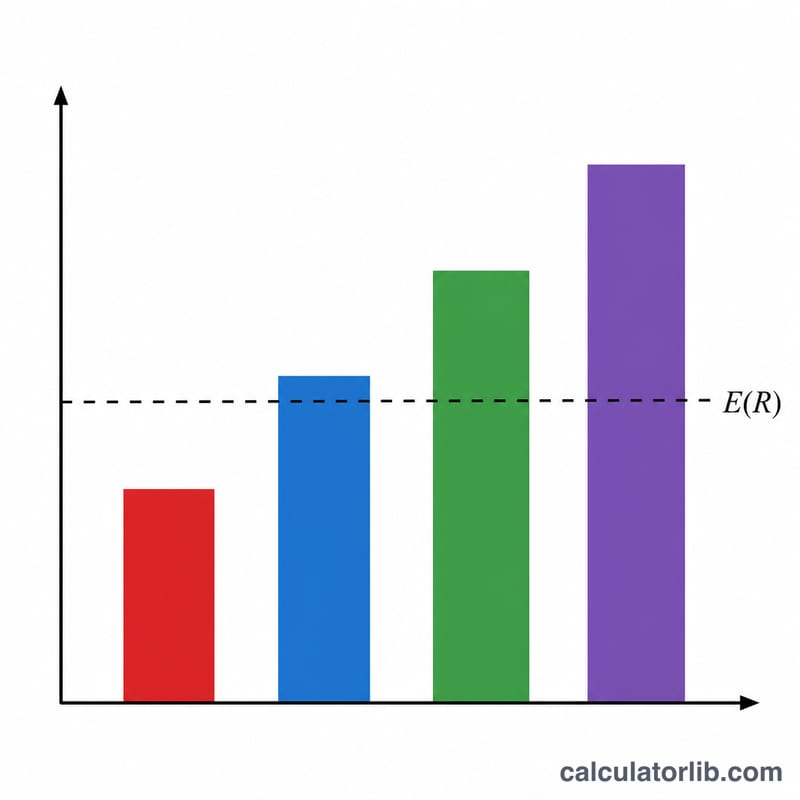
Suppose an investment has three outcomes: a 25% chance of a 20% return (boom), a 50% chance of a 10% return (normal), and a 25% chance of a −5% return (recession). The expected return is:
$$E(R) = (0.25 \times 20) + (0.50 \times 10) + (0.25 \times -5) = 5 + 5 - 1.25 = \textbf{8.75\%}.$$
FAQ
Do my probabilities have to add up to 100%? Yes, for a mathematically valid expected return your probabilities should sum to 100%. The calculator shows the total so you can verify this.
Can returns be negative? Absolutely — enter a negative return (e.g. −5) for loss scenarios such as a downturn.
Is expected return the same as guaranteed return? No. It is a long-run average across many possible outcomes, not a promise of what any single period will deliver.