
What Is an Investment Fee Calculator?
An investment fee calculator shows how much you pay in fees on a given investment amount based on a stated fee rate (often called an expense ratio or management fee). Even small percentage fees can add up significantly over time, so understanding what you are charged is an important part of evaluating any fund, advisor, or platform.
How to Use It
Enter your total investment amount and the annual fee rate as a percentage. The calculator instantly returns the fee charged, your net amount after the fee is deducted, and a summary of your inputs. This is a universal calculation that applies regardless of currency or country — simply read the dollar sign as your own currency.
The Formula Explained
The fee is a simple percentage of the invested amount:
$$\text{Fee} = \text{Investment} \times \frac{\text{Fee Rate (\%)}}{100}$$Dividing the fee rate by 100 converts the percentage into a decimal fraction. The net amount is then your investment minus this fee.
$$\text{Net} = \text{Investment} - \text{Fee}$$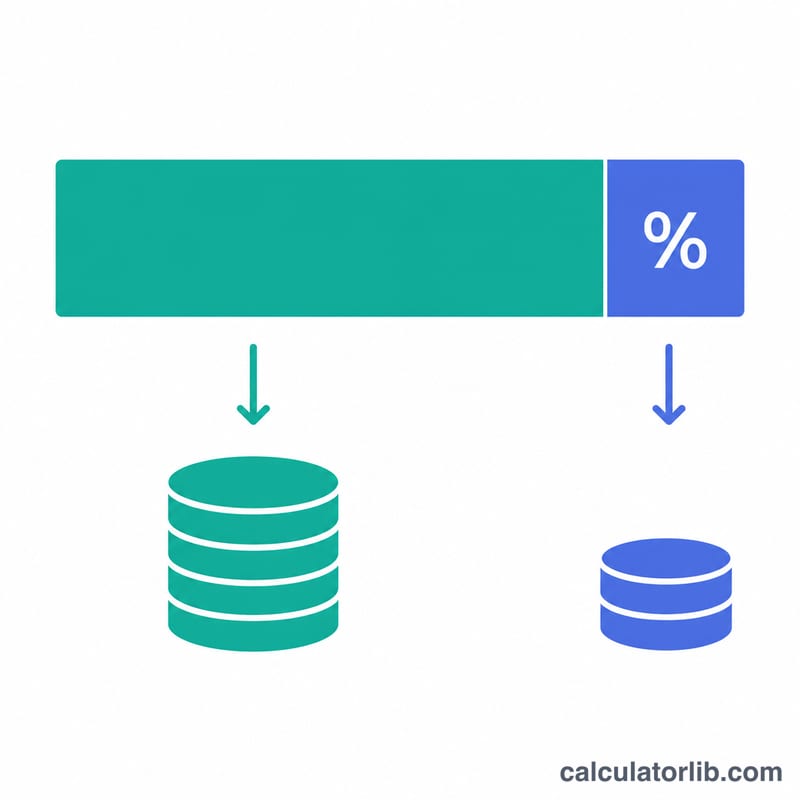
Worked Example
Suppose you invest $10,000 in a fund with a 1% annual fee. The fee is $$10{,}000 \times (1 \div 100) = \$100.$$ Your net amount after the fee is $$10{,}000 - 100 = \$9{,}900.$$ Over many years, paying this fee repeatedly can meaningfully reduce your returns.
FAQ
Is this an annual fee? Most fund management fees and expense ratios are quoted annually, so the result represents one year's charge. Multiply by the number of years for a rough cumulative estimate.
Does this include compounding effects? No — this is a single-period fee calculation. It does not account for how lost fees reduce future compounded growth.
What fee rate should I expect? Index funds often charge well under 0.5%, while actively managed funds and some advisors may charge 1% or more. Lower fees generally mean more of your money stays invested.