

What Is Market Value Added (MVA)?
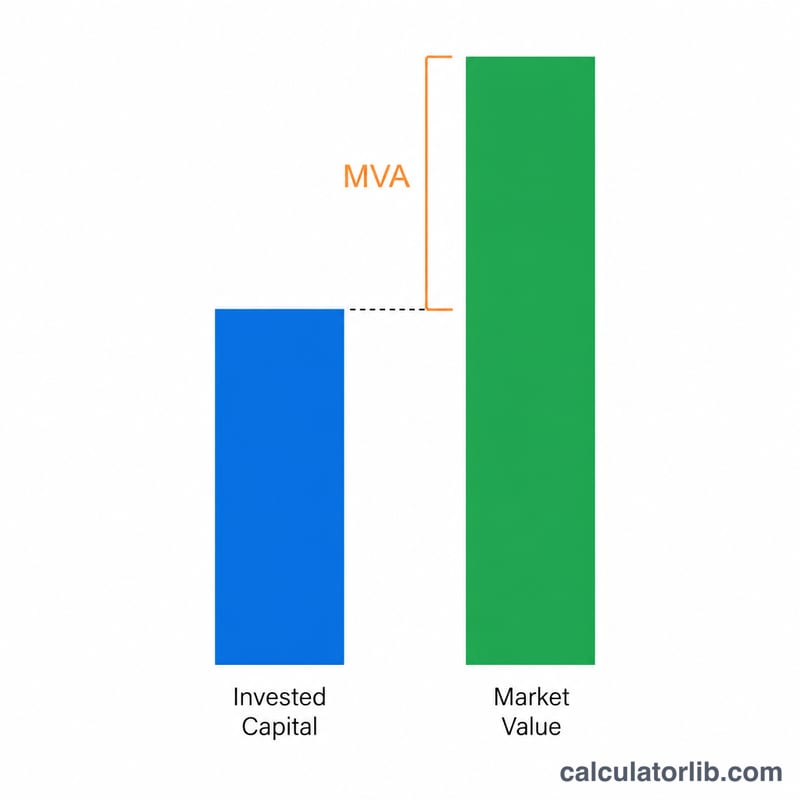
Market Value Added (MVA) measures the amount of wealth a company has created for its investors. It is the difference between the total market value of a company (the combined value of its equity and debt) and the total capital that investors have put into the business. A positive MVA means management has created value above and beyond what was invested; a negative MVA signals that value has been destroyed.
How to Use This Calculator
Enter two figures: the current Market Value of the company (typically market capitalization plus the market value of debt) and the Invested Capital (the total funds contributed by shareholders and lenders). The calculator instantly returns the MVA along with its ratio to invested capital, so you can quickly gauge how efficiently the firm turns capital into market value.
The Formula Explained
The core equation is simple:
$$\text{MVA} = \text{Market Value} - \text{Invested Capital}$$
Market Value reflects what the market is willing to pay for the company today. Invested Capital is the historical sum of money supplied by all capital providers. The gap between them is the net value the company's strategy, operations, and management have generated.
Worked Example
Suppose a company has a market value of $5,000,000 and investors have put in $3,000,000 of capital. Then:
$$\text{MVA} = \$5{,}000{,}000 - \$3{,}000{,}000 = \$2{,}000{,}000$$
As a percentage of capital: \((2{,}000{,}000 \div 3{,}000{,}000) \times 100 \approx 66.67\%\). The company has created an extra $2 million of value, equal to about two-thirds of the capital invested.

FAQ
Is a higher MVA always better? Generally yes — a higher positive MVA indicates more wealth created. But always compare it relative to the size of invested capital and against peers.
What does a negative MVA mean? It means the company's market value is below the capital invested, suggesting value destruction or market pessimism about future returns.
How is MVA different from EVA? EVA (Economic Value Added) measures value created in a single period, while MVA is a cumulative, market-based measure of total value created over the company's life.