

What Is Terminal Value?
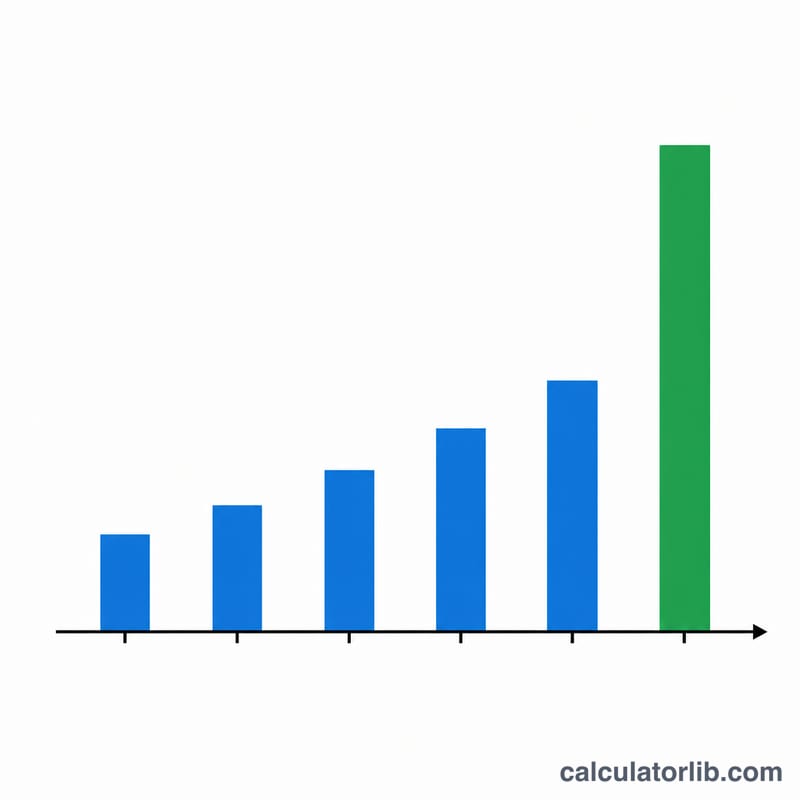
Terminal value (TV) represents the value of a business or investment beyond an explicit forecast horizon, when cash flows are assumed to grow at a stable, perpetual rate. In a discounted cash flow (DCF) model the terminal value often accounts for 60–80% of total enterprise value, so getting it right matters enormously. This calculator supports the two industry-standard methods: the perpetuity growth (Gordon Growth) model and the exit multiple method.
How to Use This Calculator
Choose a method. For Perpetuity Growth, enter your final forecast-year free cash flow (FCF), the long-term growth rate \(g\), and your weighted average cost of capital (WACC). For the Exit Multiple method, enter final-year EBITDA and the multiple you expect a buyer to pay (e.g. an EV/EBITDA of 8×). The result is the undiscounted terminal value as of the end of the forecast period — remember to discount it back to today in your DCF.
The Formula Explained
The perpetuity growth formula is $$\text{TV} = \frac{\text{FCF}\left(1 + \text{g}\right)}{\text{WACC} - \text{g}}$$ It treats the post-forecast cash flows as a perpetuity growing forever at rate \(g\). The denominator \(\text{WACC} - \text{g}\) must be positive, so \(g\) must stay below your discount rate — typically near long-run GDP or inflation (2–3%). The exit multiple formula is simply $$\text{TV} = \text{EBITDA} \times \text{Exit Multiple}$$ anchoring value to current market pricing of comparable companies.

Worked Example
Suppose final-year FCF is 100, \(g\) is 2.5%, and WACC is 9%. Then $$\text{TV} = \frac{100 \times (1.025)}{0.09 - 0.025} = \frac{102.5}{0.065} = \mathbf{1{,}576.92}$$ Using the exit multiple method with EBITDA of 150 and an 8× multiple gives $$\text{TV} = 150 \times 8 = \mathbf{1{,}200}$$
FAQ
Which method should I use? Many analysts compute both and triangulate. Perpetuity growth is theory-driven; exit multiple is market-driven.
What if WACC equals g? The perpetuity formula breaks down (division by zero) — lower \(g\) below WACC for a sensible result.
Is this value discounted? No. The output sits at the end of the forecast period; divide by \((1+\text{WACC})^n\) to bring it to present value.