
What Is ROCE?
Return on Capital Employed (ROCE) is a profitability ratio that measures how efficiently a company generates operating profit from the capital it has invested. It compares earnings before interest and tax (EBIT) to the total capital employed in the business. A higher ROCE indicates the company is using its capital more effectively to produce profits, making it a favourite metric for long-term investors comparing capital-intensive businesses.
How to Use This Calculator
Enter three figures from the financial statements: EBIT (also called operating profit), total assets, and current liabilities. The calculator subtracts current liabilities from total assets to find capital employed, then divides EBIT by that figure and expresses the result as a percentage. All inputs should use the same currency and the same reporting period.
The Formula Explained
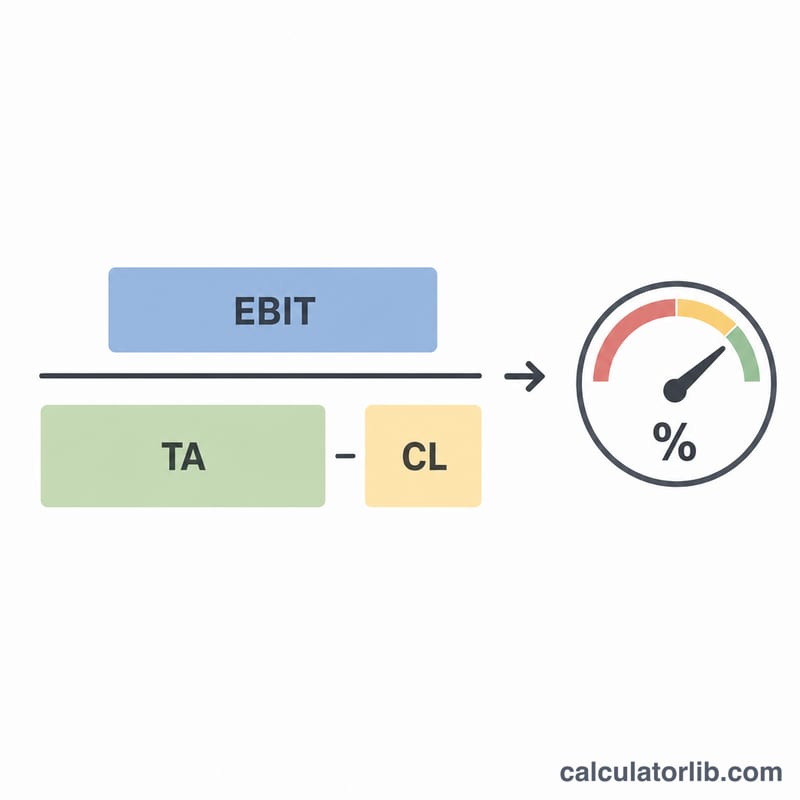
$$\text{ROCE} = \frac{\text{EBIT}}{\text{Total Assets} - \text{Current Liabilities}} \times 100\%$$ EBIT strips out the effects of financing and taxes so you measure pure operating performance. Capital employed (total assets minus current liabilities) represents the long-term funds — both equity and long-term debt — that are working in the business.
Worked Example
Suppose a company reports EBIT of 150,000, total assets of 1,000,000, and current liabilities of 400,000. Capital employed is \(1{,}000{,}000 - 400{,}000 = 600{,}000\). $$\text{ROCE} = \frac{150{,}000}{600{,}000} = 0.25 = 25\%$$ This means the firm earns 25 cents of operating profit for every dollar of capital employed.
FAQ
What is a good ROCE? As a rule of thumb, a ROCE above 15% is considered healthy, but it varies widely by industry. Compare against peers and the company's cost of capital.
How does ROCE differ from ROE? ROE measures return on shareholders' equity only, while ROCE includes long-term debt, giving a fuller view of how all long-term capital is deployed.
Should I use average capital employed? For more accuracy, you can average the opening and closing capital employed for the period. This calculator uses the period-end figures you enter.