
What Is the Utilization Rate Calculator?
The utilization rate (or billable utilization) measures how much of a person's or team's available working time is spent on billable, revenue-generating work. It is one of the most important productivity metrics for consultancies, agencies, law firms, and any service business that bills by the hour. This calculator turns two simple inputs — billable hours and total available hours — into a clear percentage.
How to Use It
Enter the number of billable hours (time charged to clients) and the total available hours (the capacity you are measuring against, such as a 40-hour week, a month, or a quarter). The calculator returns your utilization percentage along with a breakdown of billable and non-billable hours.
The Formula Explained
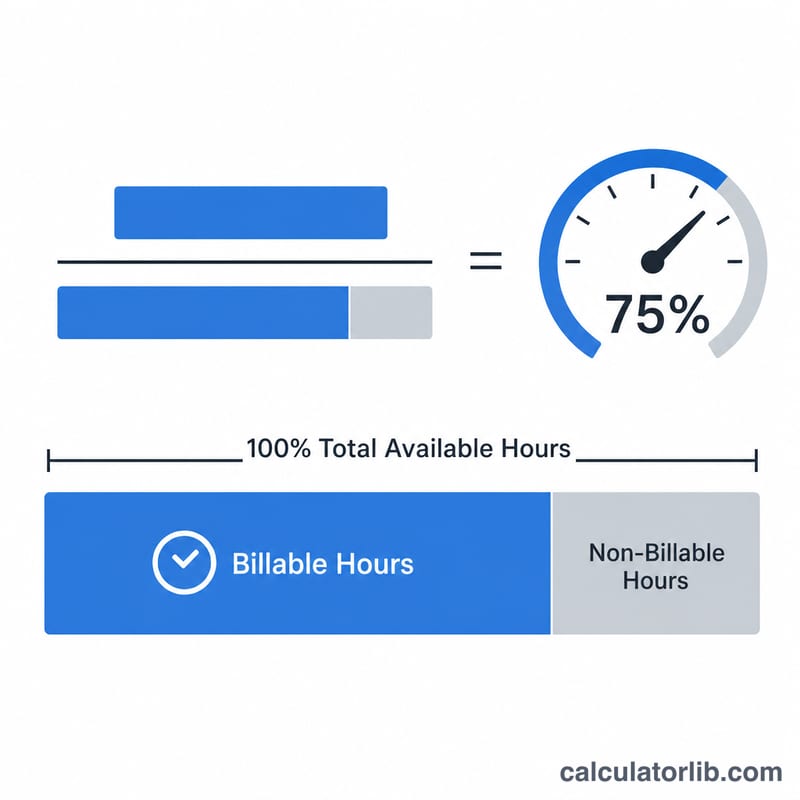
Utilization % = (Billable Hours ÷ Total Available Hours) × 100.
$$\text{Utilization} = \frac{\text{Billable Hours}}{\text{Total Available Hours}} \times 100\%$$If you bill 32 hours out of a 40-hour week, your utilization is \((32 \div 40) \times 100 = 80\%\). Non-billable time covers admin, training, internal meetings, and downtime, so 100% utilization is rarely sustainable. Many firms target 70–85% as a healthy range.
Worked Example
A consultant logs 150 billable hours in a month where 160 hours were available. Utilization =
$$\text{Utilization} = \frac{150}{160} \times 100 = 93.75\%$$That is very high — useful short term, but it leaves little room for business development and may signal burnout risk.
FAQ
What is a good utilization rate? Most service businesses aim for 70–85%. Lower means underused capacity; consistently higher can indicate overwork.
Should I use billable or available hours as capacity? Use the total hours you actually expect someone to be available to work — typically scheduled hours minus paid leave.
Can utilization exceed 100%? Yes, if billable hours exceed planned available hours (overtime), but it usually signals that your capacity baseline is set too low.