
What is CO₂-equivalent (CO₂e)?
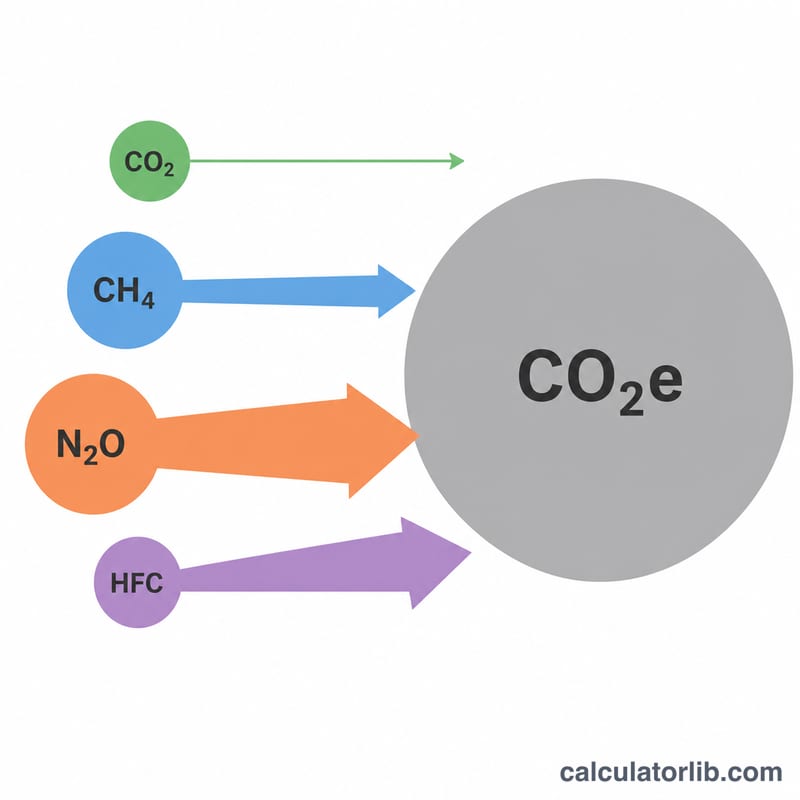
Different greenhouse gases trap heat with very different intensities. To compare them on a single scale, scientists use the Global Warming Potential (GWP) — the warming caused by one tonne of a gas relative to one tonne of carbon dioxide over a chosen time horizon (usually 100 years). Multiplying the mass of each gas by its GWP and adding the results gives the total CO₂-equivalent (CO₂e) — a universal currency for carbon accounting and footprint reporting.
How to use this calculator
Enter the mass (in kilograms) of each gas you emitted. CO₂ has a GWP of 1 by definition. The default GWP factors follow the IPCC AR5 100-year values: methane (CH₄) ≈ 28 and nitrous oxide (N₂O) ≈ 265. HFCs vary widely, so adjust the HFC GWP to match your refrigerant (e.g. HFC-134a ≈ 1430). The calculator returns total CO₂e in kilograms and tonnes, plus the contribution of each gas.
The formula explained
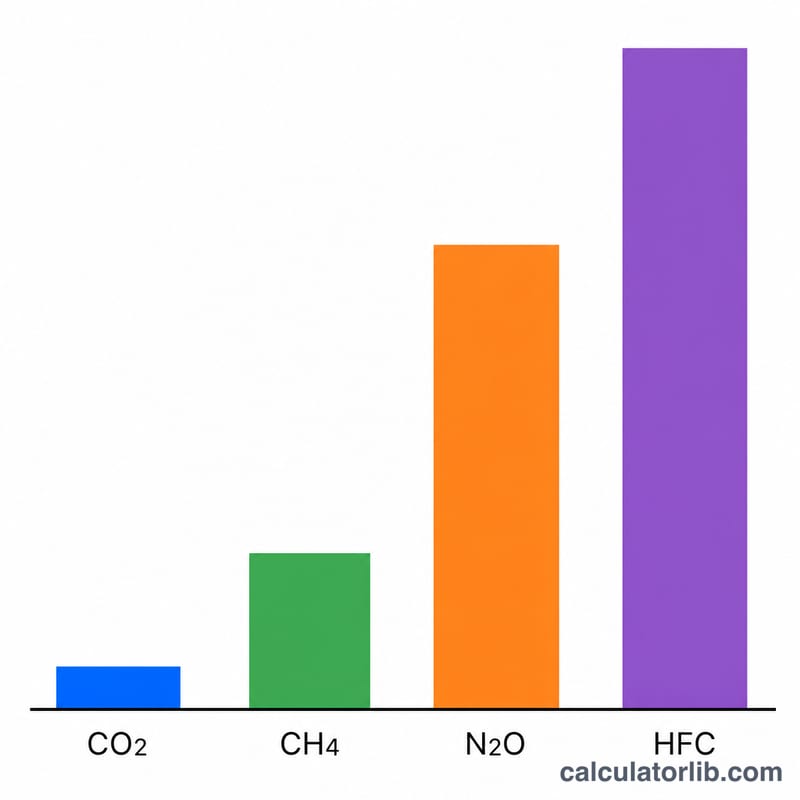
The core equation is simply $$\text{CO}_2\text{e} = \text{CO}_2 + \text{CH}_4 \cdot \text{GWP}_{\text{CH}_4} + \text{N}_2\text{O} \cdot \text{GWP}_{\text{N}_2\text{O}} + \text{HFC} \cdot \text{GWP}_{\text{HFC}}$$ Because GWP is dimensionless and relative to CO₂, a small mass of a high-GWP gas can dominate the total. For example, 1 kg of methane (GWP 28) contributes as much warming as 28 kg of CO₂.
Worked example
Suppose you emit 1,000 kg CO₂, 10 kg CH₄ and 2 kg N₂O. Using GWP factors of 28 and 265: \(\text{CO}_2 = 1{,}000\); \(\text{CH}_4 = 10 \times 28 = 280\); \(\text{N}_2\text{O} = 2 \times 265 = 530\). Total = $$1{,}000 + 280 + 530 = 1{,}810 \text{ kg CO}_2\text{e}$$ 1,810 kg CO₂e, or 1.81 tonnes CO₂e.
FAQ
Which GWP values should I use? Most modern inventories use IPCC AR5 100-year values (CH₄ = 28, N₂O = 265). Older reports may use AR4 (CH₄ = 25, N₂O = 298). You can override the factors in the form.
Why is methane sometimes given as 84? That is the 20-year GWP, which weights short-term warming more heavily. The 100-year value (28) is the standard for national reporting.
Do I include CO₂ from biomass? Biogenic CO₂ is often reported separately; include only the sources required by your reporting standard.