What This Calculator Does
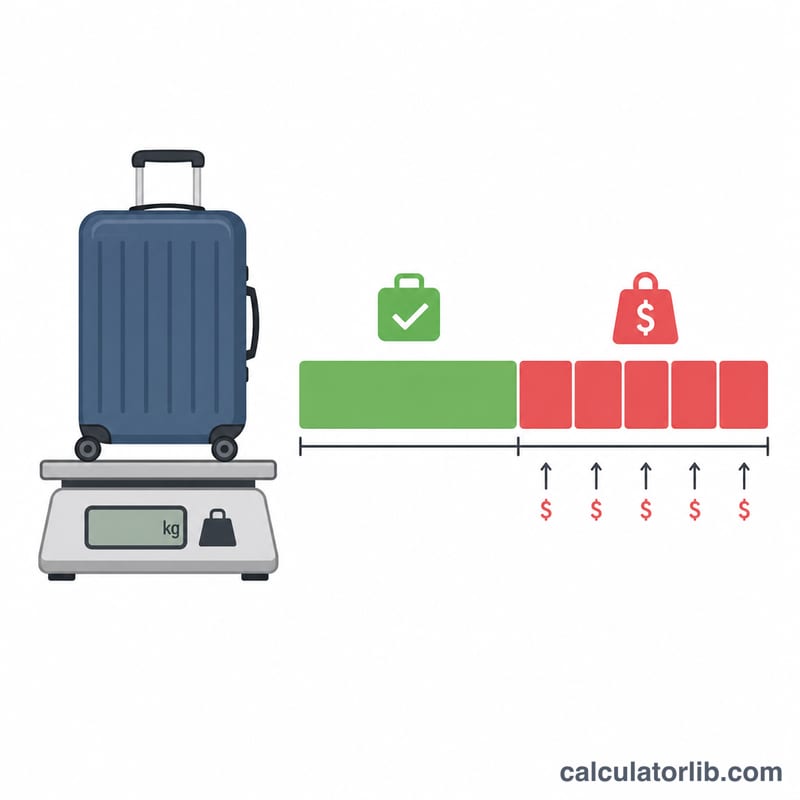
The Overweight Baggage Fee Calculator estimates the surcharge an airline will add when your checked bag is heavier than the included free allowance. Airlines typically charge in fixed steps — for example, a set fee for each kilogram (or each band of kilograms) you exceed the limit. This tool turns those rules into a single, clear number so you can decide whether to repack, redistribute weight, or pay the fee.
How to Use It
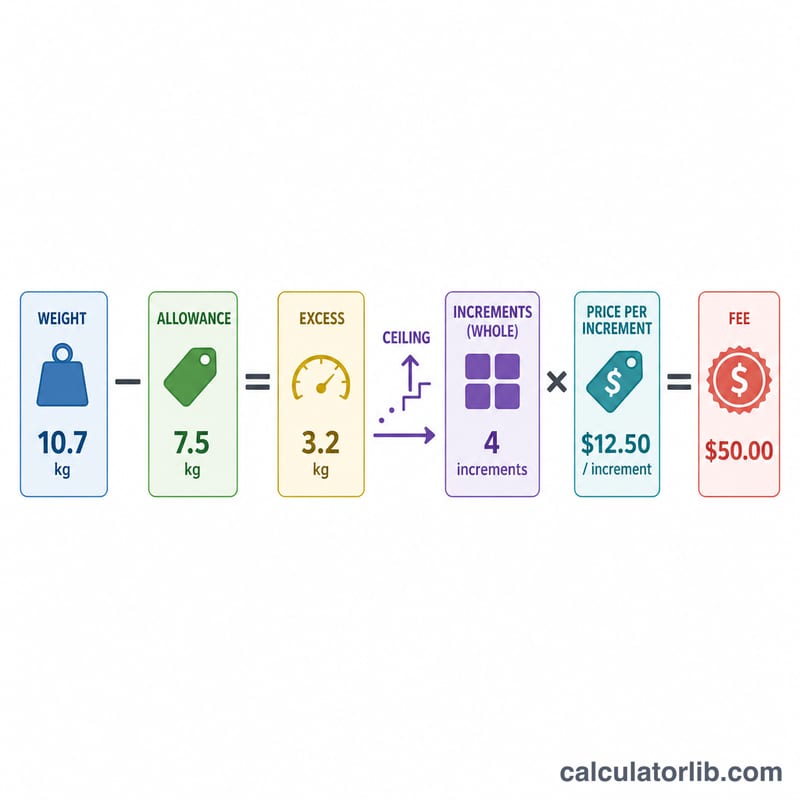
Enter your bag's actual weight, the airline's free allowance, the size of each fee step (the increment), and the charge applied per step. The calculator finds how much you are over, rounds the excess up to the next whole increment, and multiplies by the price per increment. Fee policies vary widely by airline, route, and fare class, so check your carrier's published rules; this tool is a universal estimator and not an official quote.
The Formula Explained
The core equation is $$\text{Fee} = \max\left(0, \left\lceil \frac{\text{Weight} - \text{Allowance}}{\text{Increment}} \right\rceil\right) \times \text{FeePerIncrement}$$ The difference between weight and allowance is divided by the increment to get how many steps you are over. The ceiling function rounds up because partial steps are still billed in full. The \(\max(0, \ldots)\) guard ensures bags at or under the allowance incur no fee.
Worked Example
Suppose your bag weighs 26 kg, the allowance is 23 kg, the increment is 1 kg, and the fee is 50 per increment. You are 3 kg over, which is 3 increments, so the fee is $$3 \times 50 = \mathbf{150}$$ If the bag weighed 23.4 kg instead, you would be 0.4 kg over — still 1 billable increment — for a fee of \(50\).
Kilogram to Pound Conversion for Baggage Limits
Airlines publish checked-bag limits in kilograms or pounds depending on the region. The table below uses 1 kg = 2.20462 lb and rounds to one decimal place.
| Weight (kg) | Weight (lb) |
|---|---|
| 7 kg | 15.4 lb |
| 10 kg | 22.0 lb |
| 15 kg | 33.1 lb |
| 20 kg | 44.1 lb |
| 23 kg | 50.7 lb |
| 30 kg | 66.1 lb |
| 32 kg | 70.5 lb |
In the other direction, the common pound-based limits are close to round kilogram figures: 50 lb is about 22.7 kg and 70 lb is about 31.8 kg. A bag of exactly 23 kg is therefore slightly heavier than a 50 lb limit (50.7 lb).
Keep units consistent: the bag weight, the free allowance and the fee increment must all be in the same unit (all kg or all lb). If your airline quotes an allowance in pounds but your scale shows kilograms, convert first, and if the increment is stated in kg (for example 1 kg or 5 kg), convert it as well.
Fee Scenarios Compared
The calculator applies the formula \(\text{Fee} = \lceil (\text{Weight} - \text{Allowance}) / \text{Increment} \rceil \times \text{Fee per Increment}\). If the bag is at or under the allowance, the excess is zero and no overweight fee applies. Any part of an increment is billed as a full increment (the ceiling function).
The figures below are illustrative only and are not any airline's actual rates. Both cases use a 23 kg allowance. Fees are in generic currency units.
| Bag weight (kg) | Excess (kg) | Case A: 1 kg increments billed | Case A fee (50 per 1 kg) | Case B: 5 kg bands billed | Case B fee (100 per 5 kg) |
|---|---|---|---|---|---|
| 22 | 0 | 0 | 0 | 0 | 0 |
| 24 | 1 | 1 | 50 | 1 | 100 |
| 26 | 3 | 3 | 150 | 1 | 100 |
| 30 | 7 | 7 | 350 | 2 | 200 |
Worked check for the 30 kg bag in Case B: excess = 30 − 23 = 7 kg; bands = \(\lceil 7 / 5 \rceil = \lceil 1.4 \rceil = 2\); fee = 2 × 100 = 200.
Takeaway: per-kg billing rewards trimming a few kilograms, while band billing charges the same for 1 kg or 5 kg over, so the first kilogram of excess can be expensive but small additional excess within the band costs nothing extra.
Typical Checked Baggage Weight Allowances
Allowances differ widely, but some ranges are commonly published by airlines worldwide:
- Economy fares that include a checked bag: usually about 20–23 kg per bag (roughly 44–50 lb).
- Premium economy, business and first class: often up to 32 kg per bag (about 70 lb).
- Heavier bags: many carriers refuse bags above 32 kg (70 lb) or require them to be shipped as cargo or handled specially, mainly for baggage-handler safety.
These figures are general patterns, not rules. The actual allowance depends on the airline, route, fare class, frequent-flyer status and sometimes the number of bags. Some fares include no checked bag at all. Always verify the current allowance, increment and fee with your carrier before travelling, and weigh your bag at home on a scale in the same unit the airline uses.
FAQ
Why is a 0.4 kg overage charged as a full increment? Most airlines round overage up to the next billing step, which is why the formula uses a ceiling function.
Does this give an official price? No. It is an estimate based on the figures you enter; always confirm with your airline.
What if my bag is under the allowance? The fee is 0 — the calculator never returns a negative charge.