
What is the MB to GB Converter?
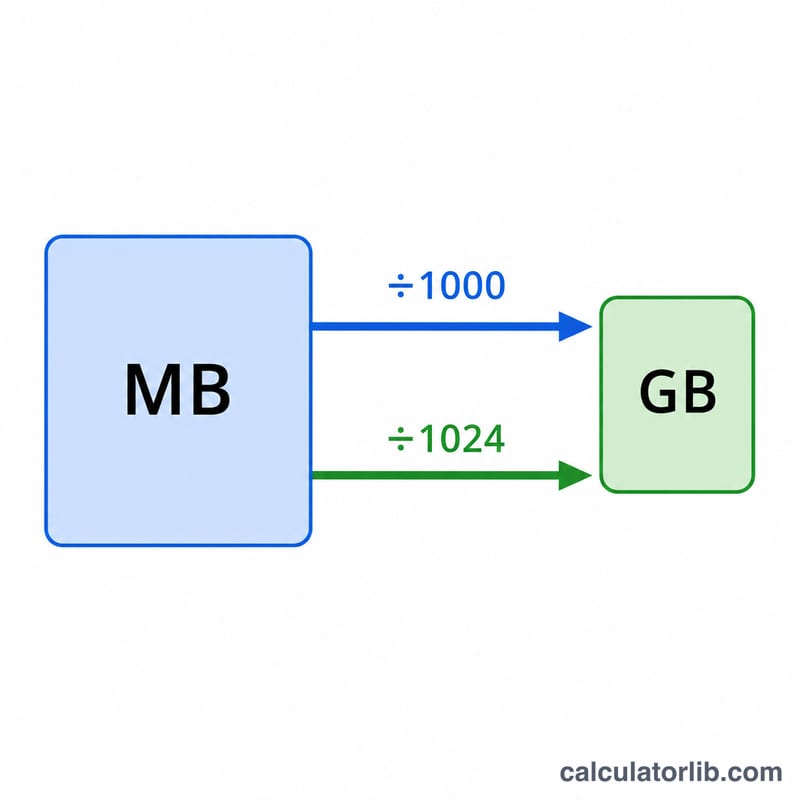
This tool converts a value in megabytes (MB) into gigabytes (GB). Because the computing industry uses two different conventions, the converter lets you choose between the decimal standard, where 1 GB equals 1000 MB, and the binary standard, where 1 GB equals 1024 MB. Storage makers and most modern operating systems use the decimal definition, while some software and memory specifications still use the binary one.
How to use it
Enter the number of megabytes you want to convert, pick the standard that matches your context, and read the result. If you are unsure, the decimal (\(\div 1000\)) option is the most common choice for file sizes and disk capacities.
The formula explained
The conversion is a simple division. Under the decimal standard you divide the megabytes by 1000; under the binary standard you divide by 1024. In symbols: $$\text{GB} = \frac{\text{Megabytes (MB)}}{1000}$$ or $$\text{GB} = \frac{\text{Megabytes (MB)}}{1024}$$ The binary result is slightly smaller for the same input because each gigabyte holds more megabytes.
Worked example
Suppose you have a 2048 MB file. Using the binary standard: $$2048 \div 1024 = 2 \text{ GB}$$ exactly. Using the decimal standard: $$2048 \div 1000 = 2.048 \text{ GB}$$ The choice of standard changes the displayed size even though the underlying data is identical.
FAQ
Which standard should I use? For disk and SSD capacities and most files, use decimal (\(\div 1000\)). For RAM and some technical specs, binary (\(\div 1024\)) is common.
Is GB the same as GiB? Strictly, the binary value (\(\div 1024\)) is a gibibyte (GiB), but it is widely labeled as GB in everyday use.
How many MB are in 1 GB? Either 1000 MB (decimal) or 1024 MB (binary), depending on the convention.