
What is the Overweight Calculator?
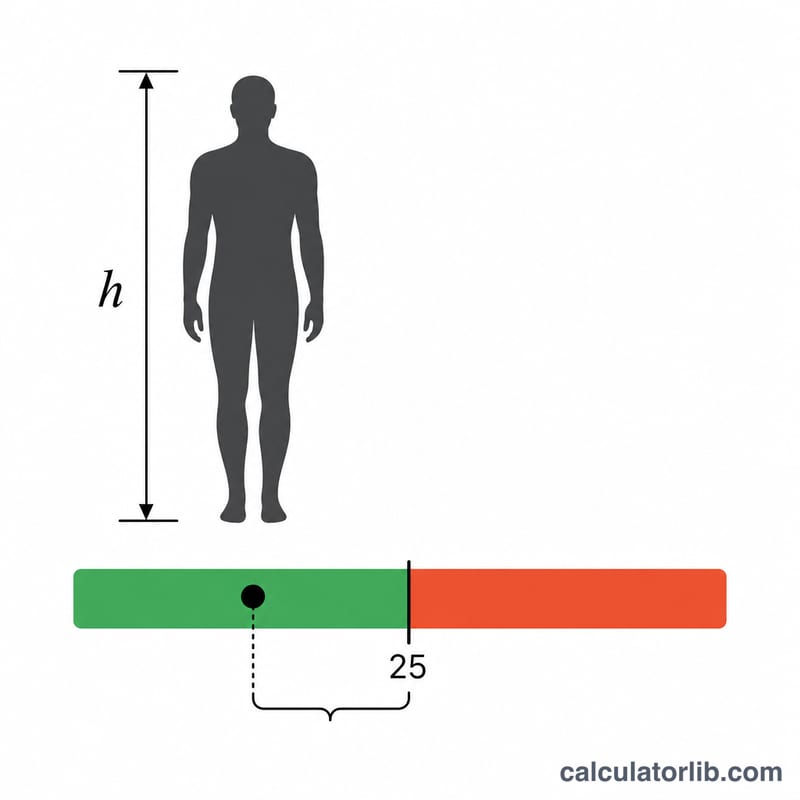
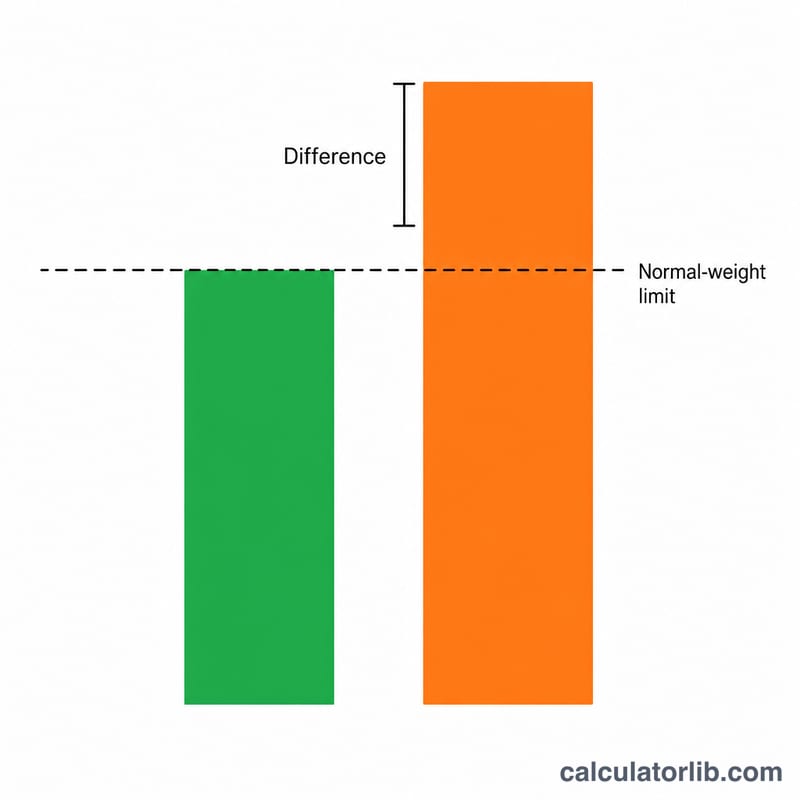
This tool estimates how many kilograms you weigh above the upper end of the healthy weight range for your height. A Body Mass Index (BMI) of 25 is widely used as the threshold between "normal" and "overweight," so the calculator finds the weight that corresponds to a BMI of exactly 25 and subtracts it from your current weight.
How to use it
Enter your current weight in kilograms and your height in centimetres. The calculator returns your excess weight (a positive number means you are above the normal range, a negative number means you are below the upper-normal weight), the upper-normal weight for your height, and your current BMI.
The formula explained
Height is first converted from centimetres to metres. The upper-normal weight is \(25 \times \text{height}^{2}\), because \(\text{BMI} = \text{weight} \div \text{height}^{2}\). Excess weight is simply your current weight minus that upper-normal weight.
$$\text{Excess} = \text{Weight (kg)} - 25 \times \left(\frac{\text{Height (cm)}}{100}\right)^{2}$$
Worked example
For someone weighing 85 kg at 170 cm: height = 1.70 m, so the upper-normal weight is $$25 \times 1.70^{2} = 25 \times 2.89 = 72.25 \text{ kg}.$$ Excess weight = $$85 - 72.25 = 12.75 \text{ kg}.$$ Their BMI is \(85 \div 2.89 \approx 29.41\).
FAQ
What does a negative result mean? It means you are below the upper-normal weight for your height — you have no excess weight by this measure.
Is BMI 25 always the right cutoff? BMI thresholds are general guidelines and do not account for muscle mass, age, or body composition. Use the result as a rough indicator only.
Does this replace medical advice? No. Consult a healthcare professional for personalised guidance.