
What Is the Rate Pressure Product?
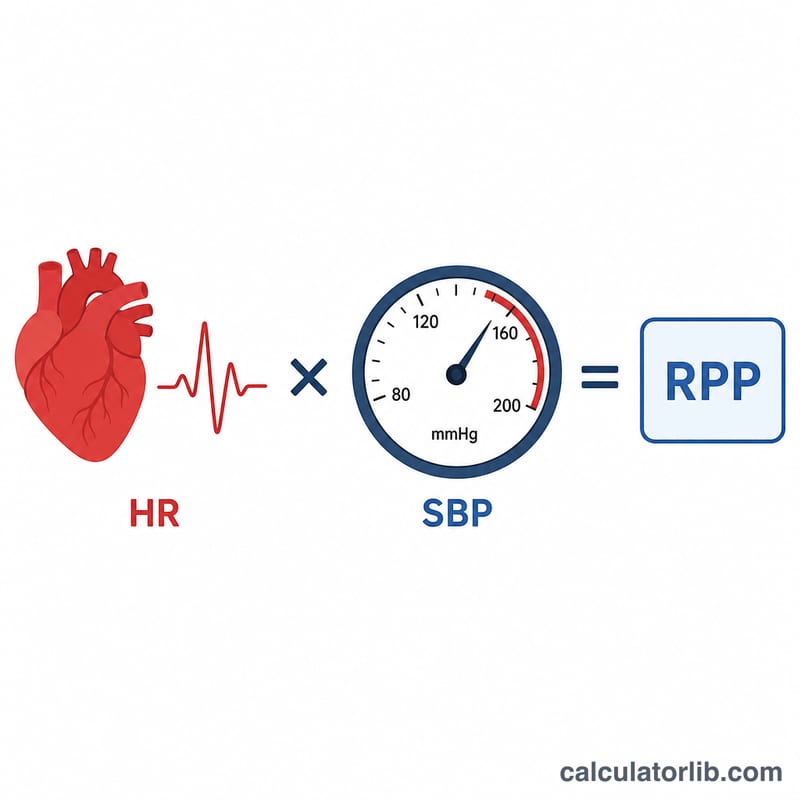
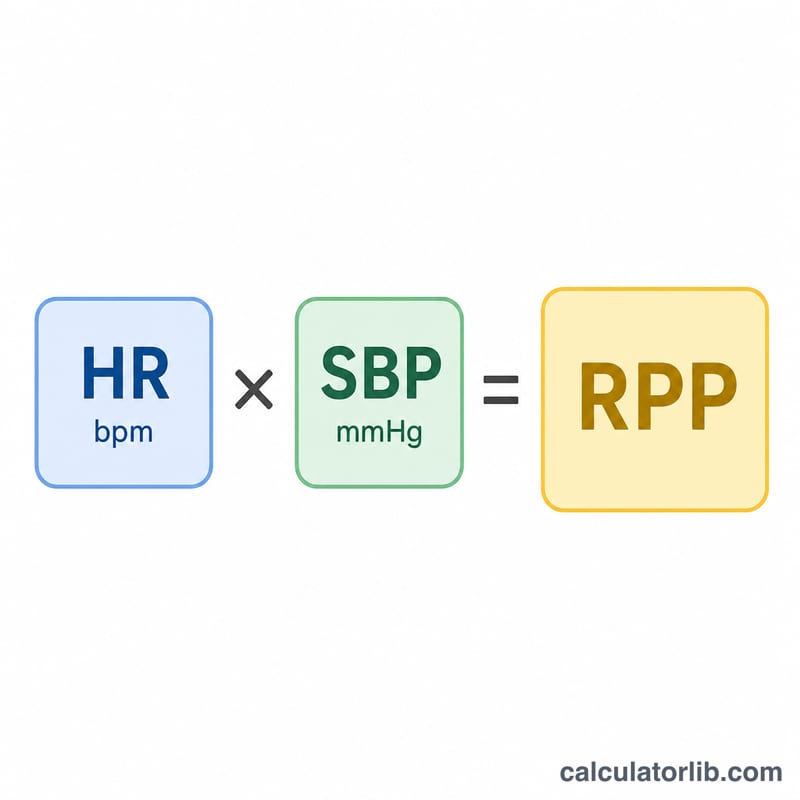
The Rate Pressure Product (RPP), also called the double product, is a simple index of cardiac workload and myocardial (heart muscle) oxygen demand. It is calculated by multiplying heart rate (HR) by systolic blood pressure (SBP). Because the heart's oxygen consumption rises with both how fast it beats and how hard it pumps, RPP gives clinicians and exercise physiologists a quick, non-invasive estimate of cardiovascular stress.
How to Use This Calculator
Enter your heart rate in beats per minute (bpm) and your systolic blood pressure (the top number of a blood pressure reading) in mmHg. The calculator multiplies the two values and displays the RPP. Resting values are typically around 6,000–10,000, while peak exercise values can exceed 25,000–35,000 in healthy adults.
The Formula Explained
The equation is straightforward:
$$\text{RPP} = \text{HR} \times \text{SBP}$$For example, a heart rate of 70 bpm and a systolic blood pressure of 120 mmHg give an RPP of \(70 \times 120 = 8{,}400\). There are no units beyond the product of mmHg and bpm; RPP is treated as a dimensionless workload index.
Worked Example
Suppose during a stress test a patient reaches a heart rate of 150 bpm and a systolic pressure of 180 mmHg. The RPP is
$$150 \times 180 = 27{,}000$$This high value reflects substantial myocardial oxygen demand at peak exertion.
FAQ
Is RPP the same as MVO2? RPP is a strong correlate and practical surrogate for myocardial oxygen consumption (MVO2), but it is an estimate rather than a direct measurement.
What is a normal resting RPP? A typical resting RPP is roughly 6,000–10,000, depending on individual fitness and physiology.
Can I use diastolic pressure instead? No—RPP specifically uses systolic blood pressure, which best reflects the pressure load on the heart during contraction.