
What Is the Fertility by Age Calculator?
This calculator estimates the typical chance of conceiving naturally per menstrual cycle and over a year, based on age. Female fertility declines gradually with age as the number and quality of eggs decrease, so age is one of the strongest predictors of how quickly conception is likely to occur. The figures here are population averages and are intended for general education only — they are not a medical diagnosis or a prediction for any individual.
How to Use It
Simply enter your age in years and press calculate. The tool returns two numbers: your estimated monthly (per-cycle) conception probability and the cumulative chance of conceiving within one year of trying. Use these as rough benchmarks, not guarantees.
The Formula Explained
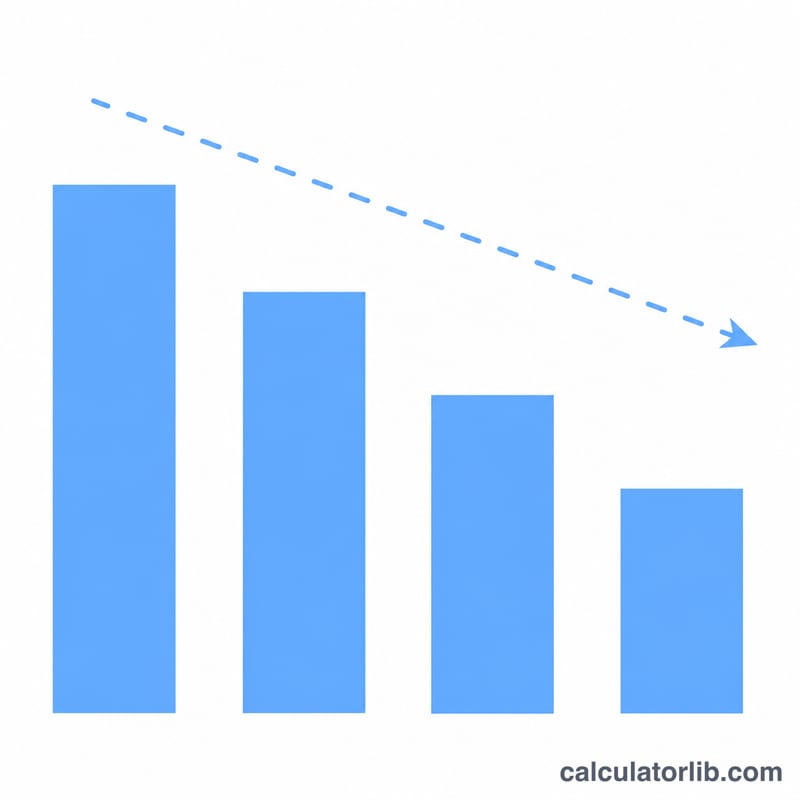
The monthly rate is assigned by age band: about 25% under 30, 15% from 30 to 34, 10% from 35 to 39, and 5% at 40 and over. To project a full year, the calculator assumes each cycle is an independent attempt and uses the cumulative probability formula \(P = 1 - (1 - p)^{12}\), where \(p\) is the monthly probability and 12 is the number of cycles.
$$P = 1 - (1 - p)^{12}$$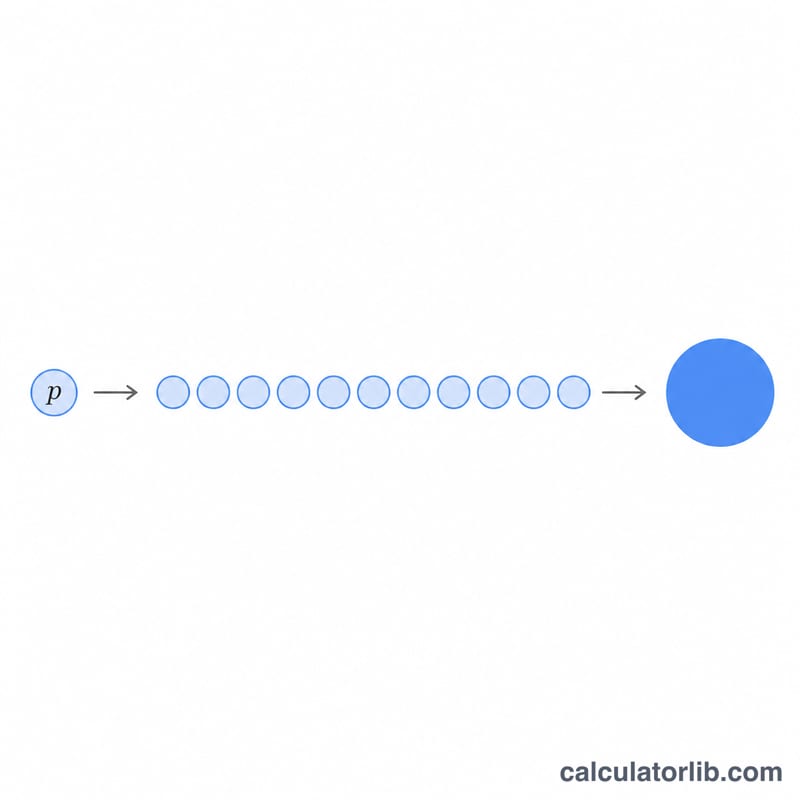
Worked Example
A 32-year-old falls in the 30–34 band, so her monthly rate is 15% (\(p = 0.15\)). Over a year the cumulative chance is
$$1 - (1 - 0.15)^{12} = 1 - 0.85^{12} \approx 1 - 0.1422 = 0.8578$$or about 85.8%.
FAQ
Are these numbers exact? No. They are simplified averages from fertility research; real odds depend on health, cycle regularity, partner fertility, and timing of intercourse.
Why does fertility drop after 35? Egg quantity and quality decline more rapidly after the mid-30s, lowering both conception rates and increasing miscarriage risk.
Should I see a doctor? If you are under 35 and have tried for 12 months, or 35+ and tried for 6 months, consult a fertility specialist for personalized assessment.