
What Is the Bird Age Calculator?
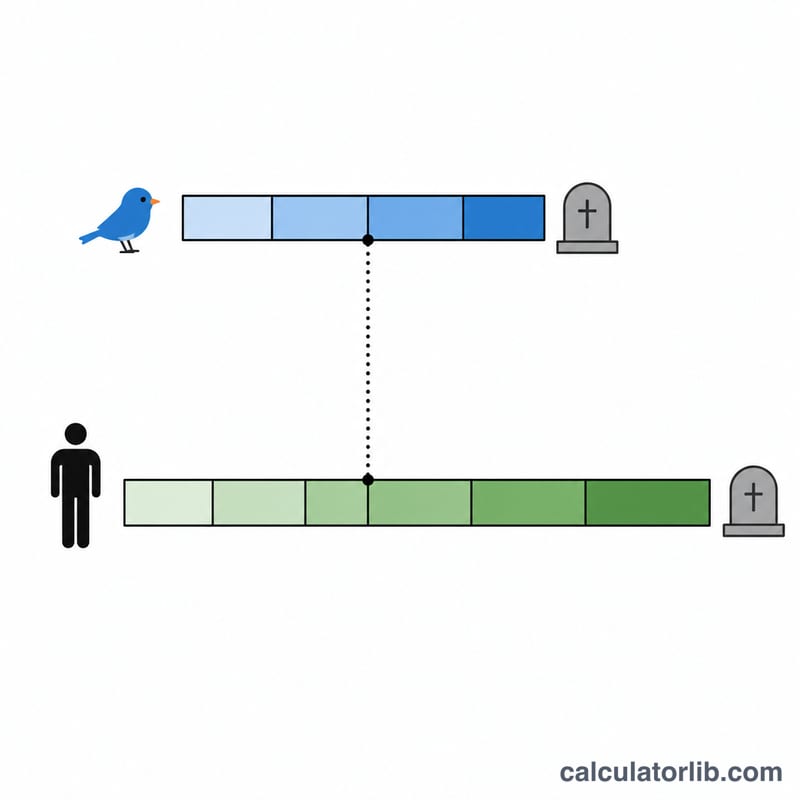
The Bird Age Calculator converts your feathered friend's chronological age into "human years" so you can intuitively understand its life stage. Because bird species vary enormously in lifespan — a budgie may live 8–12 years while a macaw can reach 50+ — a single conversion factor doesn't work. This tool scales age proportionally using your bird's species lifespan against a typical human lifespan.
How to Use It
Enter three values: your bird's current age in years, the average lifespan for its species, and a reference human lifespan (80 years is a common default). The calculator returns the equivalent human age plus the aging ratio — how many human years each bird year represents.
The Formula Explained
The core equation is $$\text{Human Years} = \text{Bird Years} \times \dfrac{\text{Human Lifespan}}{\text{Bird Species Lifespan}}$$. The fraction is the aging ratio: it answers "how many human years pass for every bird year?" Multiplying by the bird's age maps the same fraction of life lived onto a human timescale.
Worked Example
Imagine a cockatiel aged 4 years with a species lifespan of 16 years, compared to an 80-year human lifespan. The ratio is \(80 \div 16 = 5\), so each bird year equals 5 human years. The cockatiel's human-equivalent age is \(4 \times 5 = 20\) human years — a young adult.
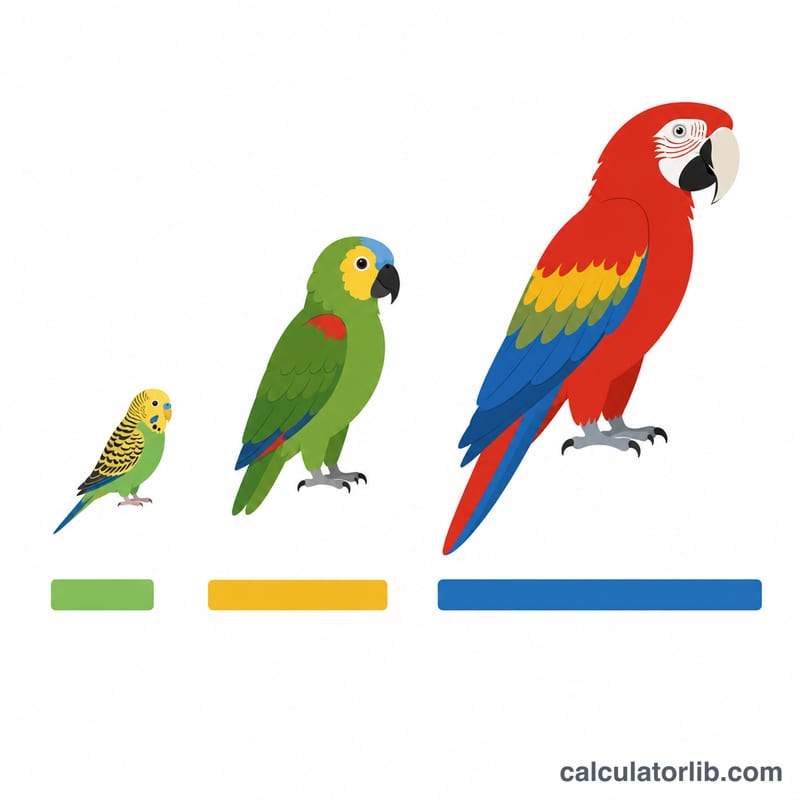
Typical Lifespans by Bird Species
The Bird Age Calculator scales your bird's age by the ratio of human lifespan to bird lifespan. To use it, you need a realistic figure for your bird's species lifespan under good care. The table below gives typical well-cared-for captive lifespan ranges you can plug into the birdLifespan field. Within a species, the upper end usually requires excellent diet, veterinary care, and a safe environment.
| Species | Typical captive lifespan (years) | Suggested value for birdLifespan |
|---|---|---|
| Finch | 5–10 | 8 |
| Canary | 8–12 | 10 |
| Budgie (parakeet) | 7–15 | 10 |
| Lovebird | 10–15 | 12 |
| Cockatiel | 15–20 | 18 |
| Conure | 20–30 | 25 |
| Amazon parrot | 40–60 | 50 |
| African grey | 40–60 | 50 |
| Macaw | 50–70 | 60 |
| Cockatoo | 40–70 | 60 |
Note: "Parakeet" most often refers to the budgerigar (budgie) in the United States, so the same lifespan applies. These are general guidance ranges, not guarantees — individual longevity depends heavily on diet, exercise, and care.
Bird Age vs Human Age Across Species
Because each species ages at a different pace, the same chronological age maps to very different human-equivalent ages. The table below compares several birds all at 4 years old, using a human lifespan of 80 years. The aging ratio is \(\frac{\text{Human Lifespan}}{\text{Bird Lifespan}}\), and the human-equivalent age is that ratio times the bird's age.
| Species | Bird lifespan (yr) | Aging ratio (80 ÷ lifespan) | Human-equivalent age at 4 yr |
|---|---|---|---|
| Finch | 8 | 10.0 | 40 years |
| Budgie | 10 | 8.0 | 32 years |
| Cockatiel | 18 | 4.44 | 17.8 years |
| Conure | 25 | 3.2 | 12.8 years |
| African grey | 50 | 1.6 | 6.4 years |
| Macaw | 60 | 1.33 | 5.3 years |
The pattern is clear: a 4-year-old finch is already middle-aged in human terms, while a 4-year-old macaw is still a young child. Short-lived birds compress a human lifetime into a decade, so their aging ratio is large; long-lived parrots have ratios close to 1, aging at a pace much closer to humans. For other companion animals, a similar lifespan-ratio idea drives the Cat Age Calculator and the combined Pet to Human Age Calculator.
FAQ
Is this scientifically exact? No. It is a proportional estimate. Real aging is non-linear (birds mature faster early in life), but proportional scaling gives a useful, intuitive figure.
What lifespan should I use for my species? Use the average lifespan for a well-cared-for captive bird of that species. Wild lifespans are often shorter.
Why 80 for human lifespan? It approximates global average life expectancy. You can adjust it to match any reference you prefer.