
What this calculator does
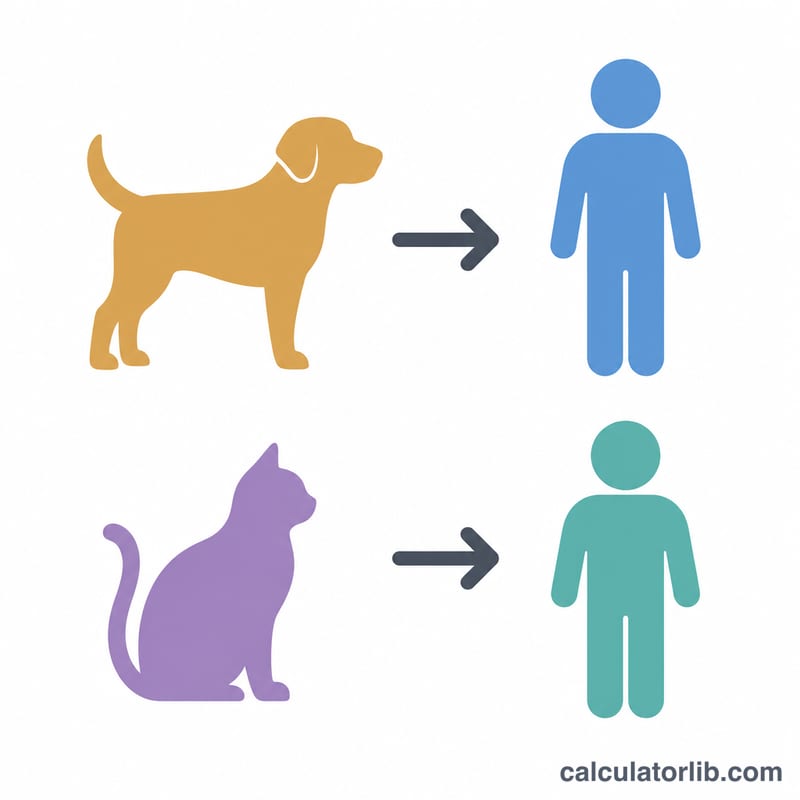
This tool converts the age of a dog or cat into the equivalent human age. Pets mature very quickly in their first two years and then age at a steadier rate, so a simple "multiply by seven" rule is misleading. This calculator uses a piecewise model that matches the conversion guideline published by Japan's Ministry of the Environment in its "Pet Food Guidelines". The underlying biology is not country-specific, so the calculator itself is universal; only the cited reference source is Japanese.
How to use it
Pick whether your animal is a small-to-medium dog or a cat (these share the same curve), or a large dog, which ages faster after reaching maturity. Then enter your pet's current age in years; fractional ages such as 0.5 are allowed. The result is the approximate equivalent human age in years. Cats should always use the small-to-medium option, as the guideline gives no separate cat-only curve.
The formula explained
For a small-to-medium dog or cat, the first year of life equals about 15 human years, the second year adds another 9 (so age 2 equals roughly 24 human years), and every year after that adds 4 human years. For a large dog, the first year equals about 12 human years, the second adds 7 (age 2 equals about 19), and each later year adds 7, reflecting the faster aging of large breeds.
$$\text{Human Age} = \begin{cases} 15\,a & 0 < a \le 1 \\[4pt] 15 + 9\,(a - 1) & 1 < a \le 2 \\[4pt] 24 + 4\,(a - 2) & a > 2 \end{cases} \quad\text{where } a = \text{Pet Age (yrs)}$$$$\text{Human Age} = \begin{cases} 12\,a & 0 < a \le 1 \\[4pt] 12 + 7\,(a - 1) & 1 < a \le 2 \\[4pt] 19 + 7\,(a - 2) & a > 2 \end{cases} \quad\text{where } a = \text{Pet Age (yrs)}$$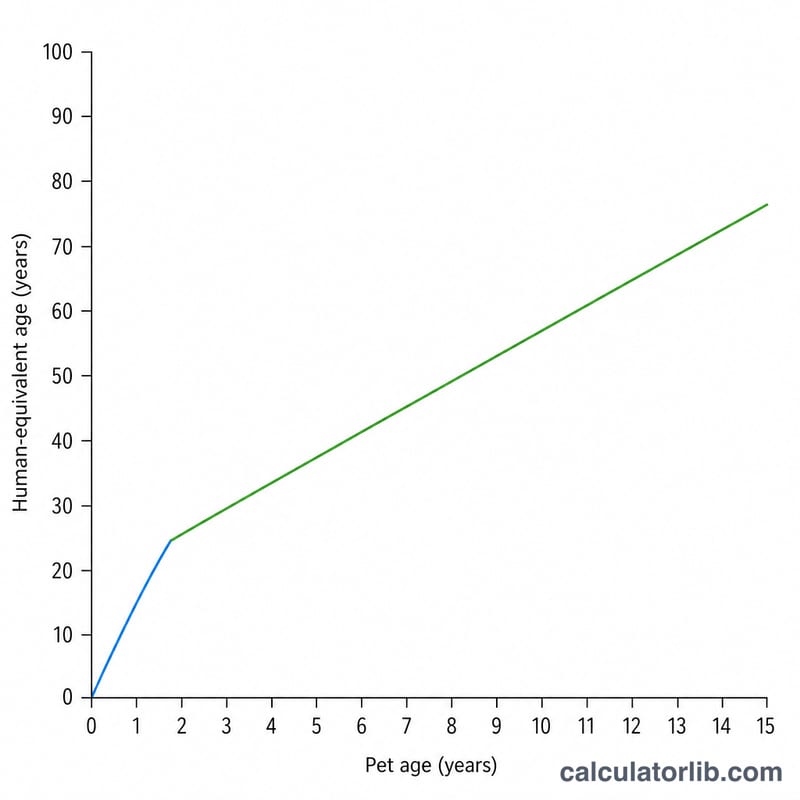
Worked example
A 13-year-old small or medium dog: $$24 + (13 - 2) \times 4 = 24 + 44 = 68 \text{ human years.}$$ A 13-year-old large dog: $$19 + (13 - 2) \times 7 = 19 + 77 = 96 \text{ human years.}$$ The same 13-year cat would be treated like the small/medium dog at 68 human years.
FAQ
Is this exact? No. It is an approximation; actual aging varies widely by breed, size, health and individual animal. Treat it as a rough guideline only.
Why are large dogs older in human years? Larger breeds tend to have shorter lifespans and age more rapidly after maturity, which is why their per-year increment is higher.
What about very old pets? Beyond about 24 years the model is extrapolated linearly and should be interpreted with extra caution.