
What is the Hexagon Calculator?
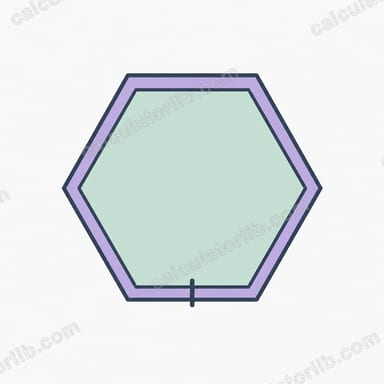
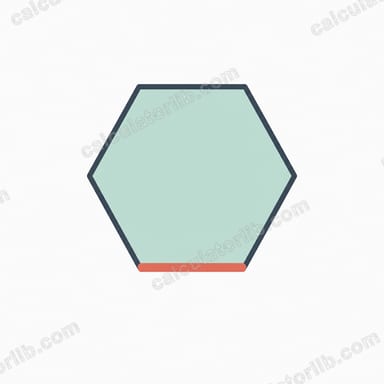
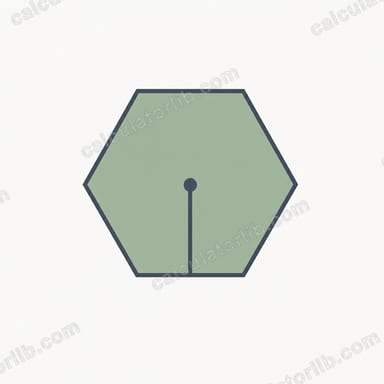
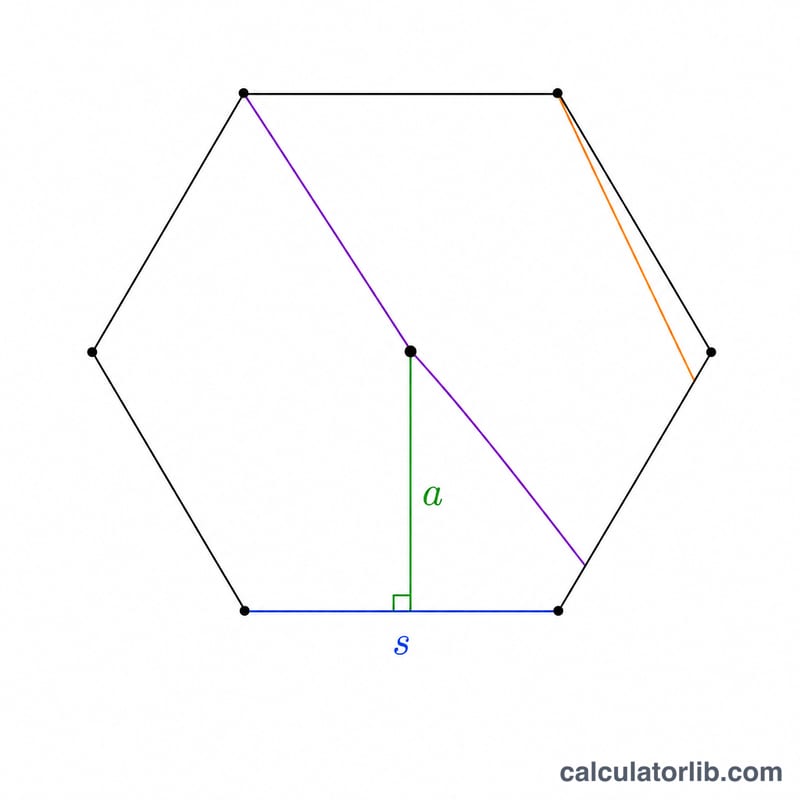
This tool computes the key measurements of a regular hexagon — a six-sided polygon where every side and every interior angle is equal. From a single input, the side length s, it instantly returns the area, perimeter, apothem (the distance from the centre to the midpoint of a side), and the long diagonal that crosses the shape through its centre.
How to use it
Enter the side length of your hexagon in any unit (cm, m, inches — the results use the same unit). Press calculate and you'll see the area in square units along with the perimeter, apothem and long diagonal. Because a regular hexagon is fully defined by one side, no other measurements are needed.
The formulas explained
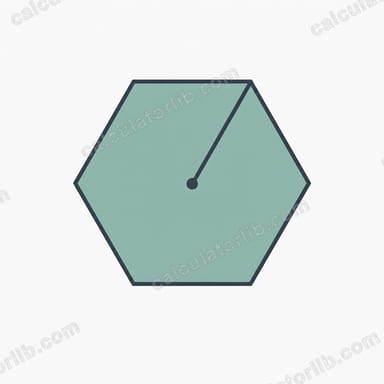
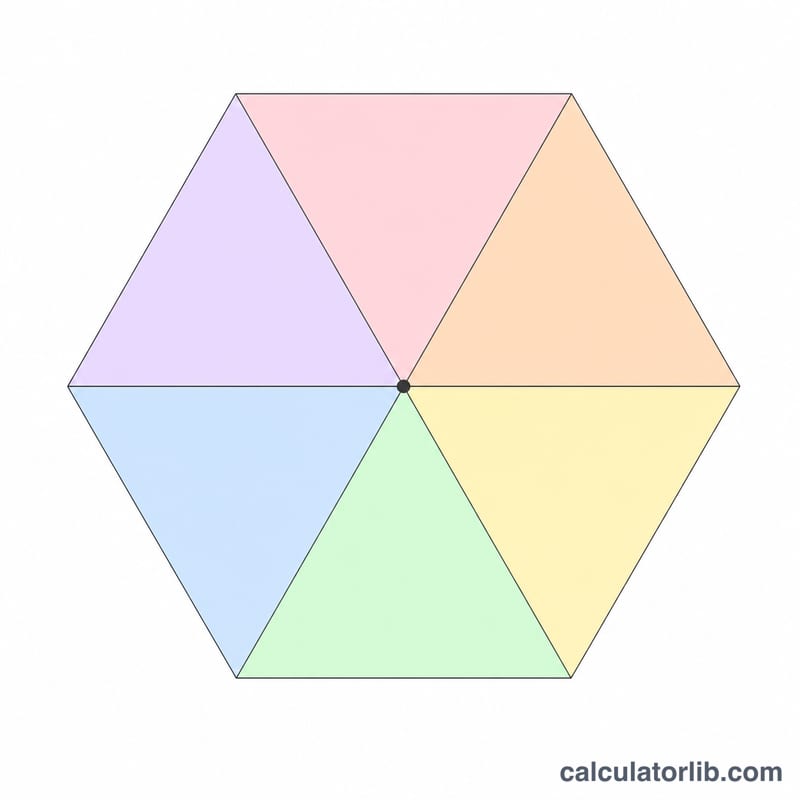
A regular hexagon can be split into six identical equilateral triangles meeting at the centre. Each triangle has area \(\frac{\sqrt{3}}{4}s^{2}\), so six of them give the area \(A = \frac{3\sqrt{3}}{2}s^{2}\). The perimeter is simply six sides, \(P = 6s\). The apothem equals the height of one of those equilateral triangles, \(a = \frac{\sqrt{3}}{2}s\). The long diagonal spans two side lengths, \(d = 2s\), because opposite vertices are exactly two radii apart and the circumradius equals the side length.
Worked example
For a hexagon with side s = 10:
$$A = \frac{3\sqrt{3}}{2}\cdot 100 \approx 259.81 \text{ square units}$$$$P = 6\cdot 10 = 60 \text{ units}$$$$a = \frac{\sqrt{3}}{2}\cdot 10 \approx 8.66 \text{ units}$$$$d = 2\cdot 10 = 20 \text{ units}$$FAQ
Does this work for irregular hexagons? No. These formulas only hold for a regular hexagon where all sides and angles are equal.
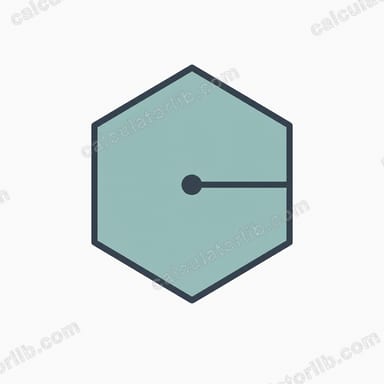
What is the difference between the apothem and the radius? The apothem reaches the midpoint of a side, while the circumradius reaches a vertex. For a regular hexagon the circumradius equals the side length \(s\).
What are the interior angles? Each interior angle of a regular hexagon is 120°, and the angles sum to 720°.