What is the Regular Hexagon Area Calculator?
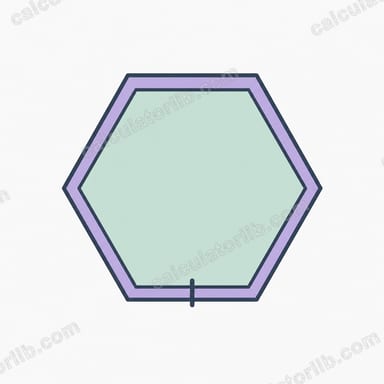
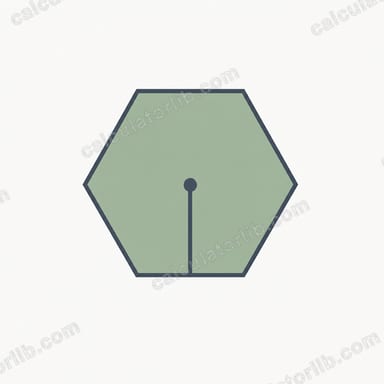
A regular hexagon is a six-sided polygon where every side and every interior angle is equal. This calculator finds its area directly from the length of one side, and as a bonus also returns the perimeter and the apothem (the distance from the center to the midpoint of a side). It works with any consistent unit — centimeters, meters, inches — and the area is simply expressed in those units squared.
How to use it
Enter the side length s of your hexagon and press calculate. The tool computes the area using the exact closed-form formula, so there is no need to split the shape into triangles by hand. Because a regular hexagon is made of six identical equilateral triangles, the result is always reliable for any positive side value you provide.

The formula explained
The area of a regular hexagon is:
$$A = \frac{3\sqrt{3}}{2}\,s^{2}$$
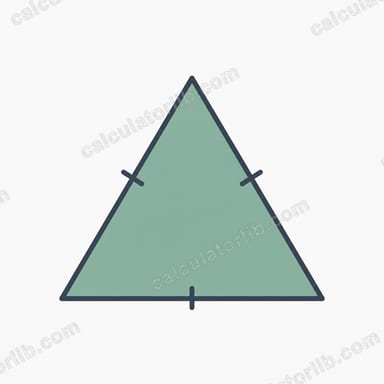
This comes from the fact that a regular hexagon can be divided into six equilateral triangles of side s. Each triangle has area \(\frac{\sqrt{3}}{4}\,s^{2}\), and six of them give \(6 \times \frac{\sqrt{3}}{4}\,s^{2} = \frac{3\sqrt{3}}{2}\,s^{2}\). The perimeter is simply \(P = 6s\), and the apothem is \(a = \frac{\sqrt{3}}{2}\,s\).
Worked example
Suppose the side length is \(s = 10\). Then \(s^{2} = 100\), and $$A = \frac{3\sqrt{3}}{2} \times 100 = 150\sqrt{3} \approx 259.81 \text{ square units}.$$ The perimeter is \(6 \times 10 = 60\) units and the apothem is \(\frac{\sqrt{3}}{2} \times 10 \approx 8.66\) units.

Other Regular Hexagon Formulas (From Apothem, Radius or Diagonal)
A regular hexagon is fully determined by any one of its linear measurements, so every other quantity follows from a fixed ratio. If you know something other than the side, convert it to the side length \(s\) and feed that into \(A = \frac{3\sqrt{3}}{2}s^{2}\) — or use the direct area formula in the last column. These are pure geometric identities and apply to any regular (equilateral, equiangular) hexagon in any unit system; the area comes out in the square of whatever length unit you put in.
| Known measurement | Relation to side \(s\) | Side from it | Area directly | Area coefficient (decimal) |
|---|---|---|---|---|
| Side \(s\) (edge) | — | \(s\) | \(A = \frac{3\sqrt{3}}{2}s^{2}\) | \(2.598076\,s^{2}\) |
| Apothem \(a\) (centre to edge midpoint; inradius, half the across-flats width) | \(a = \frac{\sqrt{3}}{2}s\) | \(s = \frac{2a}{\sqrt{3}} \approx 1.154701\,a\) | \(A = 2\sqrt{3}\,a^{2}\) | \(3.464102\,a^{2}\) |
| Circumradius \(R\) (centre to vertex; half the long diagonal) | \(R = s\) | \(s = R\) | \(A = \frac{3\sqrt{3}}{2}R^{2}\) | \(2.598076\,R^{2}\) |
| Long diagonal \(d\) (vertex to opposite vertex; across-corners width) | \(d = 2s\) | \(s = \frac{d}{2}\) | \(A = \frac{3\sqrt{3}}{8}d^{2}\) | \(0.649519\,d^{2}\) |
| Short diagonal \(w\) (vertex to next-but-one vertex; across-flats width) | \(w = \sqrt{3}\,s = 2a\) | \(s = \frac{w}{\sqrt{3}} \approx 0.577350\,w\) | \(A = \frac{\sqrt{3}}{2}w^{2}\) | \(0.866025\,w^{2}\) |
| Perimeter \(P\) | \(P = 6s\) | \(s = \frac{P}{6}\) | \(A = \frac{\sqrt{3}}{24}P^{2}\) | \(0.072169\,P^{2}\) |
Note the two "widths" that are easy to confuse: the across-flats distance \(w = \sqrt{3}\,s\) (what a caliper or wrench spans on a hexagonal bar or nut) is the short diagonal, while the across-corners distance \(d = 2s\) is the long diagonal. Their ratio is \(d/w = 2/\sqrt{3} \approx 1.1547\).
The general regular-polygon identity
Every regular polygon — hexagon included — satisfies
$$A = \tfrac{1}{2}\,P\,a$$where \(P\) is the perimeter and \(a\) the apothem. For a hexagon, substituting \(P = 6s\) and \(a = \frac{\sqrt{3}}{2}s\) recovers the main formula:
$$A = \tfrac{1}{2}\,(6s)\!\left(\frac{\sqrt{3}}{2}s\right) = \frac{3\sqrt{3}}{2}s^{2}$$Worked conversion: from an across-flats measurement
Suppose you measure a hexagonal bar and the across-flats width is \(w = 12\) cm. First convert to the side:
$$s = \frac{w}{\sqrt{3}} = \frac{12}{1.732051} = 6.9282\ \text{cm}$$Then the area, either way:
$$A = \frac{\sqrt{3}}{2}w^{2} = 0.866025 \times 144 = 124.71\ \text{cm}^{2}$$Checking with the side-based formula gives the same answer, \(A = 2.598076 \times 6.9282^{2} = \) 124.71 cm². The apothem is simply half the across-flats width, \(a = 6\) cm, and the perimeter is \(P = 6 \times 6.9282 = 41.569\) cm — which satisfies the identity above: \(\tfrac{1}{2} \times 41.569 \times 6 = 124.71\) cm².
FAQ
Does this work for irregular hexagons? No — the formula applies only to regular hexagons where all sides and angles are equal. Irregular hexagons must be split into triangles individually.
What units does the result use? Whatever unit you used for the side. If the side is in cm, the area is in cm².
What is the apothem used for? The apothem is handy because area can also be written as \(A = \frac{1}{2} \times \text{perimeter} \times \text{apothem}\), a formula that works for any regular polygon.