
What is the Right Triangle Area Calculator?
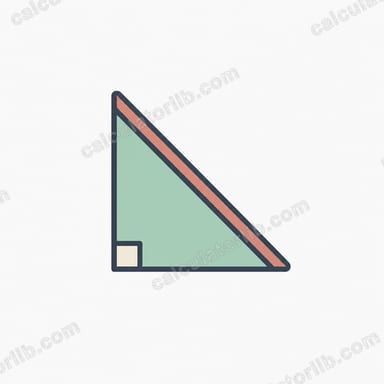
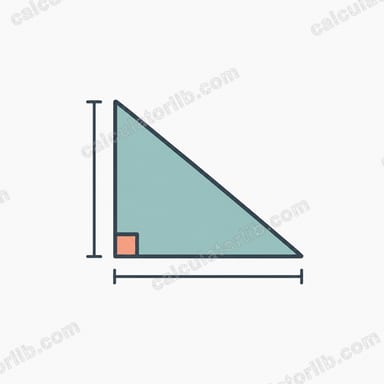
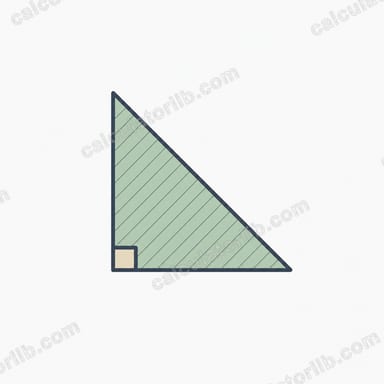
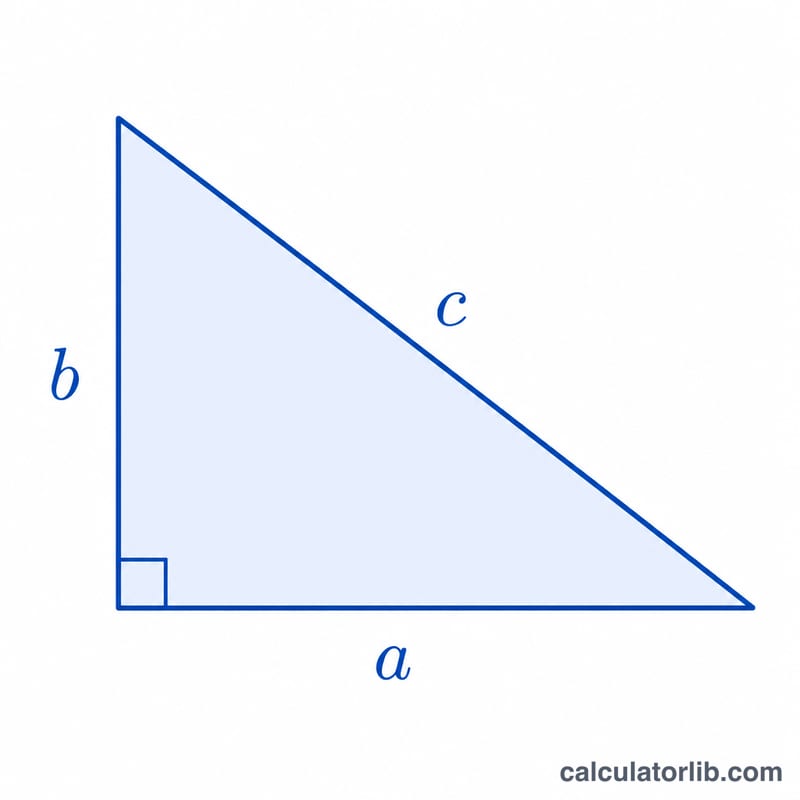
A right triangle has one 90° angle. The two sides that meet at that right angle are called the legs (a and b), and the longest side opposite the right angle is the hypotenuse. Because the two legs are perpendicular, one acts as the base and the other as the height, so the area is simply half their product. This calculator computes the area from the two legs and also reports the hypotenuse and perimeter.
How to use it
Enter the lengths of the two legs, a and b, in any consistent unit (cm, m, inches, etc.). The result is the area in those units squared. The tool also gives the hypotenuse and the full perimeter for convenience.
The formula explained
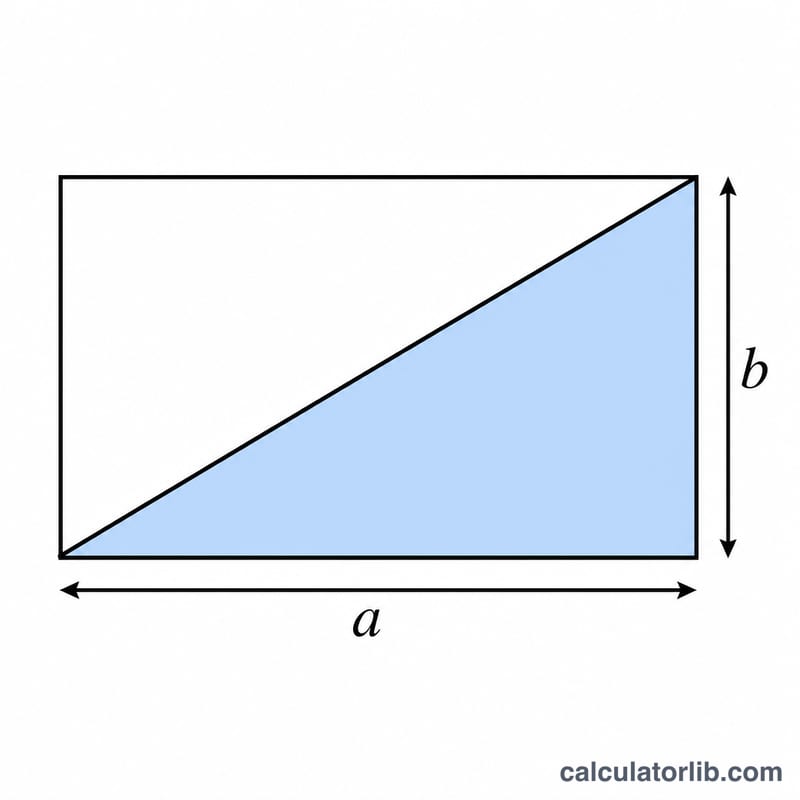
The general triangle area is \(A = \tfrac{1}{2} \times \text{base} \times \text{height}\). In a right triangle the two legs are perpendicular, so they already form the base and height:
$$A = \frac{1}{2} \cdot a \cdot b$$
The hypotenuse follows from the Pythagorean theorem, \(c = \sqrt{a^2 + b^2}\), and the perimeter is \(a + b + c\).
Worked example
Suppose a = 3 and b = 4. The area is $$\frac{1}{2} \times 3 \times 4 = 6 \text{ square units}.$$ The hypotenuse is \(\sqrt{3^2 + 4^2} = \sqrt{25} = 5\), and the perimeter is \(3 + 4 + 5 = 12\).
FAQ
Do I need the hypotenuse to find the area? No. The area only depends on the two legs, since they are perpendicular.
What units should I use? Any unit works, as long as both legs use the same one. The area comes out in that unit squared.
Can I use this for a non-right triangle? No. This formula relies on the two given sides being perpendicular. For other triangles use base × height ÷ 2 or Heron's formula.