What this calculator does
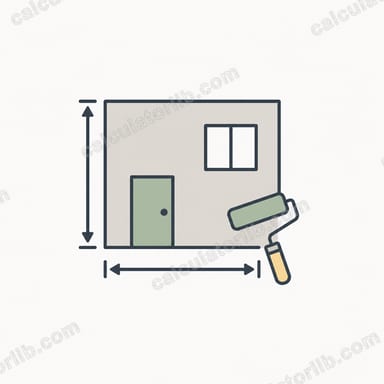
The Wall Paint Surface Area Calculator estimates the total paintable wall area of a rectangular room and converts it into the number of gallons of paint you need. It starts from the room's perimeter and wall height, then subtracts the area taken up by doors and windows so you don't overbuy. Measurements use feet, the common unit on paint can coverage labels.
How to use it
Enter the room's length, width and wall height in feet. Add how many standard doors and windows the walls contain. Set the paint coverage rate printed on your can (typically 350–400 sq ft per gallon for one coat). The calculator returns the gross wall area, the area deducted for openings, the net paintable area, and the gallons needed for one coat.

The formula explained
The four walls form a band around the room. Its area equals the perimeter, \(2(l + w)\), times the wall height \(h\). From this gross figure we subtract the openings. This tool assumes each door is \(3\,\text{ft} \times 7\,\text{ft} = 21\,\text{sq ft}\) and each window is \(3\,\text{ft} \times 5\,\text{ft} = 15\,\text{sq ft}\). The net area divided by the coverage rate gives gallons.
$$\text{Gallons} = \frac{2\,(L + W)\,H - O}{C}$$$$\text{where}\quad \left\{ \begin{aligned} L &= \text{Length (ft)} \\ W &= \text{Width (ft)} \\ H &= \text{Height (ft)} \\ O &= 21\,\text{Doors} + 15\,\text{Windows} \\ C &= \text{Coverage (sq ft/gal)} \end{aligned} \right.$$
Worked example
A 12 ft × 10 ft room with 8 ft walls has a perimeter of \(2(12 + 10) = 44\,\text{ft}\), so the gross area is \(44 \times 8 = 352\,\text{sq ft}\). With 1 door (21) and 2 windows (30), openings total 51 sq ft, leaving a net 301 sq ft. At 350 sq ft per gallon that's about 0.86 gallons for one coat — round up to 1 gallon, or 2 for a second coat.
$$\frac{352 - 51}{350} = \frac{301}{350} \approx 0.86\ \text{gallons}$$
Paint Needed for Common Room Sizes
The table assumes 8 ft ceilings, a standard door of 21 sq ft, a standard window of 15 sq ft, and coverage of 350 sq ft per gallon per coat. Gross wall area is \(2(L+W)H\). Net area is gross area minus openings. Gallons are net area divided by 350 (doubled for two coats). The door and window counts are example assumptions, so adjust them for your room.
| Room (L × W) | Doors / Windows | Gross area (sq ft) | Openings deducted (sq ft) | Net area (sq ft) | Gallons, 1 coat | Gallons, 2 coats |
|---|---|---|---|---|---|---|
| 10 × 10 ft | 1 / 1 | 320 | 36 | 284 | 0.81 | 1.62 |
| 12 × 10 ft | 1 / 2 | 352 | 51 | 301 | 0.86 | 1.72 |
| 14 × 12 ft | 2 / 2 | 416 | 72 | 344 | 0.98 | 1.97 |
| 16 × 14 ft | 2 / 3 | 480 | 87 | 393 | 1.12 | 2.25 |
Worked example for the 14 × 12 ft room: gross area \(= 2(14+12)\times 8 = 416\) sq ft; openings \(= 21\times 2 + 15\times 2 = 72\) sq ft; net area \(= 416 - 72 = 344\) sq ft; one coat \(= 344 \div 350 \approx 0.98\) gallons; two coats \(= 688 \div 350 \approx 1.97\) gallons.
Practical Painting Tips
- Round up. Paint is sold in whole gallons (and quarts), so round the result up to the next whole gallon.
- Add about 10% extra for touch-ups, spills, roller and tray absorption, and waste. In the 14 × 12 ft example, two coats need 1.97 gallons, or about 2.2 gallons with 10% extra, so plan on 3 gallons or 2 gallons plus a quart.
- Double for two coats. Most color changes and many finishes need two coats. Multiply the one-coat figure by 2.
- Prime when needed. Use primer on new drywall, patched areas, stains, or when covering a dark color with a light one. Primer is a separate coat that needs its own quantity.
- Expect lower coverage on rough or porous surfaces. Textured walls, raw plaster, brick, and unsealed surfaces soak up more paint, so coverage can fall well below 350 sq ft per gallon. Enter a lower coverage value in the calculator.
- Keep the batch consistent. Buy all the paint for a room at the same time, or mix cans together ("boxing") so slight batch-to-batch color differences don't show.
- Calculate ceilings and trim separately. This calculator covers walls only. Ceiling area is length × width, and trim, baseboards, and doors are usually painted with a different product and finish.
- Check the can. Manufacturers state a coverage rate for each product, so use that figure when it differs from 350.
Standard Values Used
| Item | Value |
|---|---|
| Standard door | 3 ft × 7 ft = 21 sq ft |
| Standard window | 3 ft × 5 ft = 15 sq ft |
| Typical paint coverage | 350–400 sq ft per gallon per coat |
| Common ceiling height | 8 ft (9–10 ft in some homes) |
| Volume | 1 gallon = 4 quarts |
These are typical figures, mainly for US-style room dimensions and gallons. Measure your actual doors and windows if they differ from the standard sizes. Coverage depends on the product and the surface.
FAQ
Should I round up the gallons? Yes. Always round up to the next whole can and double the figure if you plan two coats.
What if my openings are unusual sizes? The tool uses standard door/window sizes. For large picture windows or sliding doors, treat them as extra openings or subtract a custom area manually.
Does this include the ceiling? No — it covers only the four walls. Add the ceiling area (length × width) separately if you're painting it.