
What is the UTC to CET Converter?
This tool converts a time given in Coordinated Universal Time (UTC) into Central European Time (CET). CET is the standard time zone used across much of continental Europe — including Germany, France, Italy, Spain, Poland and others — and is exactly one hour ahead of UTC (UTC+1). Note that during summer many of these countries switch to Central European Summer Time (CEST, UTC+2); this converter uses standard CET (UTC+1).
How to use it
Enter the UTC hour (0–23) and minute (0–59). The calculator adds one hour and displays the equivalent CET clock time in 24-hour format. If adding an hour crosses midnight, it flags that the CET time falls on the next day.
The formula explained
The conversion is simply \(\text{CET} = \text{UTC} + 1\ \text{hour}\). To handle minutes and day wrap-around, the time is converted to total minutes since midnight, 60 minutes are added, and the result is taken modulo 1440 (the number of minutes in a day).
$$\text{CET} = \left( \text{UTC Hour} \times 60 + \text{UTC Minute} + 60 \right) \bmod 1440$$The CET hour and minute are then recovered as:
$$\begin{gathered} T = \left( \text{UTC Hour} \times 60 + \text{UTC Minute} + 60 \right) \bmod 1440 \\[1.5em] \text{where}\quad \left\{ \begin{aligned} \text{CET Hour} &= \left\lfloor \frac{T}{60} \right\rfloor \\ \text{CET Minute} &= T \bmod 60 \end{aligned} \right. \end{gathered}$$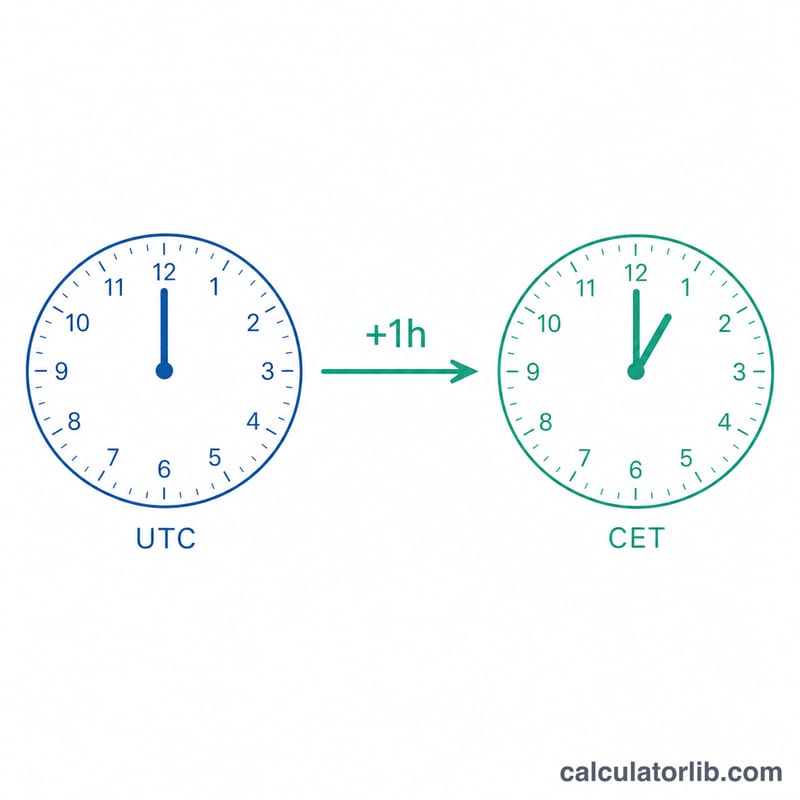
Worked example
Suppose the UTC time is 23:30. Adding one hour gives \(00{:}30\) — and because we passed midnight, the CET time is 00:30 on the next day. For a daytime example, 14:15 UTC becomes 15:15 CET on the same day.
$$\left( 23 \times 60 + 30 + 60 \right) \bmod 1440 = 1470 \bmod 1440 = 30 \;\Rightarrow\; 00{:}30$$For the daytime case:
$$\left( 14 \times 60 + 15 + 60 \right) \bmod 1440 = 915 \bmod 1440 = 915 \;\Rightarrow\; 15{:}15$$FAQ
Is CET the same all year? No. CET (UTC+1) applies in winter; in summer most of the region observes CEST (UTC+2). This tool assumes standard CET.
What if my UTC time is 23:xx? Adding one hour rolls over into the next calendar day, which the result notes as "next day".
Does this account for seconds? No, conversion is done to the minute, which is sufficient for clock-time scheduling.