

What Is the CET to EST Converter?
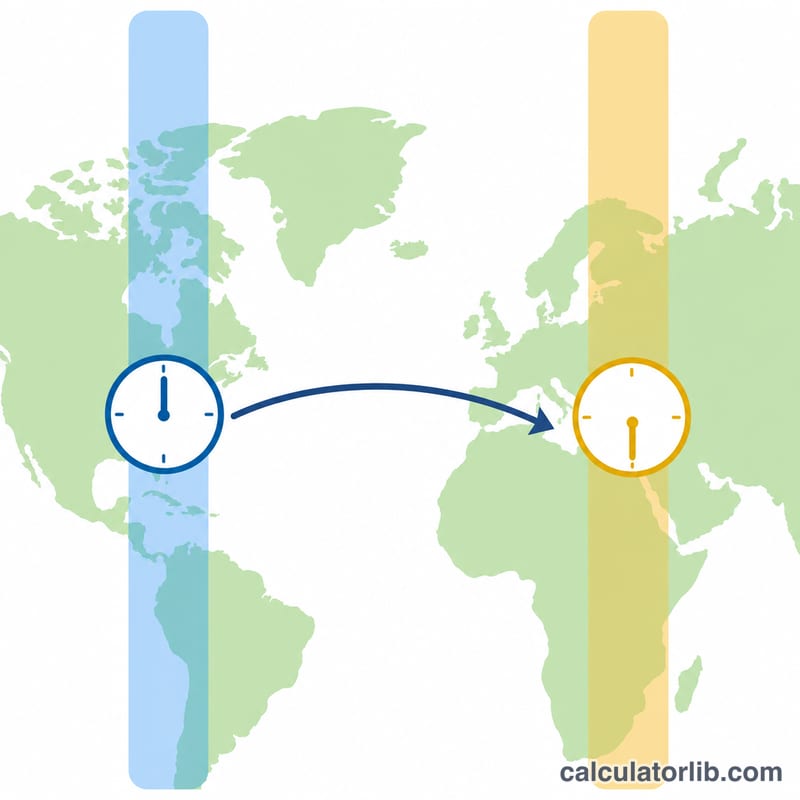
This tool converts a time given in Central European Time (CET) to Eastern Standard Time (EST). CET is the standard winter time zone used across much of mainland Europe — including cities like Paris, Berlin, Madrid, and Rome — and sits at UTC+1. EST is the standard winter time zone for the eastern United States and Canada (New York, Toronto, Miami) at UTC-5. Because the two zones are six hours apart, you simply subtract 6 hours from a CET time to get the EST equivalent.
How to Use It
Enter the hour (0–23, in 24-hour format) and minutes of your CET time, then read the converted EST time below. If subtracting 6 hours rolls the clock back past midnight, the result is shown as the previous day.
The Formula Explained
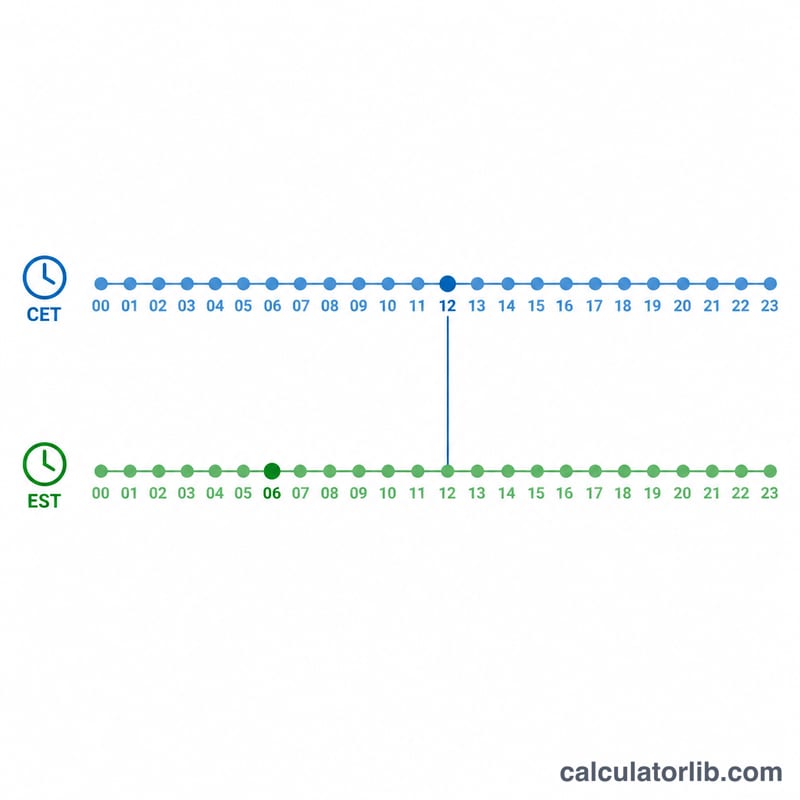
The conversion is purely an offset calculation: EST = CET − 6 hours. Since CET = UTC+1 and EST = UTC−5, the gap is \(1 - (-5) = 6\) hours. We compute the EST hour with modulo-24 arithmetic so that negative results wrap correctly (for example, 03:00 CET becomes 21:00 EST on the previous day). The full formula is:
$$\text{EST} = \left(\left(\text{Hour (CET)} - 6\right) \bmod 24\right) : \text{Minute}$$
Worked Example
Suppose a meeting is scheduled for 15:30 CET. Subtract 6 hours: \(15 - 6 = 9\), so the meeting is at 09:30 EST. For 02:00 CET, \(2 - 6 = -4\), which wraps to 20:00 — that is 20:00 EST on the previous day.
FAQ
Does this account for daylight saving time? No. This converter uses the fixed standard-time offset (CET vs EST). During summer, Europe uses CEST (UTC+2) and the US uses EDT (UTC-4), which keeps the difference at 6 hours, but the labels change.
Is CET always 6 hours ahead of EST? When both regions are on standard time, yes. The gap can briefly differ during the few weeks each spring/autumn when the two regions switch clocks on different dates.
Which cities use CET and EST? CET: Paris, Berlin, Madrid, Rome, Warsaw. EST: New York, Washington D.C., Toronto, Atlanta, Miami.