
What is the Decimal Time to Hours and Minutes Converter?
Timesheets, payroll systems, and spreadsheets often record time as a decimal number — for example 2.75 hours instead of 2 hours 45 minutes. This converter turns those decimal hours back into a familiar hours-and-minutes format so you can read durations naturally, double-check pay, or write clear schedules.
How to use it
Enter the decimal hours value into the box and submit. The calculator separates the whole-number part (the hours) from the fractional part, then converts that fraction into minutes. The result shows the equivalent hours and minutes along with the total number of minutes.
The formula explained
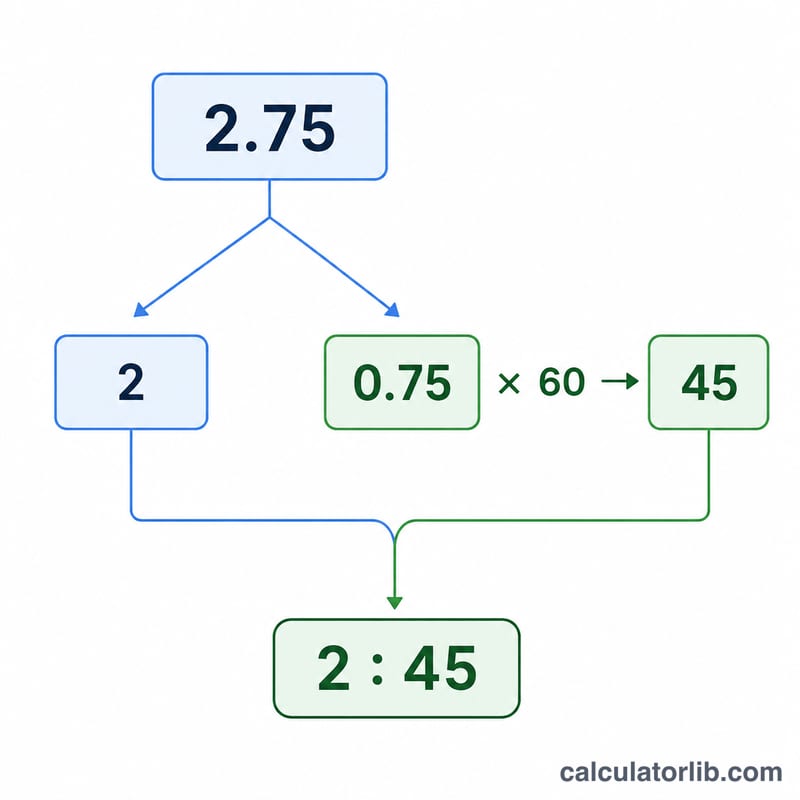
The conversion works in two steps. First, the whole hours are the floor (the integer part) of the decimal value. Second, the leftover fraction is multiplied by 60 to get minutes:
$$\text{minutes} = \left( \text{decimalHours} - \left\lfloor \text{decimalHours} \right\rfloor \right) \times 60$$
Minutes are rounded to the nearest whole number. If rounding pushes minutes to 60, the converter carries it over into an extra hour.
Worked example
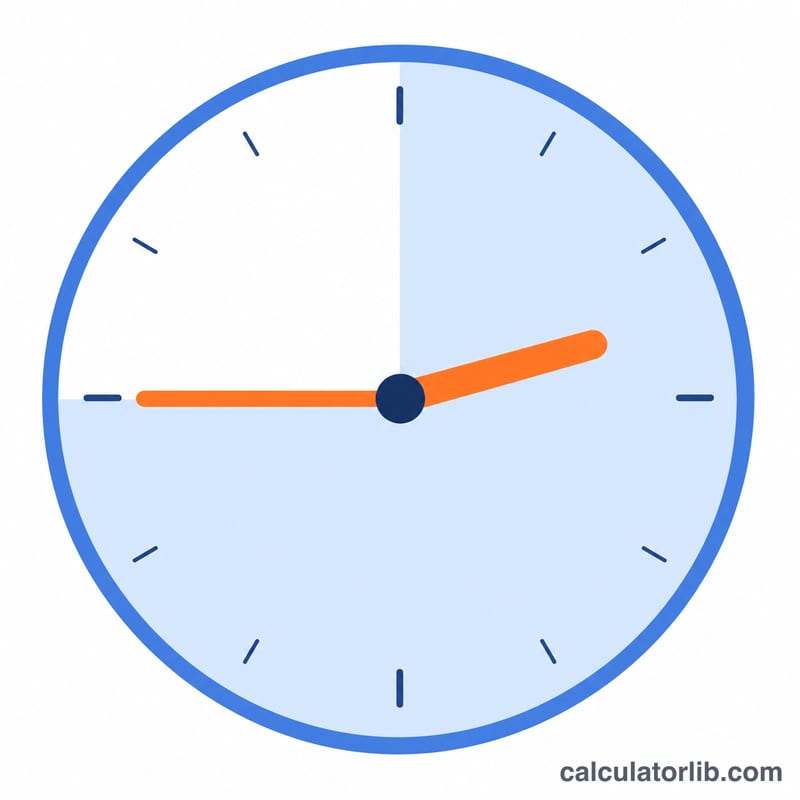
Suppose you logged 2.75 decimal hours. The whole part is 2 hours. The fraction is 0.75, and \(0.75 \times 60 = 45\) minutes. So 2.75 hours = 2 hours 45 minutes. Likewise, 5.5 hours becomes 5 hours 30 minutes, and 0.25 hours becomes 0 hours 15 minutes.
FAQ
Why does payroll use decimal hours? Decimal hours make multiplication by an hourly wage simple — \(2.75 \times \$20 = \$55\) directly.
How many minutes is 0.1 hours? \(0.1 \times 60 = 6\) minutes.
What about seconds? This tool rounds to the nearest minute; for finer precision, multiply the leftover decimal minutes by 60 to get seconds.