
What this converter does
This tool converts a local clock time into Coordinated Universal Time (UTC) using the timezone offset you supply. UTC is the global reference time standard; every timezone is defined as a fixed offset from UTC — for example New York in winter is UTC−5, India is UTC+5:30, and Sydney in summer is UTC+11. To go from local time to UTC you simply subtract that offset.
How to use it
Enter the local hour (0–23) and minute (0–59), then enter the UTC offset of that location in hours. Use a negative number for zones west of Greenwich (the Americas) and a positive number for zones east (Europe, Asia, Oceania). For half-hour or quarter-hour zones use decimals: India = 5.5, Nepal = 5.75, Newfoundland = −3.5. The calculator returns the UTC time on a 24-hour clock plus a "day shift" flag telling you if the conversion rolls over to the previous (−1) or next (+1) calendar day.
The formula explained
The core relationship is UTC = localTime − offsetHours. Internally the local time is converted to minutes since midnight, the offset (converted to minutes) is subtracted, and the result is normalized into the 0–1439 minute range. Any whole-day overflow becomes the day-shift value.
$$\text{UTC} = \left(\text{Hour} \times 60 + \text{Minute} - \text{Offset} \times 60\right) \bmod 1440$$Worked example
It is 14:30 local time in New York (UTC−5). UTC = 14:30 − (−5:00) = 14:30 + 5:00 = 19:30 UTC, same day. If it were 02:00 local at UTC−5, UTC = 02:00 + 5:00 = 07:00, same day. But 22:00 at UTC+5.5 gives 22:00 − 5:30 = 16:30, same day, while 02:00 at UTC+5.5 gives 02:00 − 5:30 = −3:30 → 20:30 of the previous day (day shift −1).
$$\text{UTC} = \left(14 \times 60 + 30 - (-5) \times 60\right) \bmod 1440 = 1170 = 19{:}30$$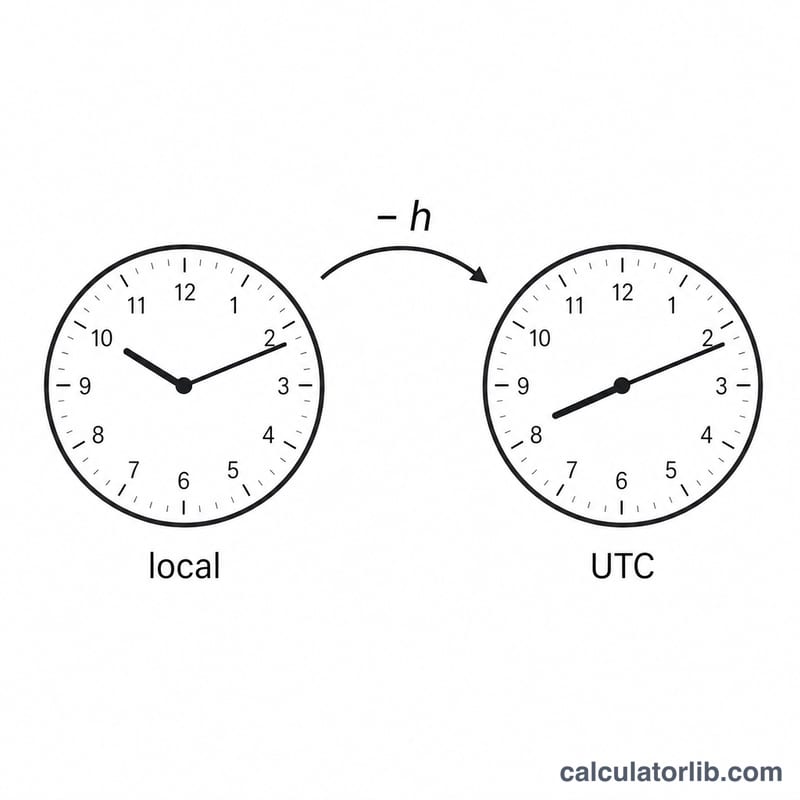
FAQ
Should I use my standard offset or daylight-saving offset? Use whichever offset is actually in effect for that date — e.g. New York is −5 in winter and −4 during daylight saving time.
What does the day shift mean? Because UTC and local times can be on different calendar days, the day shift tells you the UTC date is the next day (+1) or previous day (−1) relative to your local date.
Can I enter fractional offsets? Yes — enter 5.5 for a +5:30 zone or 5.75 for a +5:45 zone.