What Is the Jet Lag Recovery Calculator?
Jet lag happens when your internal body clock (circadian rhythm) falls out of sync with the local time at your destination. This calculator gives a quick estimate of how many days your body may need to fully adjust, based on the number of time zones you crossed and the direction you traveled.
How to Use It
Enter the number of time zones between your departure and destination cities, then select your direction of travel. Eastward trips (such as flying from the US to Europe) generally cause worse jet lag because you must advance your body clock, which is harder than delaying it. Westward trips are usually easier to recover from.
The Formula Explained
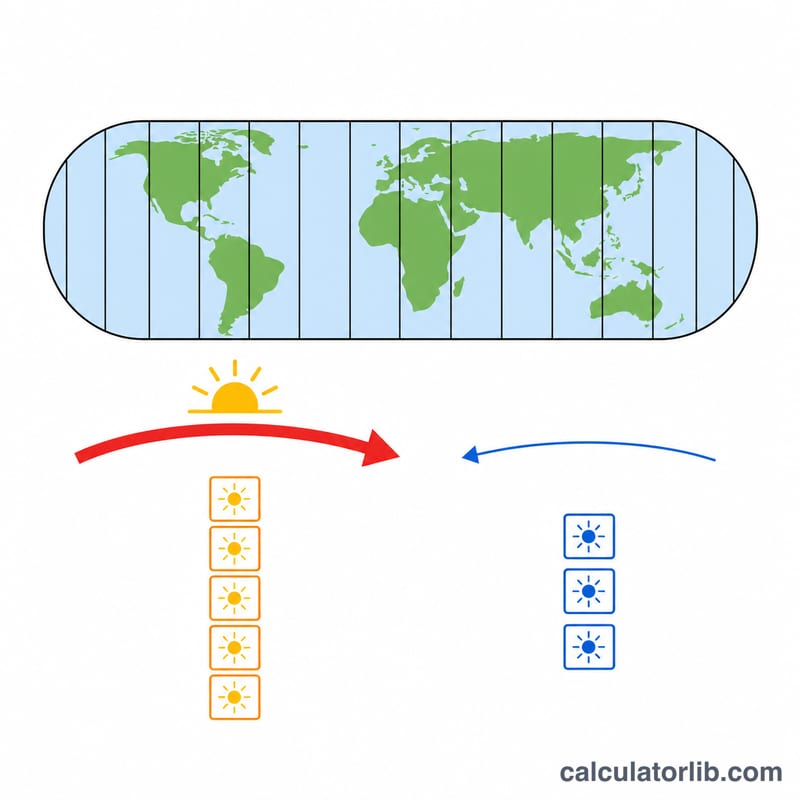
A widely cited rule of thumb is that the body adjusts roughly one time zone per day when traveling eastward, and slightly faster — about two-thirds of a day per zone — when traveling westward. We model this as $$\text{Recovery Days} = \text{Time Zones} \times \text{rate}$$, where the rate is \(1.0\) for eastward travel and \(0.67\) for westward travel.
Worked Example
Suppose you fly from New York to Paris, crossing 6 time zones eastward. Recovery days = $$6 \times 1.0 = 6 \text{ days}$$ On the return trip westward, recovery = $$6 \times 0.67 \approx 4 \text{ days}$$
Interpreting Your Estimate
The number of days this calculator returns is a rough estimate of how long full circadian adjustment to the new time zone may take. It is not a diagnosis, and it does not measure how you will actually feel. The tool's displayed formula multiplies the number of time zones crossed by a per-zone rate, so treat the result as a general guide rather than a precise prediction.
A commonly cited rule of thumb is that the body clock adjusts by about 1 hour per day after traveling eastward, which requires advancing the clock, and by about 1.5 hours per day after traveling westward, which requires delaying it. Because of this, the same number of zones usually takes longer to recover from when flying east. For example, with these rules of thumb, a 6-zone trip east is about \(6 \div 1 = 6\) days, while a 6-zone trip west is about \(6 \div 1.5 = 4\) days.
- 1–2 zones: usually minimal disruption, and many people notice little or nothing.
- 3–5 zones: moderate effects are common, such as sleepiness at odd hours or poorer sleep for a few days.
- 6+ zones: generally more disruptive, with a longer adjustment period.
- 9+ zones: the body may adapt by shifting in the opposite direction. After a large eastward trip, for example, it may delay its clock rather than advance it, so the actual adjustment path can differ from the simple estimate.
Individual variation is substantial. Timing of light exposure, age, sleep loss before and during travel, and personal sleep habits can all make your recovery shorter or longer than the estimate. Use the result for planning, such as scheduling important meetings after arrival, and not as a firm prediction. This is general information, not medical advice; if you have a sleep disorder or health concerns, consult a qualified professional.
Key Terms: Circadian Rhythm, Time Zones and Phase Shift
- Jet lag
- A temporary mismatch between your internal body clock and the local time after rapid travel across several time zones. It can cause daytime sleepiness, disturbed sleep, reduced alertness and digestive discomfort.
- Circadian rhythm
- The internal cycle of roughly 24 hours that regulates sleep and wakefulness, body temperature, hormone release and other functions. It is synchronized mainly by light.
- Phase advance (eastward)
- Shifting the body clock earlier. Traveling east means local time is ahead, so you must fall asleep and wake earlier than your body expects. This is generally slower, about 1 hour per day.
- Phase delay (westward)
- Shifting the body clock later. Traveling west means local time is behind, so you stay up later than your body expects. This is generally easier, about 1.5 hours per day.
- Time zones crossed
- The number of one-hour steps between your departure and arrival local times. One zone equals a one-hour difference. To count, subtract the two UTC offsets (for example, UTC−5 to UTC+1 is 6 zones). Some regions use half-hour or 45-minute offsets, and daylight saving time can change the difference, so use the actual current clock difference.
- Recovery rate per zone
- The assumed amount of days needed to adjust per hour of time difference. Rates differ by direction: roughly 1 day per zone eastward and about 0.67 days per zone westward when using the 1 and 1.5 hours-per-day rules of thumb. Real rates vary between individuals.
FAQ
Is this medical advice? No. This is a general estimate based on common travel rules of thumb. Individual recovery varies with age, sleep habits, and light exposure.
How can I recover faster? Get bright daylight at your destination, stay hydrated, adjust your sleep schedule before departure, and avoid heavy meals and alcohol on the flight.
Why is eastward travel worse? Advancing your body clock (going to bed earlier) is generally harder than delaying it, so eastward jet lag tends to last longer.