
What is the Jet Lag Recovery Calculator?
Jet lag happens when your body's internal clock (circadian rhythm) is out of sync with the local time at your destination. This calculator gives a quick, rule-of-thumb estimate of how many days you'll need to fully adjust, based on the number of time zones you cross and whether you travel eastward or westward.
How to use it
Enter the number of time zones between your origin and destination, then choose your direction of travel. Eastward trips (for example, North America to Europe) are typically harder to recover from than westward trips, because it is easier for the body to lengthen its day than to shorten it.
The formula explained
A widely cited rule of thumb is that the body recovers from jet lag at roughly one time zone per day. We apply a direction factor: 1.0 for eastward travel and about 0.67 for westward travel, since westward adjustment tends to be faster. The estimate is \(\text{Days} \approx \text{Time Zones} \times \text{Factor}\), rounded up to whole days.
$$\text{Recovery Days} = \left\lceil \text{Time Zones} \times 1.0 \right\rceil$$ $$\text{Recovery Days} = \left\lceil \text{Time Zones} \times 0.67 \right\rceil$$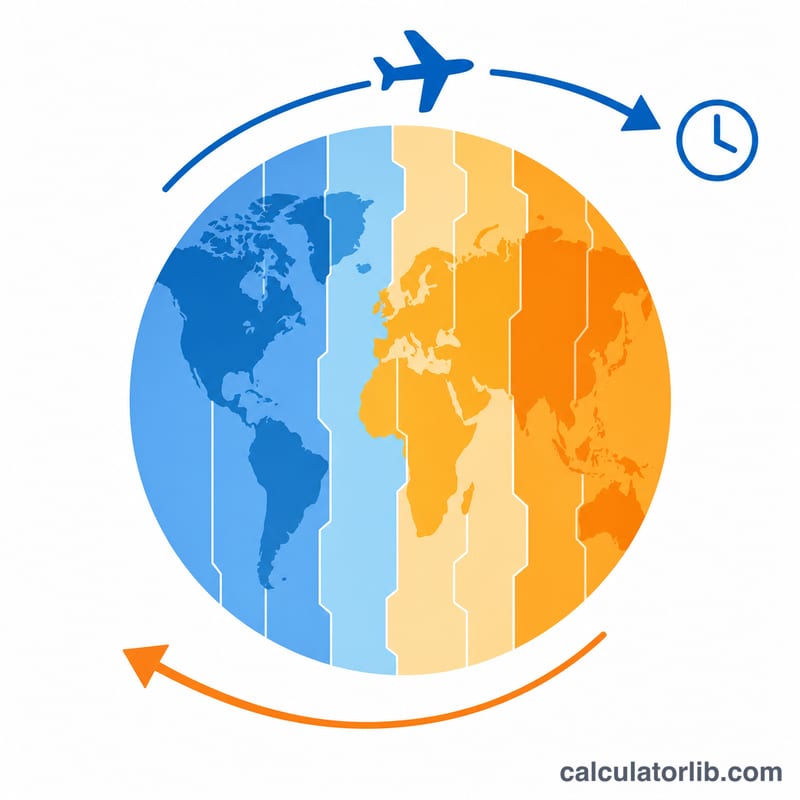
Worked example
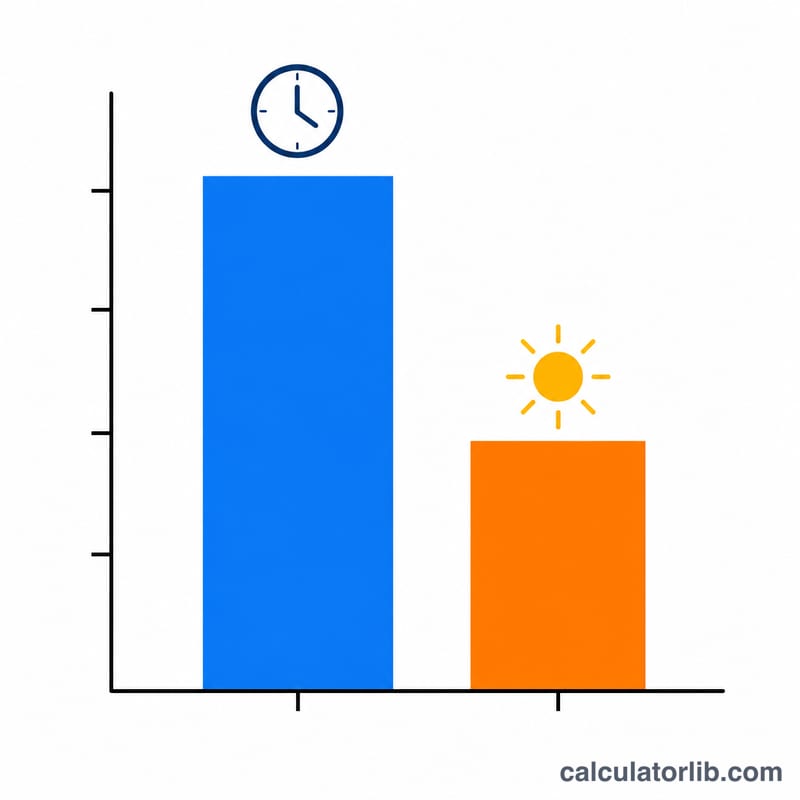
Flying from New York to London crosses 5 time zones eastward. The estimate is $$5 \times 1.0 = 5 \text{ days}.$$ The return flight (westward, 5 zones) gives $$5 \times 0.67 = 3.35,$$ rounded up to 4 days to adjust.
FAQ
Is this medically precise? No — it is an educational rule-of-thumb estimate. Individual recovery varies with age, sleep habits, light exposure and overall health.
Why is eastward worse? Eastward travel shortens your perceived day, which fights the body's natural tendency to drift later, making adaptation slower.
How can I speed up recovery? Get plenty of daylight at the right times, stay hydrated, adjust your sleep schedule before departure, and consider timed light or melatonin under medical guidance.