What Is the Jet Lag Recovery Time Calculator?
Jet lag happens when your body's internal clock (circadian rhythm) falls out of sync with the local time at your destination. This calculator gives a quick estimate of how long it takes to fully adjust, based on the number of time zones you crossed and the direction you flew. It uses the widely cited rule of thumb that the body recovers roughly one day per time zone when flying east, and slightly faster — about two-thirds of a day per zone — when flying west.
How to Use It
Enter the UTC offset of your origin city and your destination city (for example, New York is UTC−5 and London is UTC+0). Then choose your travel direction, or leave it on "Auto-detect" to let the calculator decide based on which way your clock moves. The result shows the estimated recovery in days, the number of time zones crossed, and an approximate number of hours.
The Formula Explained
First we find the time zones crossed by rounding the difference between destination and origin UTC offsets: \(Z = \text{round}(\text{dest\_offset} - \text{origin\_offset})\). Recovery time is then \(\left| Z \right| \times \text{factor}\), where the factor is 1.0 for eastward travel and 0.67 for westward travel. Eastward trips are harder because you "lose" hours and must advance your clock, which the body resists more than delaying it.
$$\text{Recovery Days} = \left| \text{Dest Offset} - \text{Origin Offset} \right| \times 1.0$$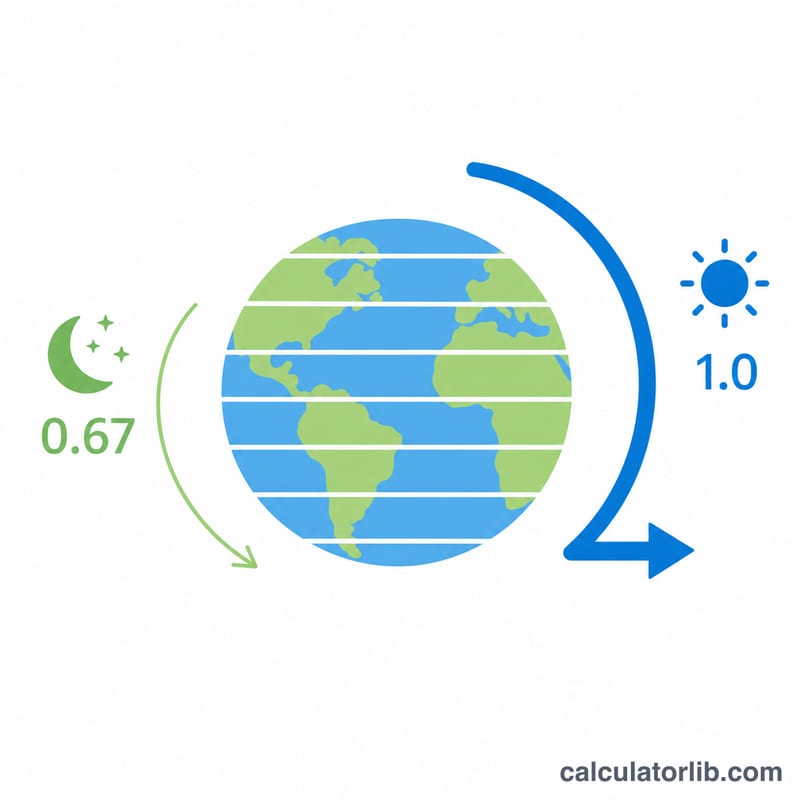
Worked Example
Flying from New York (UTC−5) to London (UTC+0) is an eastward journey. \(Z = \text{round}(0 - (-5)) = 5\) time zones. Since it is eastward, the factor is 1.0, so recovery =
$$5 \times 1.0 = 5 \text{ days}$$The same route in reverse (westward) would be
$$5 \times 0.67 \approx 3.35 \text{ days}$$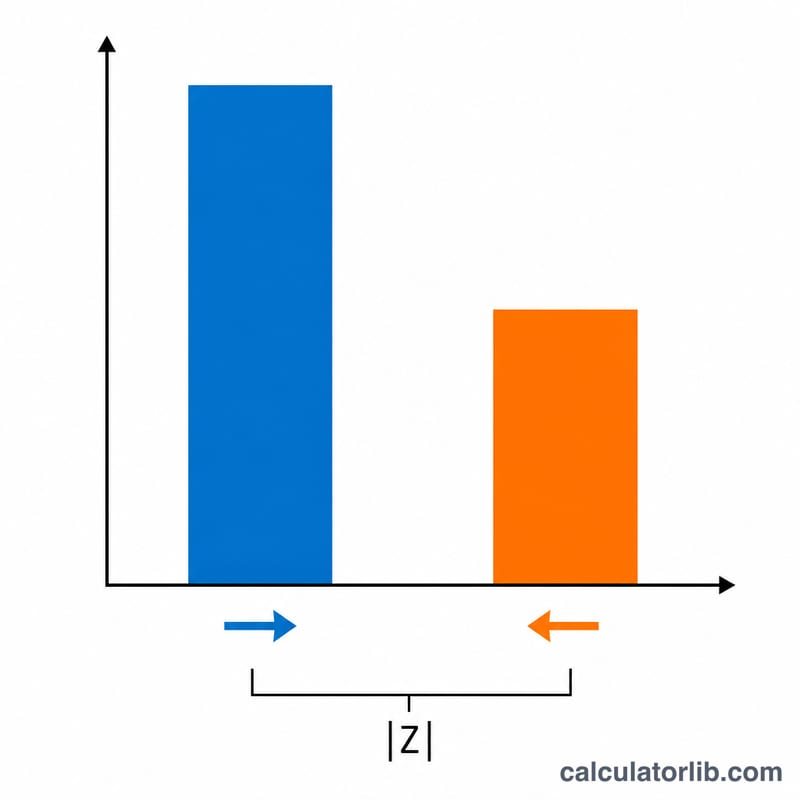
Interpreting Your Result
The number of days shown is a rule-of-thumb estimate of how long full circadian adjustment may take. It is not a precise prediction. The formula takes the absolute difference between the destination and origin UTC offsets and multiplies it by 1.0:
$$\text{Recovery Days} = \left| \text{Dest Offset} - \text{Origin Offset} \right| \times 1.0$$
For example, travelling from UTC-5 to UTC+1 crosses 6 zones: \(\left| 1 - (-5) \right| \times 1.0 = 6\) days.
How to read the size of the result
- Under 2-3 time zones: jet lag is generally minimal. Many people notice little or nothing, or only slight tiredness.
- 3 or more time zones: symptoms become more noticeable. These include daytime sleepiness, poor night sleep, reduced concentration, and digestive upset.
- 9-12 time zones: treat the estimate as an upper bound. Many people adapt faster than the full figure suggests, and some feel better partway through.
- Near 12 zones: the effective direction is ambiguous. Your body clock may shift by advancing or delaying, so eastward and westward labels lose their usual meaning. Real recovery can differ from the estimate in either direction.
Why your experience may differ
- Individual differences: age, chronotype (morning or evening person), and prior sleep debt all affect adaptation.
- Light exposure: the timing of daylight and darkness is the main cue that resets the body clock. Well-timed or poorly timed light can speed up or slow down adjustment.
- Sleep: sleep quality during and after the trip, and how closely you follow local sleep times, change how you feel.
- Direction: many people find eastward travel harder than westward, because it requires advancing the body clock. A single rule of thumb cannot capture this fully.
Use the result for rough planning, such as scheduling important meetings or events after the estimated adjustment period.
This is general information and not medical advice. If you have a sleep disorder or a medical condition, or take medication that depends on timing, consult a healthcare professional before travelling.
FAQ
Is this medically exact? No. It is an estimate based on a common heuristic. Individual recovery varies with age, sleep habits, and light exposure.
Why is eastward travel worse? Advancing your body clock (going to bed earlier) is harder than delaying it, so eastward trips typically take longer to recover from.
Do I need to count crossings under one hour? Offsets are rounded to the nearest whole hour, so a 30-minute zone difference may round to 0 or 1 zone.