
What Is the Boiling Point Altitude Calculator?
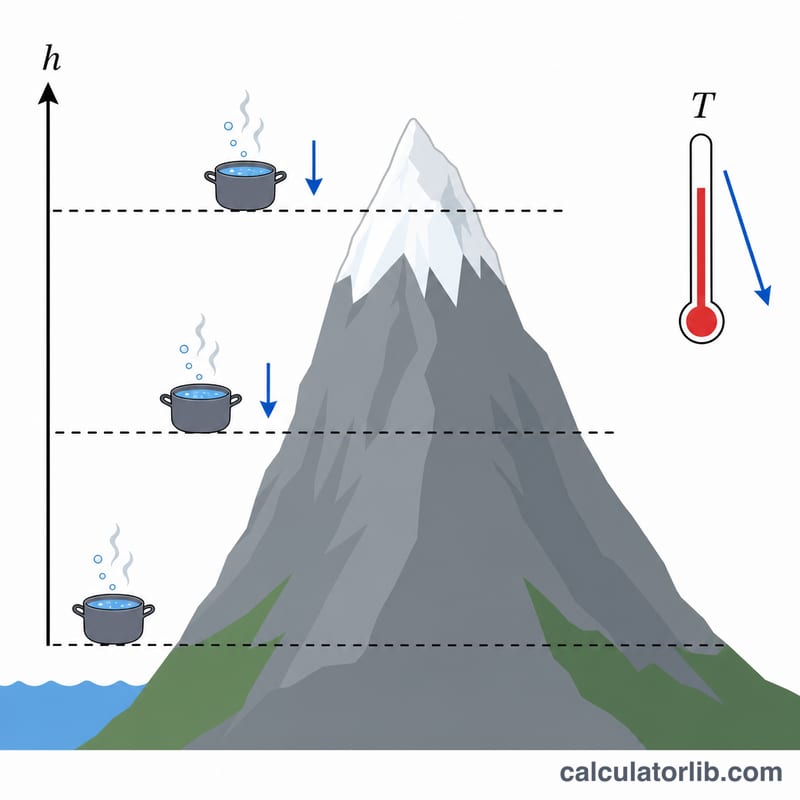
Water does not always boil at 100 °C. As you climb to higher altitudes, the surrounding air pressure drops, and water boils at a lower temperature. This calculator estimates the boiling point of water at any altitude in both Celsius and Fahrenheit, and also reports the atmospheric pressure at that height. It is useful for cooking at high elevations, scientific experiments, and understanding everyday physics.
How to Use It
Enter your altitude in meters above sea level and read off the boiling point. At sea level (0 m) water boils at 100 °C. For every roughly 300 m of elevation gain, the boiling point falls by about 1 °C, so meals take longer to cook and recipes may need adjustment.
The Formula Explained
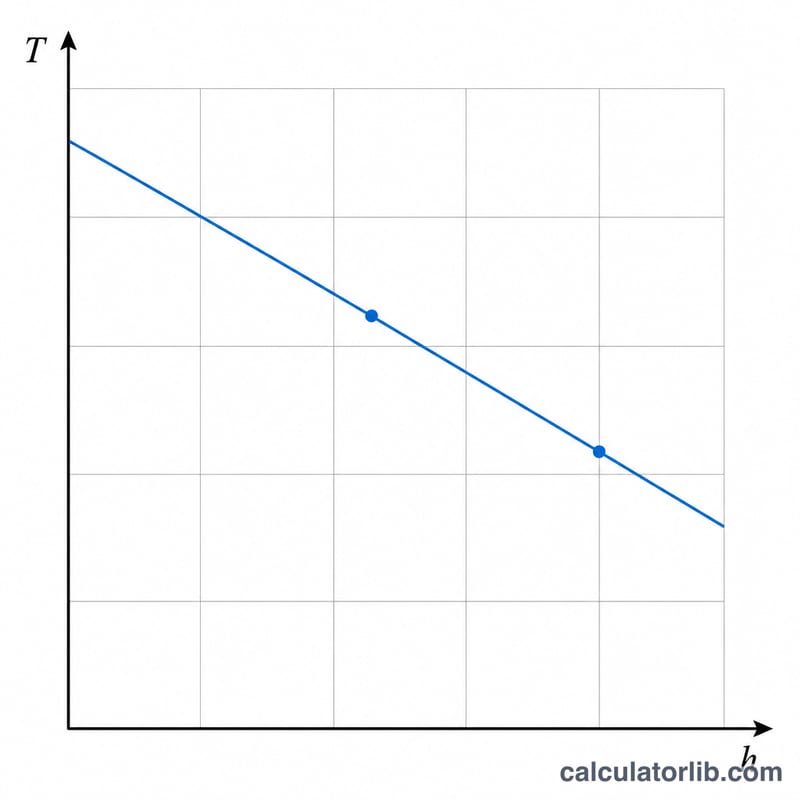
This tool uses the widely cited linear approximation $$T_b = 100 - 0.00332 \times h$$ where \(h\) is altitude in meters and \(T_b\) is the boiling point in °C. This closely matches the more complex Clausius–Clapeyron relation across the practical range of human-inhabited altitudes. Atmospheric pressure is computed separately with the standard barometric formula.
Worked Example
At an altitude of 2000 meters: $$T_b = 100 - 0.00332 \times 2000 = 100 - 6.64 = 93.36\ \text{°C}$$ (about 200.0 °F). The pressure there is roughly 79.5 kPa, well below the 101.3 kPa at sea level.
Constants & Reference Values
The calculator estimates the boiling point of water with the simple linear approximation \(T_b = 100 - 0.00332 \times \text{Altitude (m)}\), where \(T_b\) is in \(^{\circ}\text{C}\) and altitude is in metres. The values below define sea-level conditions and the constants used to relate altitude, pressure, and boiling point.
| Quantity | Value | Notes |
|---|---|---|
| Sea-level boiling point of water | 100 °C / 212 °F | At standard atmospheric pressure |
| Sea-level standard atmospheric pressure | 101.325 kPa | = 1 atm = 1013.25 hPa (mbar) = 760 mmHg |
| Linear boiling-point coefficient | 0.00332 °C/m | Drop in boiling point per metre of altitude (this tool's formula) |
| Approximate drop per 1,000 m | ≈ 3.32 °C / 1,000 m | About 1.8 °F per 1,000 ft (rough field rule) |
| Standard temperature lapse rate | 0.0065 K/m | = 6.5 °C per 1,000 m in the troposphere (ISA) |
| Sea-level standard temperature | 288.15 K | = 15 °C (ISA reference) |
| Gravitational acceleration | 9.80665 m/s² | Standard gravity, used in barometric formula |
| Molar mass of dry air | 0.0289644 kg/mol | Barometric formula constant |
| Universal gas constant | 8.31446 J/(mol·K) | Barometric formula constant |
As a worked check of the linear model, at an altitude of 1,500 m the boiling point is \(100 - 0.00332 \times 1500 = \) 95.02 °C. The barometric formula \(P = P_0 \left(1 - \dfrac{L\,h}{T_0}\right)^{\frac{gM}{RL}}\) uses the lapse, temperature, gravity, molar-mass, and gas-constant values above to give the local pressure that physically drives this lower boiling point.
FAQ
Why does water boil at a lower temperature up high? Boiling happens when vapor pressure equals the surrounding air pressure. Higher up, air pressure is lower, so less energy (heat) is needed to reach that point.
Does food cook differently at altitude? Yes. Because water boils cooler, foods boiled in water cook more slowly and may need extra time or a pressure cooker.
How accurate is this estimate? The linear formula is accurate to within a fraction of a degree across most populated elevations and is excellent for cooking and general reference.