What Is Pressure Altitude?
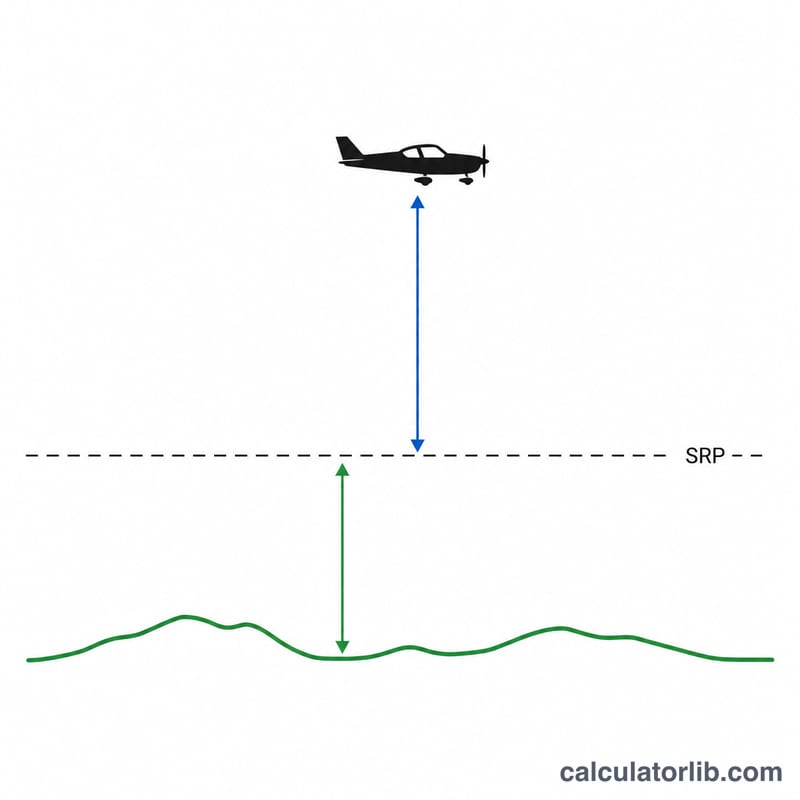
Pressure altitude is the height above the standard datum plane (the level where atmospheric pressure equals 29.92 inHg / 1013.25 hPa). It is the altitude your altimeter would indicate if you set it to the standard pressure of 29.92 inHg. Pilots use pressure altitude for performance calculations, including density altitude, true airspeed, and aircraft takeoff and climb figures.
How to Use This Calculator
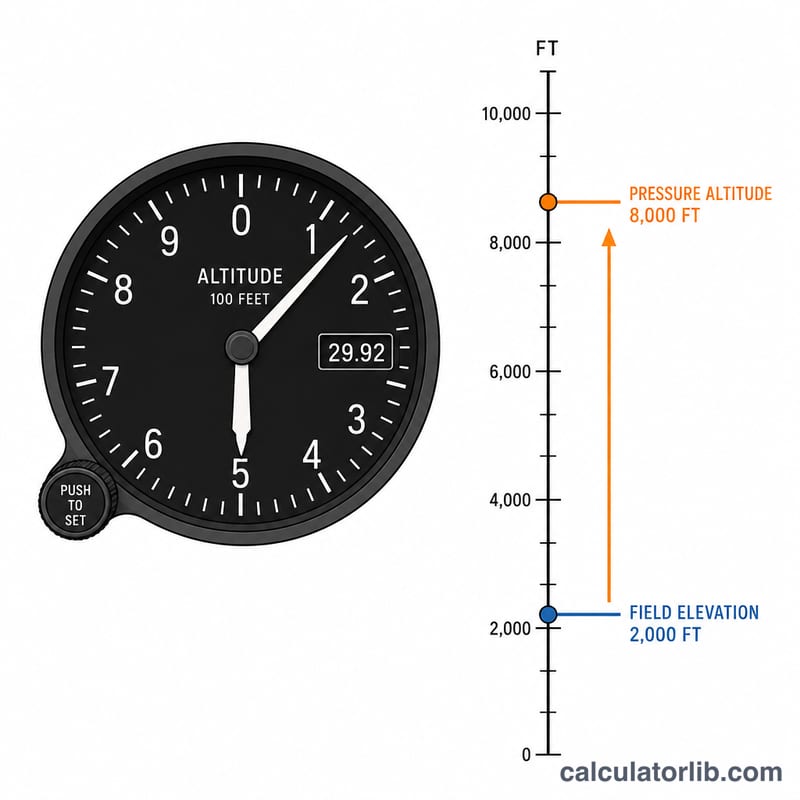
Enter your field elevation (the published elevation of the airport or your current altitude in feet) and the current altimeter setting reported in inches of mercury (inHg). The calculator applies the standard correction relative to 29.92 inHg and returns the pressure altitude in feet, along with the correction applied.
The Formula Explained
The widely used field approximation is:
$$\text{PA} = \text{Field Elevation} + \left(29.92 - \text{Altimeter Setting}\right) \times 1000$$
The constant 1000 reflects the rule of thumb that altitude changes about 1,000 feet for every 1.00 inHg change in pressure near sea level. When the altimeter setting is below 29.92, the air is lower pressure, so pressure altitude is higher than field elevation. When it is above 29.92, pressure altitude is lower than field elevation.
Worked Example
Suppose the field elevation is 1,000 feet and the altimeter setting is 30.12 inHg. Then $$\text{PA} = 1000 + \left(29.92 - 30.12\right) \times 1000 = 1000 + \left(-0.20 \times 1000\right) = 1000 - 200 = \textbf{800 feet}.$$ Because the local pressure is higher than standard, the pressure altitude is lower than the actual field elevation.
Altimeter Setting Conversion: inHg to hPa
Altimeter settings are given in inches of mercury (inHg) in the United States and some other countries, while most of the world uses hectopascals (hPa, equal to millibars). The conversion used here is 1 inHg = 33.8639 hPa. The pressure altitude correction is the amount added to field elevation, using \((29.92 - \text{setting}) \times 1000\) ft.
| Altimeter setting (inHg) | Equivalent (hPa) | Correction to field elevation (ft) |
|---|---|---|
| 28.92 | 979.34 | +1,000 |
| 29.42 | 996.28 | +500 |
| 29.92 | 1013.21 | 0 |
| 30.42 | 1030.14 | -500 |
| 30.92 | 1047.07 | -1,000 |
Example of the conversion: \(29.42 \times 33.8639 \approx 996.28\) hPa. The ICAO standard sea-level pressure is defined as 1013.25 hPa; 29.92 inHg converts to about 1013.21 hPa because of rounding in the inHg value.
FAQ
Is pressure altitude the same as density altitude? No. Density altitude is pressure altitude corrected for non-standard temperature. Pressure altitude is the first step before computing density altitude.
What if my altimeter is in hPa/millibars? Convert to inHg first (\(1\ \text{inHg} \approx 33.8639\ \text{hPa}\)), or use the standard datum of 1013.25 hPa with the equivalent metric formula.
Why use 29.92? It is the international standard sea-level pressure (29.92 inHg / 1013.25 hPa) used as the reference datum for flight levels and performance charts.