
What this calculator does
This tool estimates the local atmospheric pressure at a given elevation using the standard barometric (hypsometric) pressure-altitude relationship. It is a pure physics formula and applies anywhere on Earth — the default altitude of 3776 m simply happens to be the height of Mt. Fuji. Give it your elevation, the local air temperature, and the sea-level pressure, and it returns the pressure you would measure at that height.
How to use it
Enter three values: the altitude in meters (height above sea level), the air temperature at your location in degrees Celsius, and the sea-level pressure in hectopascals (1013.25 hPa equals one standard atmosphere). Press calculate to get the local pressure \(P\) in hPa.
The formula explained
The calculator evaluates:
$$P = P_0 \left(1 - \frac{0.0065\,h}{T + 0.0065\,h + 273.15}\right)^{5.257}$$
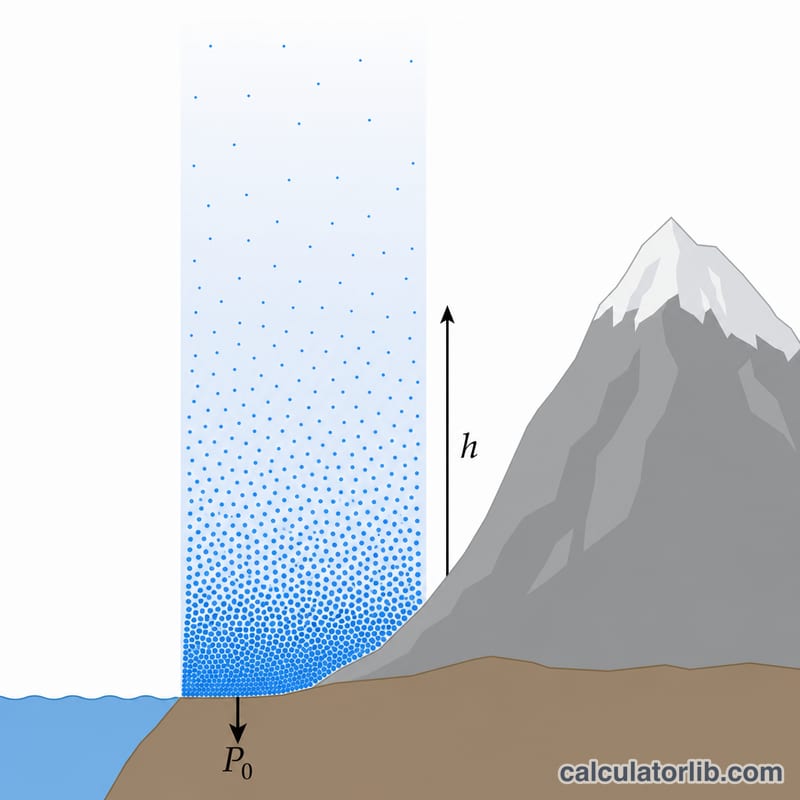
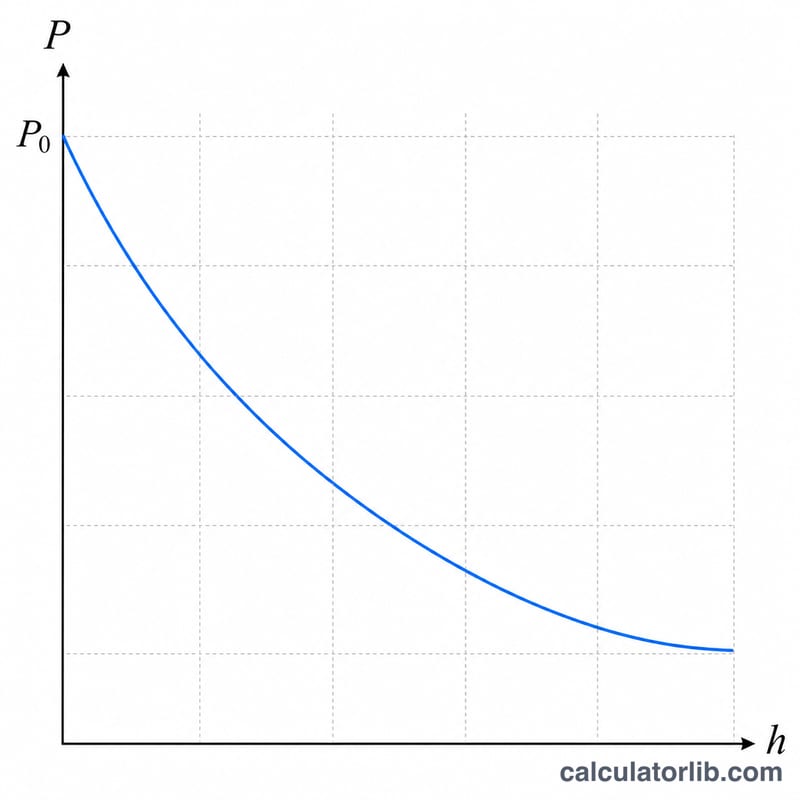
Here 0.0065 is the standard temperature lapse rate (6.5 °C per km), 273.15 converts Celsius to Kelvin, and 5.257 is the dimensionless exponent \(gM/(RL)\) for the standard atmosphere. The denominator forms an effective absolute temperature for the air column. Pressure falls as altitude rises because there is less air weighing down from above.
Worked example
For \(h = 3776\) m, \(T = 5\) °C and \(P_0 = 1013.25\) hPa: \(0.0065 \times 3776 = 24.544\), the denominator is \(5 + 24.544 + 273.15 = 302.694\), the ratio is \(24.544 / 302.694 = 0.08109\), the base is \(0.91891\), and raising it to 5.257 gives \(0.64109\). So $$P = 1013.25 \times 0.64109 \approx 649.6 \text{ hPa}$$ at the summit of Mt. Fuji.
Constants Used in the Barometric Formula
The barometric formula \(P = P_0\left(1 - \frac{L\,h}{T + L\,h + 273.15}\right)^{gM/(RL)}\) relies on a set of standard physical constants drawn from the International Standard Atmosphere (ISA). The exponent 5.257 is not an independent input but a derived combination of gravity, molar mass, the gas constant and the lapse rate.
| Symbol | Meaning | Value |
|---|---|---|
| \(L\) | Temperature lapse rate (troposphere) | 0.0065 K/m |
| \(P_0\) | Standard sea-level pressure | 1013.25 hPa |
| \(g\) | Standard gravitational acceleration | 9.80665 m/s² |
| \(M\) | Molar mass of dry air | 0.0289644 kg/mol |
| \(R\) | Universal gas constant | 8.31447 J/(mol·K) |
| \(\tfrac{gM}{RL}\) | Dimensionless exponent | 5.257 |
| — | Celsius-to-Kelvin offset | 273.15 |
The exponent follows directly from the other constants:
$$\frac{gM}{RL} = \frac{9.80665 \times 0.0289644}{8.31447 \times 0.0065} \approx 5.257$$The term \(T + 0.0065\,h + 273.15\) converts the entered Celsius temperature \(T\) to absolute kelvin while approximating the sea-level temperature that corresponds to your measured temperature at altitude \(h\).
FAQ
What happens at sea level? When \(h = 0\) the base equals 1, so \(P = P_0\) exactly.
Can altitude be negative? Yes; below sea level the formula returns a pressure greater than \(P_0\).
Why does temperature matter? Colder, denser air columns produce a slightly different pressure decline with height, which the temperature term in the denominator accounts for.