
What this calculator does
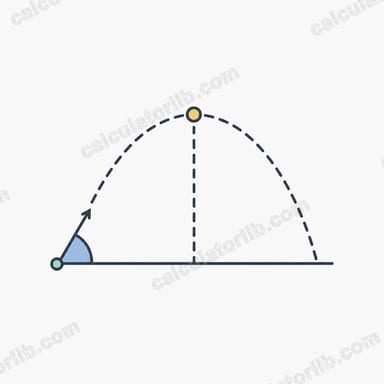
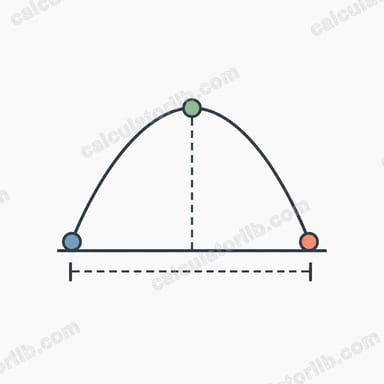
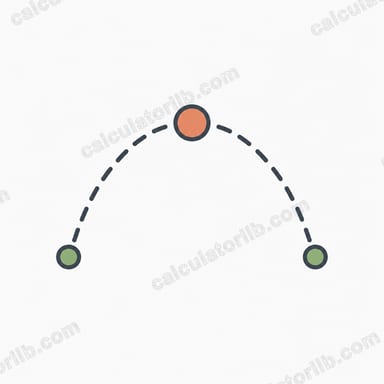
This tool models the classic physics problem of a projectile launched from ground level at a given speed and angle, then landing back at the same height. Neglecting air resistance and assuming constant gravity, it returns three key quantities: the total flight time, the maximum height reached, and the horizontal range. It is useful for physics homework, ballistics intuition, sports trajectory estimates, and engineering sanity checks.
How to use it
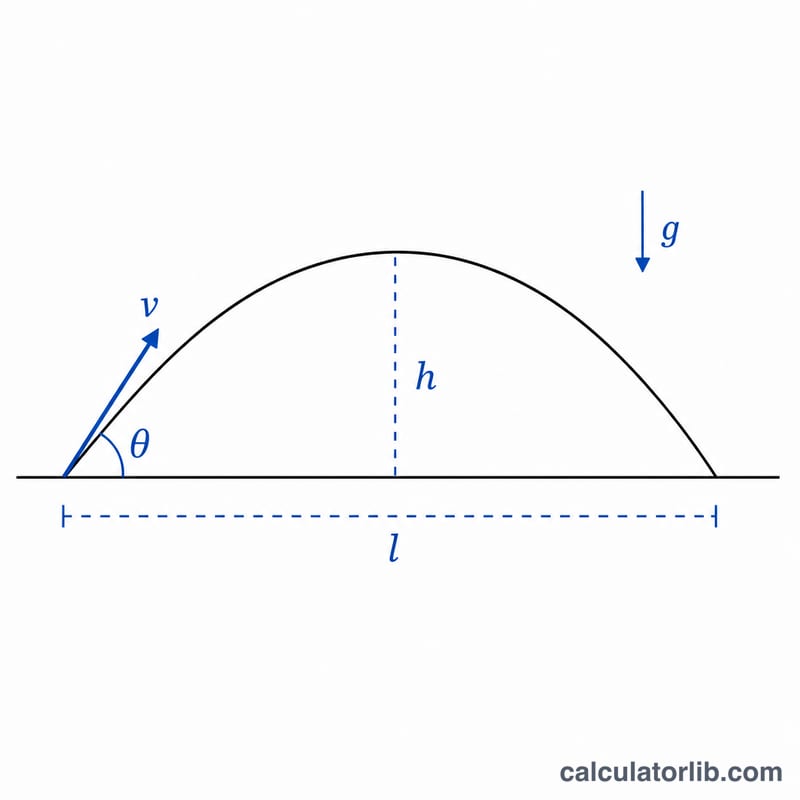
Enter the initial velocity and pick its unit (m/s or km/h). Enter the launch angle in degrees between 0 and 90. The gravitational acceleration defaults to standard gravity 9.80665 m/s², but you can change it (for example 1.62 for the Moon). The velocity is internally converted to m/s (km/h is divided by 3.6) and the angle to radians before the formulas are applied.
The formulas explained
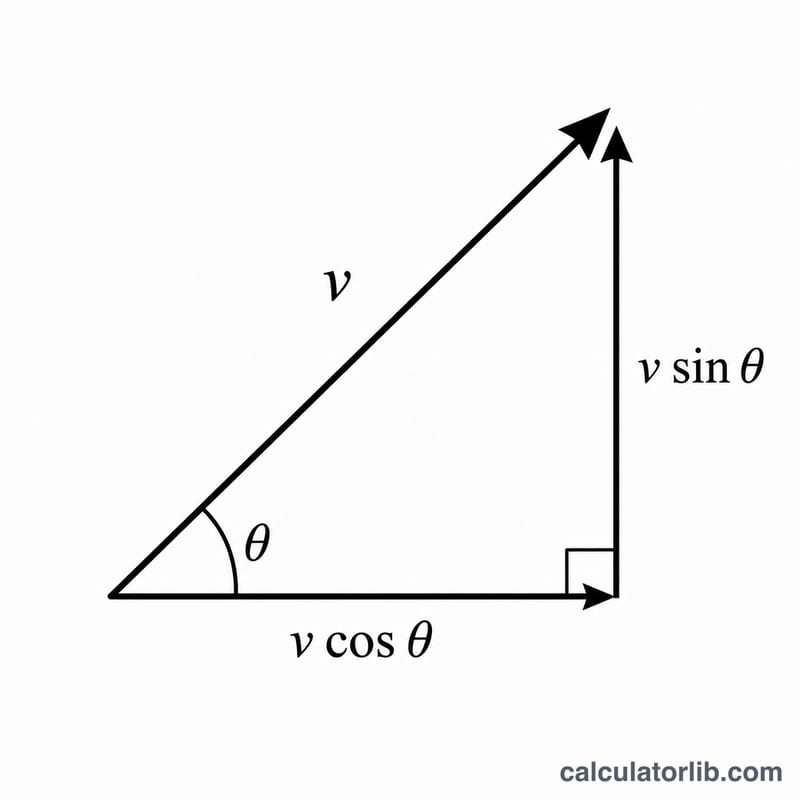
Resolve the velocity into components: horizontal \(v\cdot\cos\theta\) and vertical \(v\cdot\sin\theta\). The vertical motion is symmetric, so flight time $$t = \frac{2v\cdot\sin\theta}{g}.$$ Peak height is $$h = \frac{(v\cdot\sin\theta)^{2}}{2g}.$$ Multiplying the horizontal speed by the flight time gives range $$l = \frac{v^{2}\cdot\sin(2\theta)}{g},$$ which is maximized at \(\theta = 45^\circ\).
Worked example
For \(v = 30\) m/s, \(\theta = 60^\circ\), \(g = 9.80665\) m/s²: \(v\cdot\sin 60^\circ = 25.981\) m/s, so $$t = \frac{2\times 25.981}{9.80665} \approx 5.299 \text{ s},$$ $$h = \frac{25.981^{2}}{19.6133} \approx 34.419 \text{ m},$$ and $$l = \frac{900\times\sin 120^\circ}{9.80665} \approx 79.479 \text{ m}.$$
FAQ
What angle gives the longest range? On level ground with no air resistance, 45° maximizes range.
Why is range zero at 0° or 90°? At 0° the projectile starts at ground level with no upward speed, so it never leaves; at 90° it goes straight up and comes straight back down.
Does this account for launch height or drag? No. It assumes equal launch and landing heights and ignores air resistance, so real-world distances will usually be shorter.