
What this calculator does
This tool takes the volume of a cube and returns two key measurements: the edge length and the total surface area. It is a pure-geometry calculator, so it applies identically anywhere in the world. There is no unit dropdown because the inputs and outputs simply share consistent units. If your volume \(V\) is in cubic centimeters, the edge length \(a\) comes out in centimeters and the surface area \(S\) in square centimeters.
How to use it
Enter the cube's volume \(V\) in the input box and submit. The calculator computes the edge length as the real cube root of the volume, then derives the surface area from that edge length. Volume must be zero or greater; a negative volume is not physically meaningful for a cube, so it is treated as zero.
The formula explained
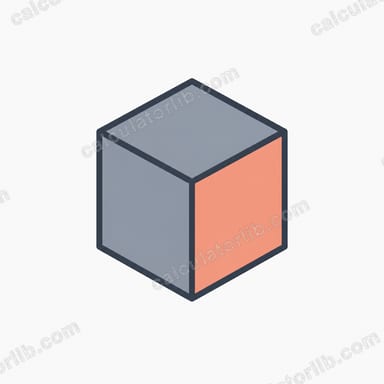
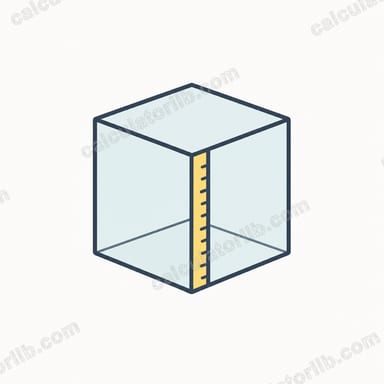
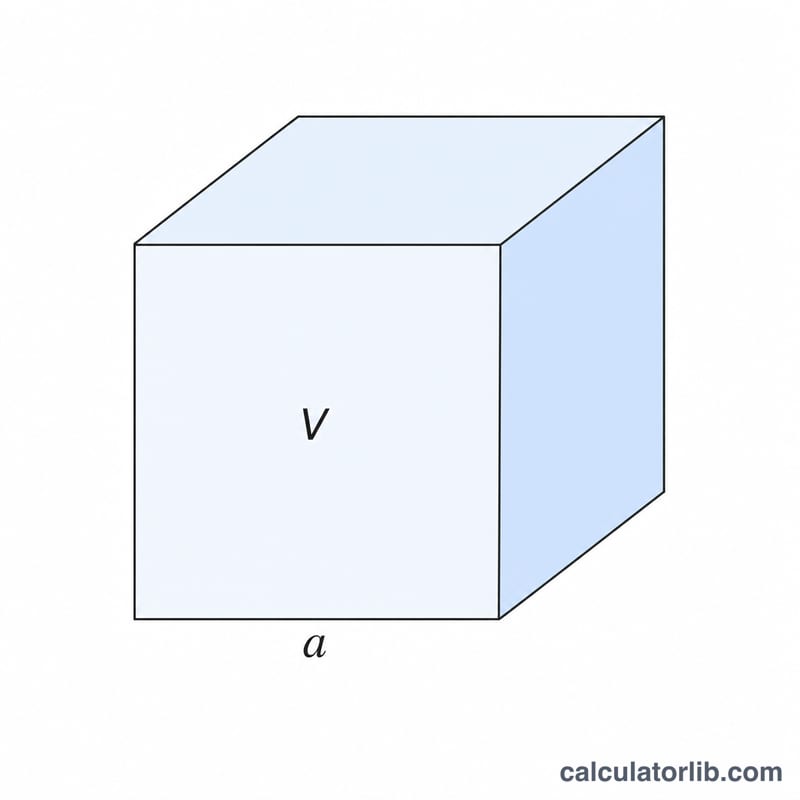
A cube has all edges of equal length \(a\), so its volume is \(V = a^3\). Solving for the edge gives \(a = V^{1/3}\), the real cube root of \(V\). A cube has six identical square faces, each with area \(a^2\), so the total surface area is \(S = 6a^2\). Together these let you recover the full geometry of the cube from a single number.
$$ a = \sqrt[3]{\text{Volume } V} $$ $$ S = 6\,a^{2} = 6 \left(\sqrt[3]{\text{Volume } V}\right)^{2} $$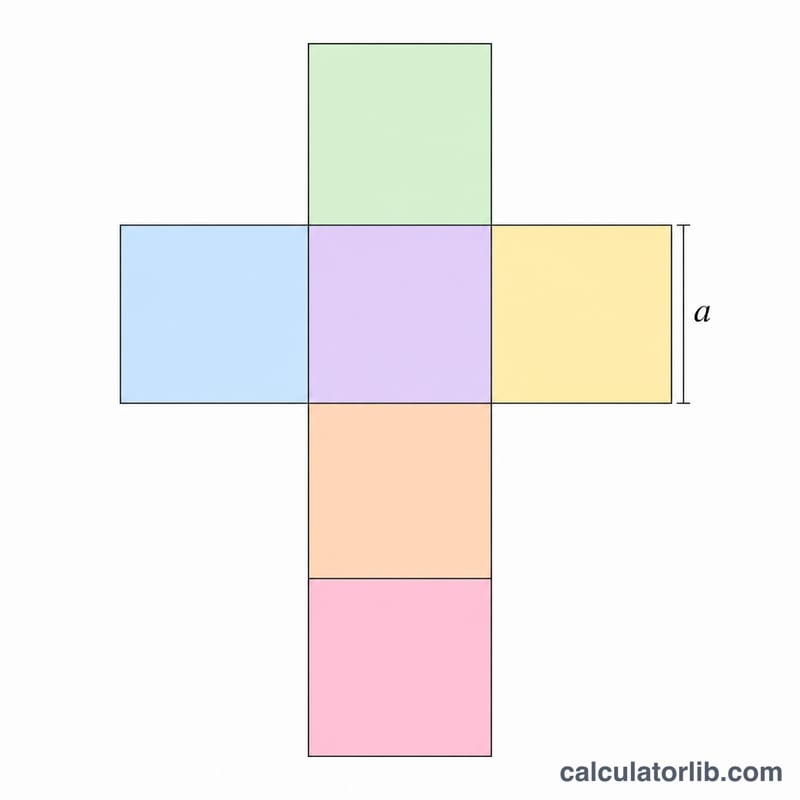
Worked example
Suppose \(V = 27\). The edge length is $$ a = 27^{1/3} = 3. $$ The surface area is $$ S = 6 \times 3^2 = 6 \times 9 = 54. $$ So a cube of volume 27 has edges of length 3 and a total surface area of 54.
FAQ
What if my volume gives an irrational edge length? Many volumes produce irrational results. For example, \(V = 2\) gives \(a = 1.259921\ldots\) and \(S = 9.524406\ldots\). The calculator displays rounded values for readability.
What happens at \(V = 0\)? Both the edge length and surface area are zero, representing a degenerate cube (a single point).
Do I need to match units? Yes. Keep everything consistent: if \(V\) is in cubic meters, then \(a\) is in meters and \(S\) is in square meters.