
What This Calculator Does
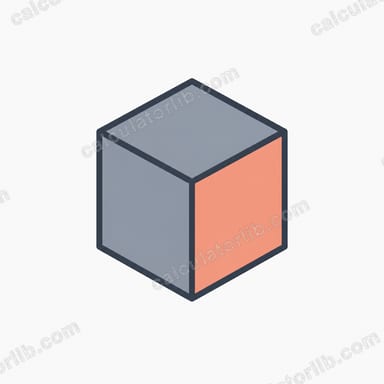
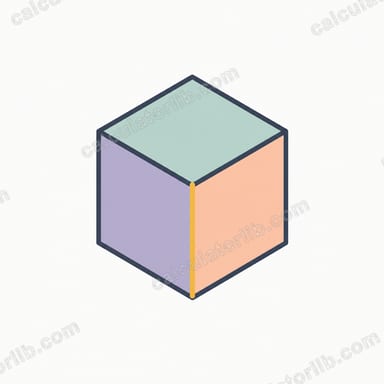
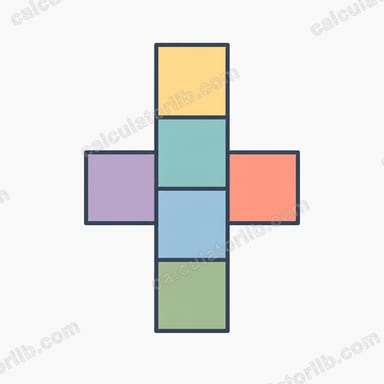
The Cube Surface Area Calculator works out the total outside area of a cube from a single measurement: the length of one edge. A cube has six identical square faces, so once you know the side length you can find the entire surface area in one step. Behind the scenes the tool also computes the cube's volume, giving you two useful results from the one number you type in.
The Input You Provide
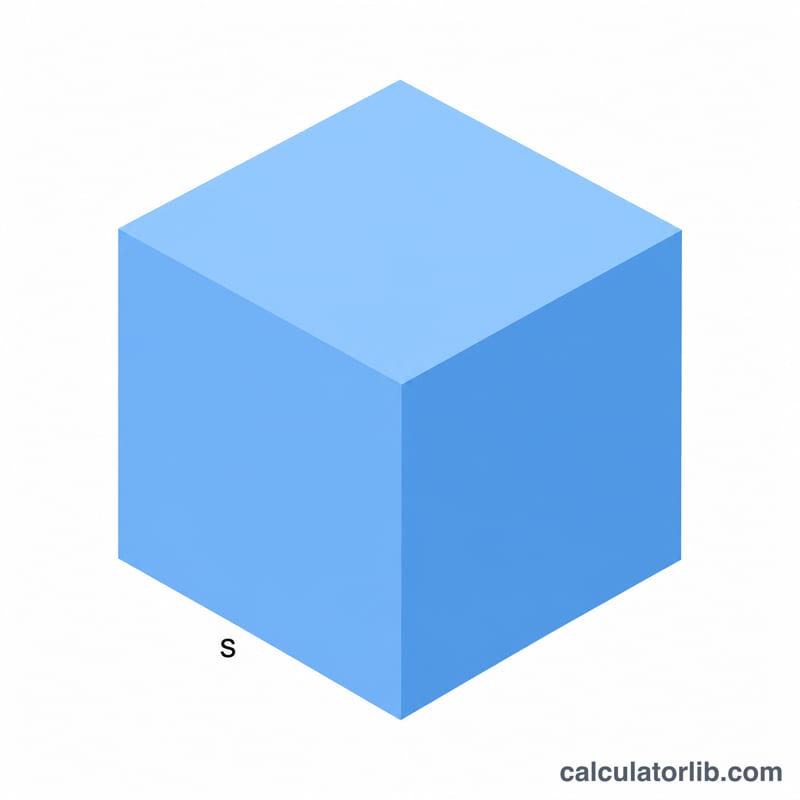
- Side Length (\(s\)): the length of any one edge of the cube. Because every edge of a cube is equal, you only need to measure one. Enter it in whatever unit you are working in — centimetres, inches, metres, etc.
That's the only field. The calculator handles the rest automatically.
The Formula Explained
The surface area of a cube is given by:
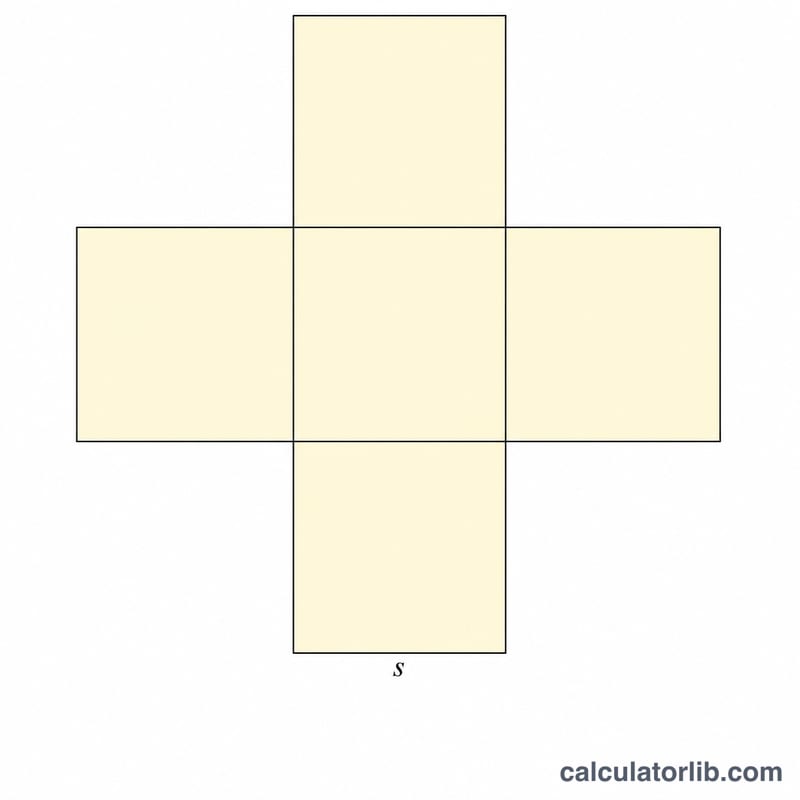
$$A = 6 \times \text{Side Length}^{2}$$Each face is a square with area \(s^2\) (side multiplied by itself). A cube has six faces, so multiplying by 6 gives the total. The calculator also returns the volume using \(V = s^3\) (side × side × side), since both quantities depend on the same edge measurement.
Remember that surface area is reported in square units (e.g. cm²) while volume is in cubic units (e.g. cm³).
Worked Example
Suppose you enter a side length of 4:
- Surface Area \(= 6 \times 4^2 = 6 \times 16 = \mathbf{96}\) square units
- Volume \(= 4^3 = 4 \times 4 \times 4 = \mathbf{64}\) cubic units
So a cube with 4 cm edges has a surface area of 96 cm² and a volume of 64 cm³.
Frequently Asked Questions
Why multiply by 6? A cube has exactly six flat square faces, all the same size. Each face has area \(s^2\), so the total is \(6 \times s^2\).
What units should I use? Use any unit you like for the side length. The surface area comes back in those units squared, and the volume in those units cubed. Just keep the input consistent.
Can I find the side length from a known surface area? Yes, rearrange the formula: \(s = \sqrt{\text{Surface Area} \div 6}\). For example, a surface area of 96 gives \(s = \sqrt{16} = 4\). This calculator works in the forward direction, but the reverse only takes one square root.