
What this calculator does
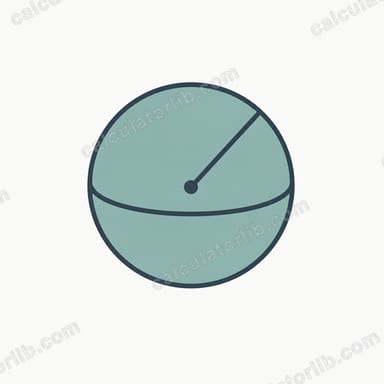
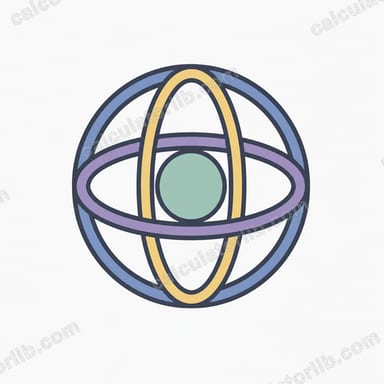
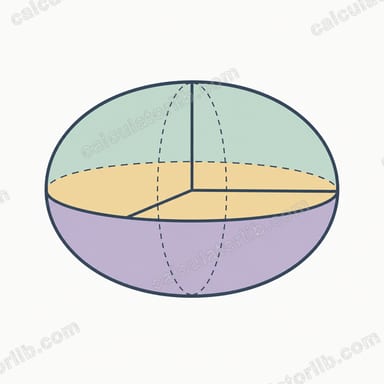
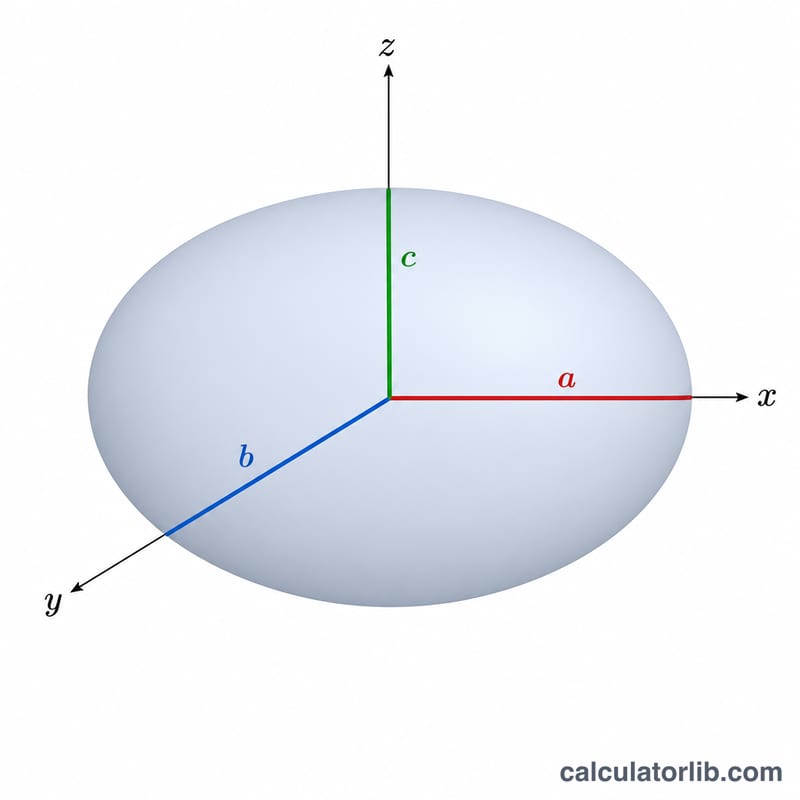
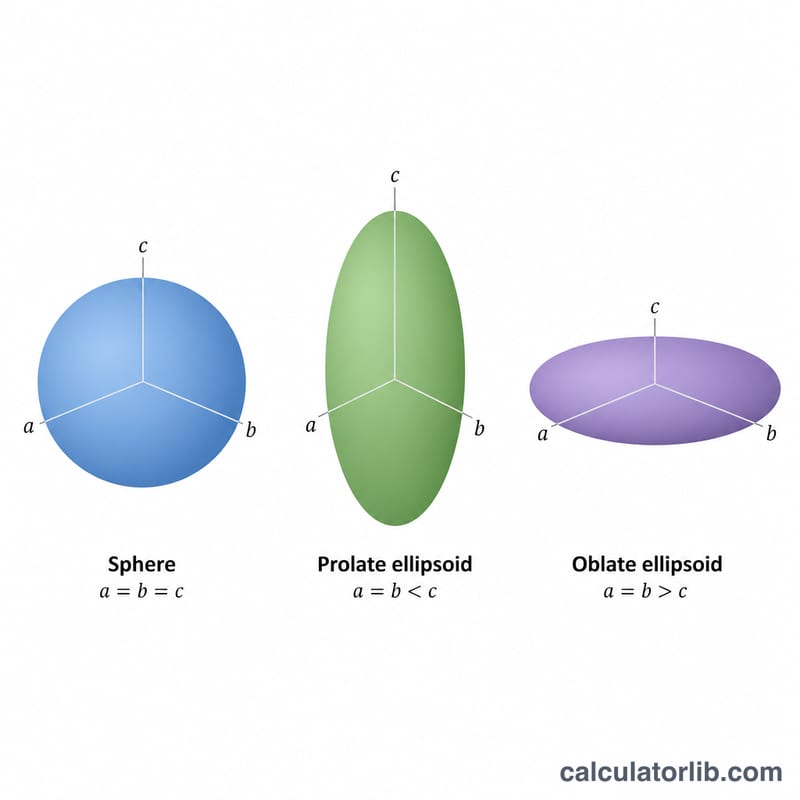
This tool computes the volume and surface area of a general (triaxial) ellipsoid — a smoothly rounded solid described by three semi-axes a, b and c. A sphere is the special case where all three are equal, and a spheroid is the case where two are equal. The tool works for any positive values and returns results in consistent units: volume in unit³ and surface area in unit².
How to use it
Enter the three semi-axis lengths (half the full width along each principal axis) in the same unit — all centimetres, all inches, whatever you like. The order does not matter; the tool sorts the axes internally. All three must be greater than zero. Press calculate to see both quantities.
The formulas explained
The volume has a simple exact form, $$V = \frac{4}{3}\pi\,\text{a}\,\text{b}\,\text{c}$$ The surface area is far harder: a triaxial ellipsoid has no elementary closed-form area. The exact answer uses incomplete elliptic integrals of the first kind \(F(\phi,k)\) and second kind \(E(\phi,k)\). After sorting the semi-axes so \(p \ge q \ge r\), we set \(\cos\phi = r/p\) and \(k^{2} = \dfrac{p^{2}(q^{2}-r^{2})}{q^{2}(p^{2}-r^{2})}\), then evaluate $$S = 2\pi r^{2} + \frac{2\pi p q}{\sin\phi}\left(E\cdot\sin^{2}\phi + F\cdot\cos^{2}\phi\right)$$ This calculator evaluates \(F\) and \(E\) by high-resolution composite Simpson integration, which converges rapidly because the integrands are smooth.
Worked example
For \(a = 3\), \(b = 2\), \(c = 1\): $$V = \frac{4}{3}\pi(3)(2)(1) = 8\pi \approx 25.133 \text{ unit}^{3}$$ Sorting gives \(p=3\), \(q=2\), \(r=1\), so \(\cos\phi = 1/3\), \(\phi \approx 1.23096\) rad, \(k^{2} = 27/32 = 0.84375\). Numerically \(F \approx 1.54125\) and \(E \approx 1.00526\), giving \(S \approx 48.88\) unit².
FAQ
Why is there no simple area formula? Unlike volume, the surface integral of a triaxial ellipsoid cannot be expressed with elementary functions; it inherently requires elliptic integrals.
What about a sphere? If all three axes are equal the tool short-circuits to \(V = \frac{4}{3}\pi a^{3}\) and \(S = 4\pi a^{2}\).
Do units matter? Use the same unit for all three inputs; volume comes out cubed and area squared in that unit.